
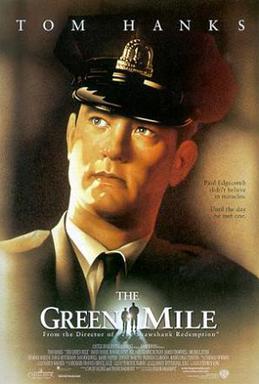
Behind the film
- Year
- 1999
- Director
- Frank Darabont
- Writers
- Frank Darabont
- Runtime
- 3h 9m
- Genres
- Drama, Flashback, Fantasy, Prison
- Production
- Warner Bros. Entertainment, Castle Rock Entertainment, Warner Bros. Pictures
- Country
- United States
- Cast
- Tom Hanks, David Morse, Bonnie Hunt, Michael Clarke Duncan, James Cromwell, Michael Jeter, Doug Hutchison, Sam Rockwell
About the film
Contains story spoilers.
Frank Darabont’s The Green Mile is framed by an elderly Paul Edgecomb remembering his time as a guard on death row at Cold Mountain Penitentiary. In 1935, Paul and his colleagues supervise the “Green Mile,” a stretch of corridor leading to the execution chamber. The inmates include Eduard “Del” Delacroix, whose pet mouse Mr. Jingles becomes a small comfort, William “Wild Bill” Wharton, unpredictable and violent, and John Coffey, a large, gentle man convicted of raping and murdering two girls. Coffey says he tried to help them, and Paul begins to wonder whether the man in his custody is what the court said he was.
Paul’s physical pain first opens the door to doubt. He has a severe urinary infection that leaves him unable to do his work comfortably. Coffey asks to touch him, absorbs the illness, then releases it as a cloud of dark, insect-like particles. Paul is stunned, but he has no clear explanation for what happened. When Percy Wetmore crushes Mr. Jingles underfoot, Coffey asks to hold the mouse and brings it back to life. These events are witnessed by the guards, not offered as rumours from outside the prison. The miracles change Paul’s understanding of Coffey, but they do not erase the official conviction or give the staff a legal way to reopen the case.
Percy’s cruelty creates a separate crisis on the Mile. His connections to the governor protect him from consequences, and the other guards resent his abuse of inmates. They agree to let Percy oversee Del’s execution if he promises to take a job at Briar Ridge mental hospital afterward. Percy deliberately fails to wet the sponge needed for the electric chair, causing Del to suffer through a prolonged death. Coffey is overwhelmed by Del’s suffering, his distress extending beyond the execution chamber. Mr. Jingles has already been healed; the mouse’s survival is a small, strange counterpoint to the suffering inflicted on his owner. The scene shows how much power the guards have over the condemned men’s final hours, and how easily that power can be used to punish someone for reasons unrelated to justice.
Warden Hal Moores is desperate because his wife Melinda is dying from a brain tumour. Paul believes Coffey may be able to heal her and persuades the other guards to take him out of the prison secretly. They confine Percy to a padded cell so he cannot interfere, then bring Coffey to the warden’s home. Coffey takes Melinda’s illness into himself and returns her to health, but the act leaves him in pain. Back at the prison, he grabs Percy and forces the sickness into him as a mass of dark particles. Percy then shoots Wharton dead. The shocking sequence connects the supernatural events to the prison’s ordinary violence and exposes how little control Paul has over the situation. Paul’s colleagues are not equally prepared to accept what they have seen. The plan relies on colleagues who have witnessed Coffey’s healing and trust Paul enough to break prison rules. The trip requires secrecy and risks their jobs. Their cooperation does not make them able to challenge the conviction in court, and the gap between private knowledge and public proof becomes one of the story’s hardest limits.
Coffey shows Paul a memory of Wharton, revealing that Wharton was responsible for the girls’ deaths and that Coffey had been trying to bring them back when he was found with their bodies. The proof makes Paul certain that Coffey is innocent, but certainty is not the same as a legal remedy. Wharton is dead, Percy is left catatonic and committed to Briar Ridge, and the execution date remains in place. Paul considers helping Coffey escape, recognising that the system will kill an innocent man. Coffey refuses to run. He says that he is exhausted by the pain and cruelty he feels in the world and no longer wants to keep carrying it.
Before the execution, Coffey asks to watch a movie because he has never seen one. Paul and the other guards watch Top Hat with him. At the chair, Coffey asks not to wear a hood because he is afraid of the dark. Paul takes his hand for a moment, then the officers carry out the sentence despite knowing the truth. The scene is difficult because Paul knows that Coffey is innocent, while the victims’ family still sees a murderer in the chair. The guards’ sympathy cannot undo the sentence or remove their own responsibility for carrying it out. Del’s execution earlier showed Percy exploiting the process, while Coffey’s final moments show what even decent people can fail to prevent.
The film returns to the older Paul, now living in a care home and telling the story to his friend Elaine. He reveals that Mr. Jingles is still alive and that he has outlived everyone close to him, including the other guards and the woman he loved. Paul understands his extraordinary longevity as a burden connected to Coffey’s death, not as a reward. The long span of his life gives the memory of the Mile a second consequence: he must keep living with the choice he made. David Tattersall’s subdued photography and the quiet framing scenes let the fantasy exist beside routine prison work, so that executions, illness, friendship and the inexplicable share the same corridor.