
Behind the film
- Year
- 1952
- Director
- Cecil B. DeMille
- Writers
- Fredric M. Frank, Theodore St. John, Barré Lyndon
- Genres
- Drama
- Production
- Paramount Pictures
- Country
- United States
- Cast
- Betty Hutton, Cornel Wilde, Charlton Heston, James Stewart, Dorothy Lamour, Gloria Grahame, Lyle Bettger, Henry Wilcoxon
About the film
Contains story spoilers.
The Greatest Show on Earth treats a circus as both an attraction and a place where people must keep working together. From the audience's side, the whole enterprise exists to make difficult things look extraordinary. From the workers' side, an extraordinary performance has schedules, rivalries, bills and consequences. The film moves between those perspectives, letting the spectacle retain its appeal while making the organisation behind it a source of drama. What seems effortless from a seat may depend on somebody accepting a risk, swallowing a grievance or finishing a job while their personal life is coming apart.
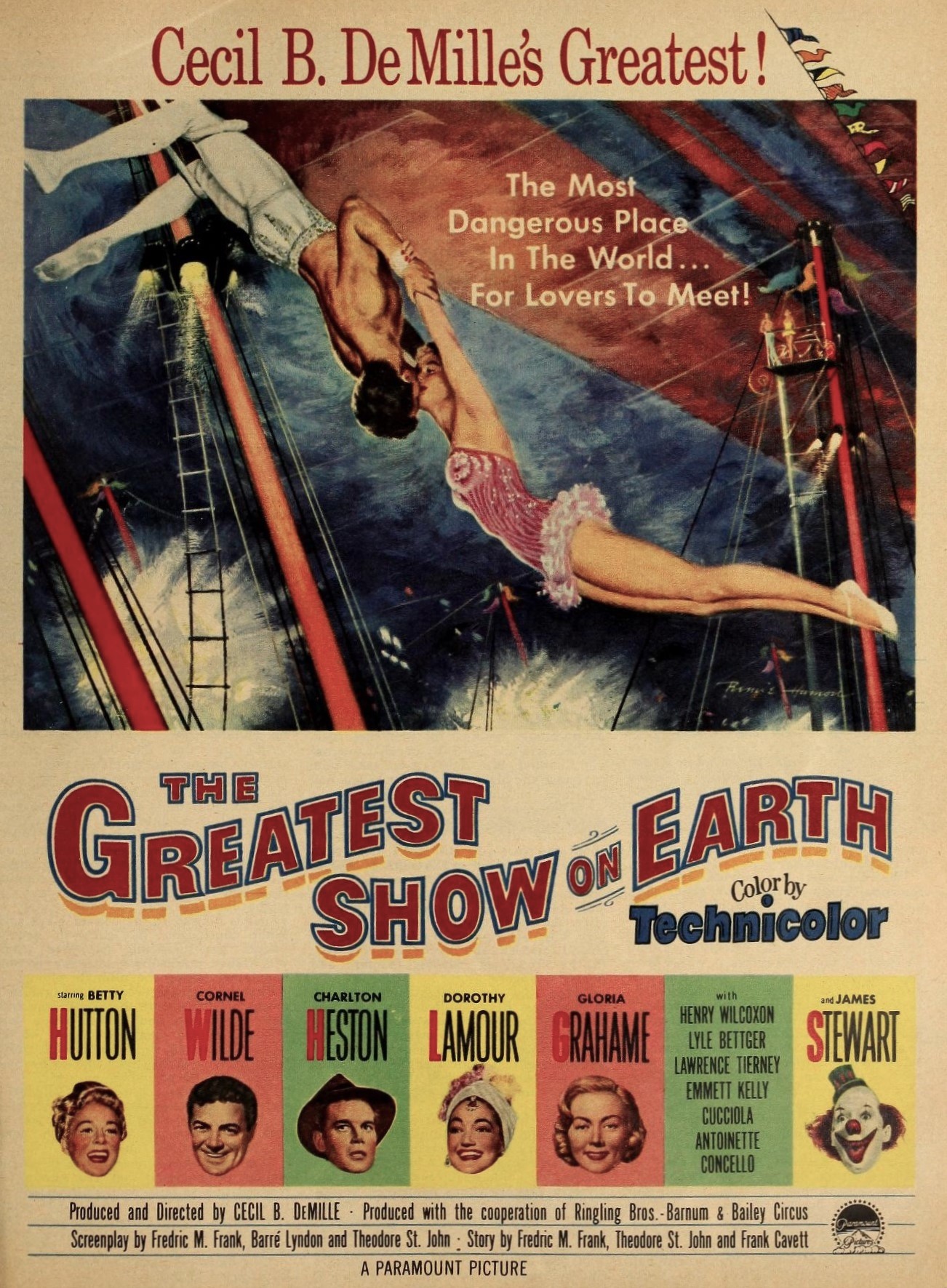
Cecil B. DeMille produced and directed the 1952 film, set within the Ringling Bros. and Barnum & Bailey Circus. Betty Hutton and Cornel Wilde play aerialists Holly and Sebastian, Charlton Heston plays manager Brad, and James Stewart plays Buttons. The screenplay is credited to Fredric M. Frank, Theodore St. John and Barré Lyndon. The film uses a real circus setting for an invented drama, so its account of specific lives should not be confused with a documentary biography of the performers working there. Its fictional relationships organise the spectacle into a world with competing attachments and obligations.
Brad fights to keep the season going as Holly competes with Sebastian for the centre ring. Sebastian's dangerous fall changes their rivalry, while Buttons conceals his identity as a doctor wanted for killing his gravely ill wife. A robbery causes a devastating train collision. Buttons saves the injured Brad, revealing his skill and facing arrest. Holly takes charge of a fresh performance, allowing the circus to continue. The conclusion combines revival with consequences that revival cannot remove. Some relationships find a new direction, but the show's survival does not grant every member of the company an uncomplicated escape.
Competition has an unusually visible form in this setting. Centre billing is not merely an abstract judgement about who matters; it determines where a performer stands in relation to everyone watching. Recognition can therefore feel like space another person has physically taken away. The story turns that pressure into a question about pride and professional judgement. A performer may need ambition to master a demanding act, yet ambition can become destructive when acclaim seems worth any risk. The circus makes the boundary difficult because risk is already part of what the public has come to see.
Brad's position supplies the opposite pressure. A manager must consider a whole institution, but considering the whole can make an individual person's hurt look like a problem to be solved quickly. His role invites a distinction between maintaining a show and caring for the people who make it possible. The two aims should support each other, though they can become separated in practice. A profitable season would be meaningless without workers, while a promise to protect workers needs an enterprise capable of paying them. The backstage drama lives in that uncomfortable interdependence rather than presenting duty as a perfectly clear instruction. The manager’s authority is consequently measured against the continued participation of people he cannot simply replace without loss.
Buttons introduces a secret that changes the meaning of performance. A clown's public identity ordinarily allows a person to disappear into costume for the length of an act. Here, disguise extends beyond that interval and becomes bound up with concealment. Reading his role in this way brings the film's concern with appearances into its moral questions. Someone offering laughter may also possess knowledge that becomes urgently serious. The eventual decision to use that knowledge has a cost. His ability to help is inseparable from the possibility of being recognised, so care cannot remain safely hidden behind an entertaining surface.
The train disaster gathers the troupe's separate tensions into a shared emergency. Before it, performers can argue about rank, affection or what somebody owes them. A catastrophe requires a different account of usefulness, measured less by applause than by what someone can do for another person in immediate danger. That shift helps explain why the film's larger spectacle belongs with its melodrama. The circus is a collective machine whose parts are human, and damage to the machine exposes those human dependencies. Continuing afterwards is not simply a business decision. It is a practical test of whether the group can still act as a group.
The ending gives the phrase about the show continuing more weight than a slogan would carry by itself. It has become a task inherited by people who have seen how quickly an apparently stable operation can break. Holly's response points toward leadership as a willingness to gather the remaining company and begin again. That renewal can be read alongside, rather than in place of, injury and arrest. The Greatest Show on Earth offers the circus as a world sustained by performance, rivalry and mutual need, where delight for the crowd is produced by people who cannot leave their complicated lives outside the ring.