
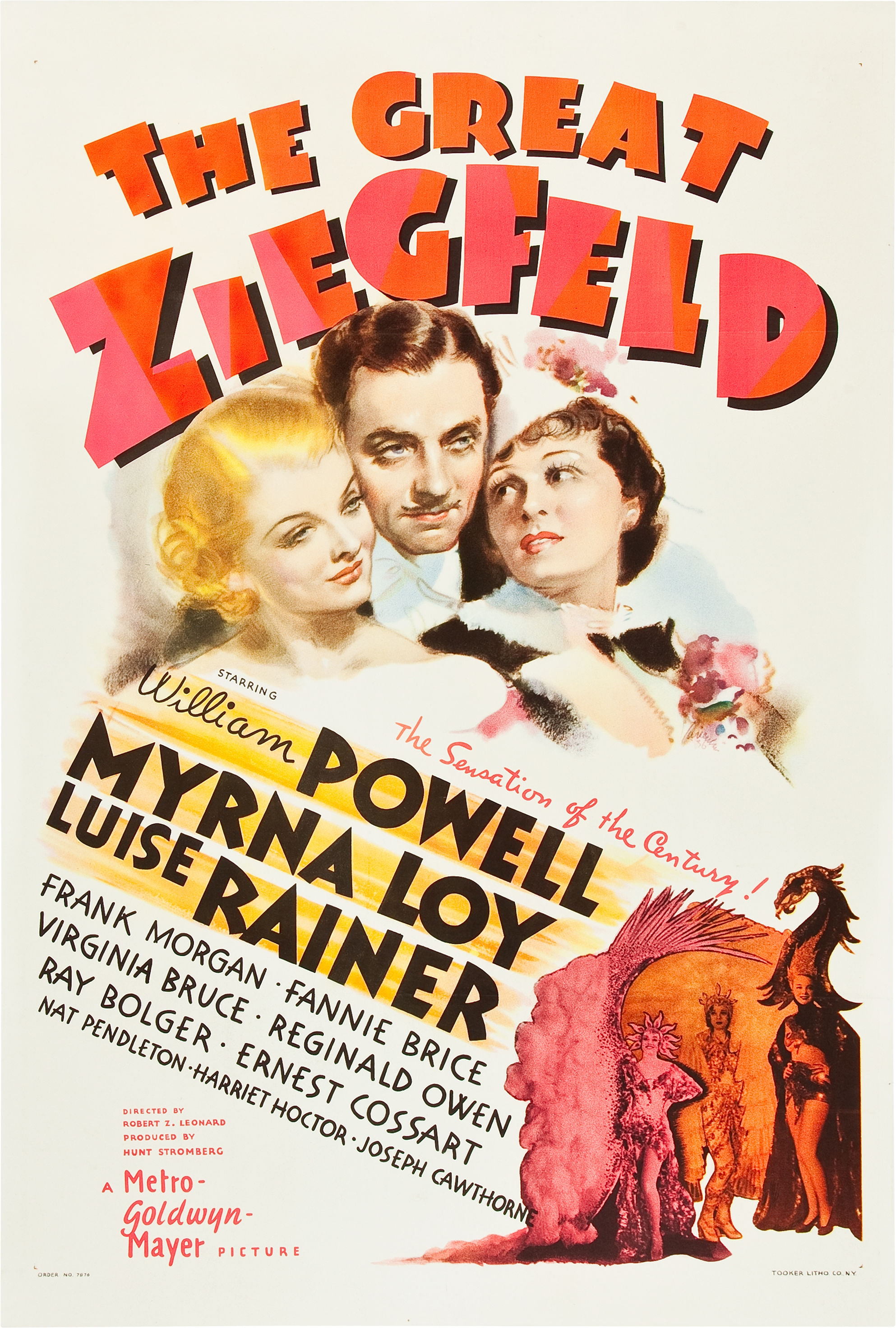
Behind the film
- Year
- 1936
- Director
- Robert Z. Leonard
- Writers
- William Anthony McGuire
- Genres
- Biographical, Musical, Drama
- Production
- Metro-Goldwyn-Mayer
- Country
- United States
- Cast
- William Powell, Myrna Loy, Luise Rainer, Frank Morgan, Fanny Brice, Virginia Bruce, Reginald Owen, Ray Bolger
About the film
Contains story spoilers.
The Great Ziegfeld tells the story of a showman by giving the audience the kind of spectacle that explains why showmanship could become a life. Florenz Ziegfeld is not satisfied merely to organise a successful performance. He wants another attraction, a grander presentation and a fresh reason for the public to pay attention. That appetite supplies the film's movement through years and relationships. The productions are evidence of ability, but they also suggest why ability might never bring rest. Robert Z. Leonard's musical biographical drama lets ambition create dazzling results while remaining something the central man has difficulty bringing to a satisfactory conclusion.
Ziegfeld begins promoting strongman Sandow, then wins singer Anna Held for his productions and marries her. Publicity helps build her success, but his growing Follies and interest in other performers strain the marriage. After divorce, he marries Billie Burke and continues producing lavish shows. Changing tastes provoke him to attempt several simultaneous Broadway hits. He succeeds, then loses his wealth in the stock-market crash. Illness and financial trouble follow. Rival Billings visits with talk of another grand project, though neither can fund it. Ziegfeld dies still imagining a larger production. The film turns his career into a pattern of creation, renewed appetite and a final dream beyond the resources available to realise it.
William Powell's Ziegfeld gives that pattern a persuasive human face. A promoter needs people to believe in something before the thing has fully proved itself, so charm is part of the work rather than simply a personal decoration. The story makes that skill useful in both public and private relationships, creating a difficulty when persuasion outruns what can actually be provided. A promise can help launch a production and also leave somebody waiting for a commitment that keeps moving elsewhere. The central role therefore has to connect invention with dissatisfaction. The same capacity that draws others towards him can make his attention hard to hold once another possibility arrives.
Luise Rainer's Anna Held supplies a view of success from the person being promoted. Becoming a central attraction can seem like receiving extraordinary recognition, yet the promoter's need for another attraction can change the terms of that recognition. Her relationship to Ziegfeld gives the expanding career a personal cost, making his professional appetite something another person has to live beside. The story does not treat a successful show as a complete answer to what a marriage needs. Public acclaim and private assurance may appear to support each other for a time, then separate when the work continues demanding attention that one person had hoped would remain available to her.
Myrna Loy's Billie Burke gives the later life another domestic frame, while Frank Morgan's Billings keeps professional rivalry close to companionship. The competitor's recurring presence allows ambition to be measured against someone who recognises its attractions and difficulties. Their relationship does not remain only a contest to take business from one another. At its later stage, it can hold a shared language for imagining a production neither is capable of creating. That changes the emotional meaning of rivalry. The wish to surpass another man becomes connected to the wish for someone else to understand why another show still seems necessary.
The musical staging makes necessity look beautiful enough to be tempting. Elaborate costumes, movement and architecture can create an image in which abundance appears to organise itself effortlessly. The extended A Pretty Girl Is Like a Melody sequence, with its enormous stepped set, gives that illusion a particularly clear form. A show can look like a complete world while being the result of coordinated labour and resources outside the audience's immediate view. The film's own scale participates in the attraction it is depicting. It asks viewers to understand a man drawn towards more spectacle by offering spectacle substantial enough to make the desire understandable.
Written by William Anthony McGuire, the film is a dramatised biography rather than a neutral record of every event in Ziegfeld's life. Its relationships and career episodes are arranged to support the portrait of a man whose creation keeps extending beyond his immediate circumstances. Performers including Fanny Brice and Ray Bolger connect the screen spectacle to entertainment identities beyond the central character, while the narrative still gives Ziegfeld the organising position. That choice is worth keeping visible when considering what the film means by a great showman. It celebrates the ability to bring an event into being, but the event necessarily depends on talents that are not reducible to one man's ambition.
The final dream makes the earlier achievements look both substantial and insufficient to the person who produced them. Ziegfeld has created things that audiences wanted to see, yet remembering them cannot entirely replace the wish to create again. The film closes with that appetite rather than with a neat account of what success should have taught him. Its grandeur and sadness arise from the same condition: the imagined production can always be bigger than the one resources permit. The Great Ziegfeld gives that drive a long, lavish cinematic form, leaving the audience with the pleasure of what was made and the impossibility of making enough to satisfy the man at its centre.