
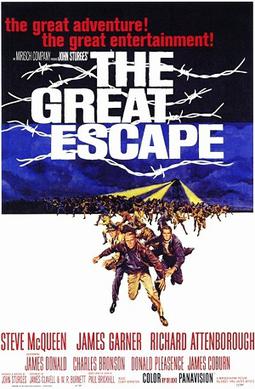
Behind the film
- Year
- 1963
- Director
- John Sturges
- Writers
- James Clavell, W. R. Burnett
- Runtime
- 2h 52m
- Genres
- War, Drama, Adventure, Thriller
- Production
- The Mirisch Company
- Country
- United States
- Cast
- Steve McQueen, James Garner, Richard Attenborough, James Donald, Charles Bronson, Donald Pleasence, James Coburn, Hannes Messemer
About the film
Contains story spoilers.
The Great Escape treats getting out as an undertaking that begins long before somebody reaches the edge of a camp. Its prisoners need one another's skills, patience and willingness to perform work that may never produce a visible reward. The ambition of the plan gives the film a large cast without making them simply interchangeable men waiting for their chance. Different abilities become necessary parts of the same effort, giving the quiet work of preparation a place alongside the more conspicuous acts of defiance. That shared labour is what makes the movement beyond the wire matter: each individual journey carries the work of people who have helped create an opportunity they may not personally receive.
John Sturges directs the 1963 film, with James Clavell and W. R. Burnett adapting Paul Brickhill's book. Steve McQueen plays Hilts, James Garner is Hendley and Richard Attenborough is Bartlett; the ensemble also includes Charles Bronson, Donald Pleasence, James Coburn and Gordon Jackson. The story draws on the real escape from Stalag Luft III, but its characters and action are heavily fictionalised. That distinction matters particularly for the adventure sequences. The film gives the historical subject an entertainment structure built around individual personalities, so its dramatic incidents should not be treated as a literal record of what particular prisoners did.
Bartlett plans to get a large group out through tunnels while other prisoners supply the supporting work. A tunnel is discovered, but the remaining effort continues. On the escape night, the exit falls short of the intended cover, slowing departure; seventy-six men get away. Their routes then separate, and the outside world brings pursuit rather than immediate safety. Hilts attempts to escape by motorcycle and is recaptured. Only a few reach freedom. Fifty of the recaptured prisoners are executed. The survivors return to a camp where the achievement and the loss cannot be separated into a comfortable account of victory.
Bartlett's leadership turns resistance into an organised demand on the camp's occupants. An escape on this scale needs more than determination from the people most eager to leave. It requires trust that the larger purpose justifies repeated risk and sustained effort. The enterprise therefore creates its own pressures within the institution holding them. A man may possess a useful skill while struggling with the particular conditions under which he must use it, and confidence in the plan cannot remove those difficulties. Cooperation includes recognising dependence on people whose limits are as real as their abilities.
Hendley's resourcefulness and his relationship with Blythe give that dependence a personal expression. A companion can be indispensable without being able to cope equally well with every stage of the attempt. The route from preparation to flight changes what each person needs and can offer. That makes friendship part of the escape's practical and emotional structure rather than an ornamental detail attached to the action. Concern for somebody else can complicate the pursuit of personal freedom, because leaving together may create difficulties that leaving alone would avoid. The film makes those choices visible through relationships instead of reducing everybody to a place in a queue.
Hilts supplies a different rhythm, with an individual defiance that sits alongside the collective organisation. His screen presence gives the camp's restrictions a repeated opponent, somebody whose refusal to settle becomes a continuing assertion of independence. Once outside, however, confidence and physical ability encounter a world that can still surround and capture him. The motorcycle sequence concentrates the appeal of a lone figure trying to outrun confinement, while its outcome prevents that appeal from becoming a guarantee. His determination remains meaningful even though it does not produce the freedom the sequence makes momentarily possible to imagine.
The story's expansion beyond the camp changes the scale of the problem. Inside, the prisoners can identify a boundary and work towards crossing it. Outside, danger is dispersed through travel, encounters and the possibility of recognition. A successful departure therefore completes only one stage of the undertaking. The separate journeys also break apart the solidarity that has made the preparations possible, leaving individuals dependent on circumstances they cannot coordinate in the same way. What the group could arrange within captivity no longer gives everybody an equal chance once their paths diverge across the surrounding landscape.
The killings make the final reckoning unavoidable. The film can preserve the ingenuity and courage of the effort without allowing those qualities to compensate for the men who do not return. Its ending holds a practical question about what the escape achieved beside the continuing importance of resistance. Hilts's return to confinement offers persistence rather than a neat answer. Sturges's adventure ultimately depends on that unresolved relationship between action and outcome: the prisoners have refused to let captivity define the entirety of their lives, but that refusal has not protected them from a cost the surviving men must continue to carry.