
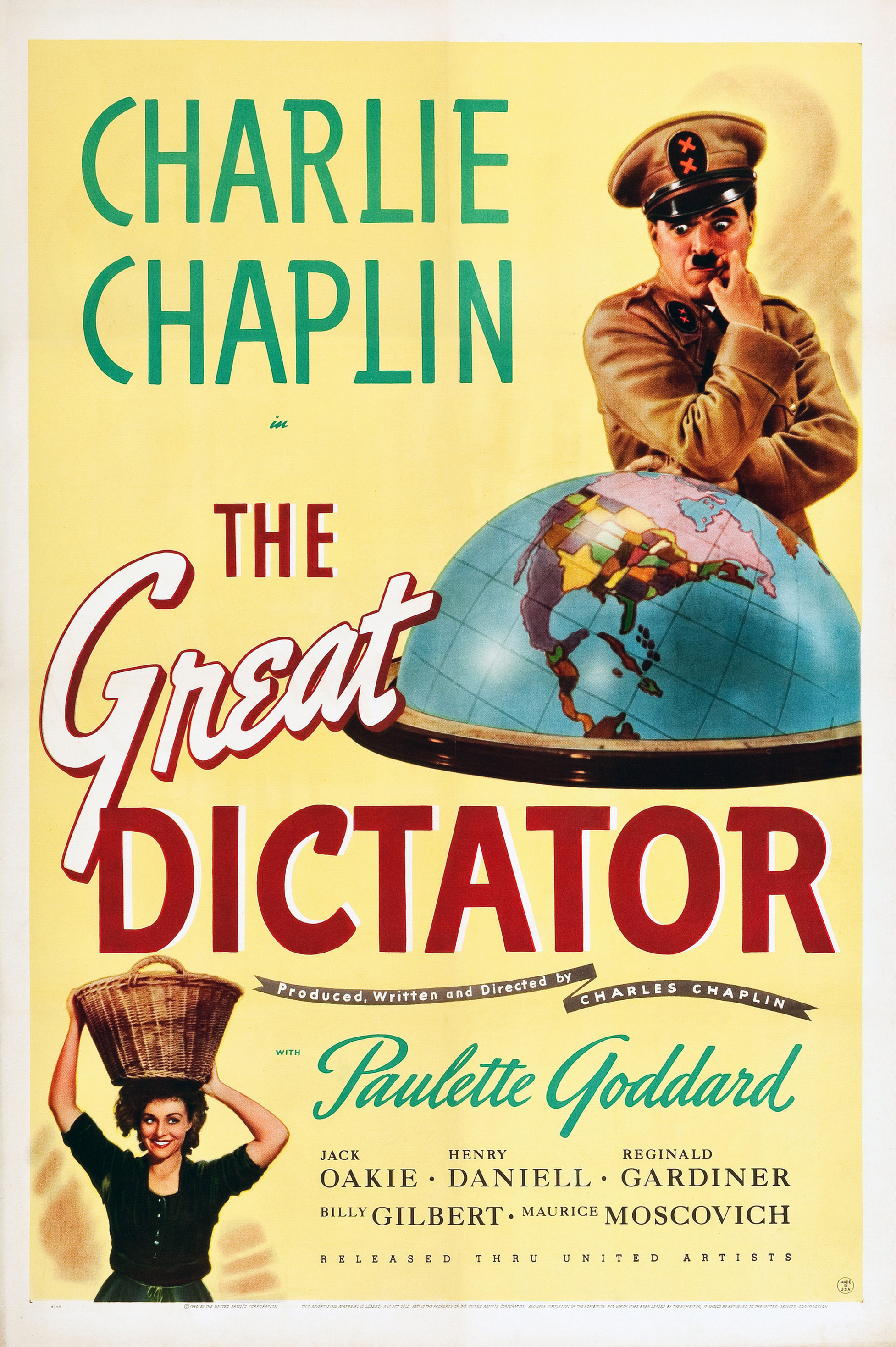
Behind the film
- Year
- 1940
- Director
- Charlie Chaplin
- Writers
- Charlie Chaplin
- Runtime
- 2h 6m
- Genres
- Comedy drama, Political satire, War, Anti-war
- Production
- Charles Chaplin Film Corporation, United Artists, Charlie Chaplin Studios
- Country
- United States
- Cast
- Charlie Chaplin, Paulette Goddard, Jack Oakie, Reginald Gardiner, Henry Daniell, Billy Gilbert, Grace Hayle, Maurice Moscovitch
About the film
Contains story spoilers.
Charlie Chaplin’s The Great Dictator opens during the First World War, where a Jewish soldier helps Commander Schultz escape with important military documents. Their plane crashes, and the soldier loses his memory. Twenty years later, he returns to his barber shop in the ghetto, unaware that the country has become a dictatorship and that he has been hospitalized for years. The story’s central joke is apparent from the start: Chaplin plays both the barber and Adenoid Hynkel, the ruler of Tomania, whose appearance resembles the man he persecutes. That doubling lets the film build comedy from mistaken identity while drawing a sharp line between a person who wants to live quietly and a leader who wants power over everyone.
The barber tries to resume his work, but stormtroopers harass him and vandalize his shop. He befriends Hannah, a neighbor who resists the regime's violence, and the two begin to imagine a life beyond the ghetto. Schultz, once a pilot saved by the barber, now holds a high position in Hynkel's government and recognizes him; their reunion awakens the barber's memory of the wartime encounter. At the same time, Hynkel's plans for conquest depend on money from a Jewish banker. When the banker refuses to finance him, the dictator orders a purge of the Jews. The political plot grows from decisions made at the palace, but the consequences arrive on ordinary streets and in private homes.
Schultz protests Hynkel’s policy and is sent to a concentration camp, where he eventually escapes and hides with the barber. They consider a plan to assassinate Hynkel, but Hannah persuades them not to turn resistance into a suicide attack. Troops search the ghetto and arrest both men, sending them to the camp. Hannah and her friends flee to a vineyard in neighboring Osterlich, hoping to live beyond the regime’s reach. The film’s comic rhythms continue even as the danger intensifies, but Chaplin does not treat persecution as a harmless backdrop. The barber’s shop, the soldiers’ raids and the people’s hurried flight make the stakes visible without pretending that comedy alone can protect anyone from state violence.
Hynkel's parallel story moves through palace rivalries and plans for expansion. He negotiates with Benzino Napaloni, the dictator of neighboring Bacteria, in a sequence of status games and comic misunderstandings. Their meeting makes the rival leaders look absurd, but their power has real effects on the countries they govern. Hynkel orders the invasion of Osterlich, and Hannah and the people around her are subjected to the regime's violence. The barber and Schultz escape from the camp in stolen uniforms and approach the frontier. Meanwhile, Hynkel goes duck hunting and is mistaken for the barber by his own troops; the barber is then carried forward as if he were the dictator. The mistaken identities place him before the crowd expecting Hynkel.
The barber recognizes that the people expect a speech from Hynkel and uses the moment to reject the dictator's beliefs, calling for democracy, solidarity and human decency. The film shifts from comedy into a direct address that breaks the boundary between the character and Chaplin's public voice. It leaves the audience with words intended to confront them, rather than showing that the political system has changed. That ending is deliberately different from a conventional victory scene. The barber's speech is an appeal and an interruption, not proof that persecution has ended.
Chaplin’s performance makes the two roles distinct through posture and movement: Hynkel’s exaggerated gestures fill the space, while the barber’s physical comedy is tentative and grounded in routine. The globe dance, the barber’s shaving scene and the final speech all use music and gesture to shape how power is seen. The opening decades-spanning structure also puts an individual life against a regime’s rise, showing how long a person can be separated from the world that has changed around him. The film was made while fascist dictatorship was an immediate political reality, before the full extent of the Holocaust was known. Its fictional country allows satire to be direct while still separating the story’s invented names from actual history. The duck-hunting episode turns the resemblance into a political accident: Hynkel's own soldiers take the barber for their leader, while the real dictator is removed from command. The plot's irony comes from the regime's dependence on uniforms and appearance, even as the barber's speech rejects the power attached to them.
The Great Dictator is an antifascist satire, not a documentary account of a specific barber or a literal episode in the history of Germany. Hynkel and Napaloni are caricatures, and Tomania and Bacteria are fictional states. Yet the film’s jokes draw on visible political features of its moment, including dictatorship, antisemitic persecution and territorial aggression. Chaplin’s final shift into direct address gives the work an unusual ending: the drama stops short of showing what the characters’ lives become, and the audience must consider the speech on its own terms. The barber’s resemblance to Hynkel makes the last scene possible, but the film’s moral distinction depends on what each man chooses to say once he stands before the crowd.