
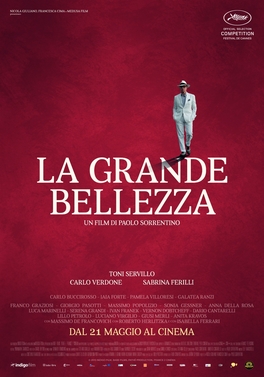
Behind the film
- Year
- 2013
- Director
- Paolo Sorrentino
- Writers
- Umberto Contarello, Paolo Sorrentino
- Runtime
- 2h 22m
- Genres
- Comedy drama
- Production
- Medusa Film, Pathé, France 2
- Country
- Italy, France
- Cast
- Toni Servillo, Carlo Verdone, Sabrina Ferilli, Carlo Buccirosso, Iaia Forte, Pamela Villoresi, Galatea Ranzi, Franco Graziosi
About the film
Contains story spoilers.
Before Jep’s birthday party, a Japanese visitor collapses while viewing Rome from the Janiculum. The film then moves to Jep Gambardella, who has spent decades becoming a fixture of the city’s literary and social circles. His only novel made him famous, but the journalist and theatre critic has not written another book. He hosts a crowded 65th-birthday party on a terrace overlooking the Colosseum, where a line dance and thumping music keep guests moving in a circle. Jep is its polished ringleader, yet retreats to watch from the edge. Sorrentino frames this pause against ancient monuments and guests trading gossip, performances and status. His success looks like both a role he plays well and a routine he has stopped believing in.
The news that Elisa, the woman he loved as a young man, has died gives that unease a personal shape. Her husband tells Jep that Elisa left a diary revealing she had loved him throughout her marriage. The revelation sends Jep through memories of their brief youth together and makes him consider the life he built after that summer. He still returns to parties, cafés and dinners, but now he watches the people around him with a more exposed curiosity. Sorrentino does not turn the diary into a neat explanation for Jep’s stalled writing; it is one shock among the sights and losses that make his old habits feel newly fragile. The past arrives through a few recollections rather than a long flashback, and its emotional weight sits beside the present instead of replacing it.
The film unfolds through encounters rather than a single investigation. Jep visits a Botox clinic, sees a child painter perform for party guests, and joins friends who discuss art and politics on his terrace. When a self-styled artist presents a performance built around repeatedly running into a wall, Jep interviews her for his newspaper and punctures her claims with dry questions. A friend with keys to Rome’s palaces takes Jep on a night visit through rooms normally closed to the public. The route shifts the film from elite nightlife into older collections of art and architecture, letting the city’s history interrupt the group’s self-importance without pretending that Jep has escaped it.
Ramona, a stripper and the daughter of one of Jep’s acquaintances, becomes a companion rather than another conquest. She is older than the young women usually found around Jep’s circle, and their conversations make room for confidences that are absent from the parties. He takes her to see Rome at night, including its hidden interiors, and introduces her to the city he knows through private access and long familiarity. The film also follows Ramona’s illness; her death removes the possibility that this closeness can become a stable new life for Jep. Their friendship briefly offers shared attention, but ends with Ramona’s death.
Jep’s friends encounter their own limits. Romano, a playwright who has spent years chasing an unfulfilled career, decides to leave Rome after another failure. Stefania, a writer who presents herself as politically committed, is humiliated when Jep reveals private details that undercut her public image. After her son Andrea dies, Viola gives her possessions to the Church and becomes a missionary in Africa. The film sets these departures beside more theatrical figures: a cardinal whose conversation turns to cooking, a magician who makes a giraffe disappear, and an extremely old missionary nun around whom Jep’s editor plans an interview.
Sorrentino’s visual approach holds the episodes together. Luca Bigazzi’s camera glides across terraces, museum rooms, streets and ceremonial interiors, often letting a scene continue as Jep watches rather than forcing a close explanation of what he feels. The film cuts between loud electronic dance music, still views of Rome and conversations that switch from comedy to mortality. The contrast between showy parties and measured passages does not make the film’s world simple; it keeps the glamour visible even as the people inside it age, quarrel and die. In a production interview, Sorrentino says Jep arrived late in development and gave the film’s many Rome-centered anecdotes a point of focus; he describes the protagonist as an observer drawn indirectly into a personal story. Sorrentino says the score pairs sacred music with popular Italian songs, echoing the city’s mixture of religious and worldly spaces.
In the closing section, Jep’s editor arranges an interview with Sister Maria, a missionary nun regarded as a saint. Jep also travels to Giglio Island to report on the Costa Concordia shipwreck; the late scenes return him to a memory of his first meeting with Elisa. The ending does not show a finished second novel or a new identity for Jep. It leaves open whether remembering will move him toward writing again. The Costa Concordia wreck gives the late story a physical image of loss as Jep looks back toward the sea and his memories of Elisa.