
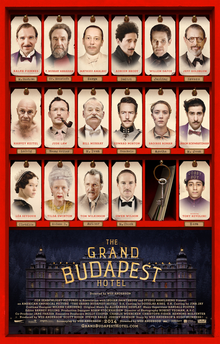
Behind the film
- Year
- 2014
- Director
- Wes Anderson
- Writers
- Wes Anderson
- Runtime
- 1h 39m
- Genres
- Comedy, Drama, Adventure, Romance
- Production
- American Empirical Pictures, Babelsberg Film GmbH, TSG Entertainment
- Country
- United States, Germany
- Cast
- Ralph Fiennes, Tony Revolori, F. Murray Abraham, Tilda Swinton, Adrien Brody, Willem Dafoe, Saoirse Ronan
About the film
Contains story spoilers.
The Grand Budapest Hotel is told through a chain of storytellers. A young woman visits the shrine of a celebrated writer and reads his novel; that book recalls the writer’s meeting in 1968 with the hotel’s elderly owner, Zero Moustafa. Over dinner, Zero describes his youth in 1932, when he arrived in the fictional country of Zubrowka as a refugee and started work as a lobby boy. The hotel he remembers was then a lavish mountain resort, and its concierge, Monsieur Gustave H., seemed to know every guest and every rule of service. The layered structure places a vivid adventure inside a memory inside a book, making the vanished hotel feel both carefully remembered and openly invented.
Gustave trains Zero in the hotel’s routines and in his own exacting standards. He is also involved with several wealthy older guests, including Madame D., a dowager with whom he has had a long affair. After she dies, Gustave and Zero travel to her family estate for the reading of her will. Her attorney, Deputy Vilmos Kovacs, announces that she has left Gustave a valuable Renaissance painting, Boy with Apple. Madame’s son Dmitri is outraged and wants Gustave arrested. Gustave and Zero leave with the painting, while the family’s butler Serge gives a statement that implicates Gustave in Madame’s death. The inheritance dispute quickly becomes a criminal case, and Gustave is arrested.
In prison, Gustave befriends a group of inmates and plots an escape. Zero helps from outside by carrying digging tools concealed inside pastries made by Agatha, his girlfriend and an apprentice baker at Mendl’s. Gustave and the prisoners tunnel out, and he reunites with Zero. Together they seek support from the Society of the Crossed Keys, a network of concierges who help them locate Serge. The butler explains that Dmitri pressured him to frame Gustave in order to conceal evidence of Dmitri’s own role in Madame’s murder. He also reveals that Madame made a second will that takes effect if she is murdered. Before they can secure his testimony, Dmitri’s enforcer Jopling kills Serge.
Jopling pursues Zero and Gustave, leading to a chase that ends with Gustave hanging over a cliff. Zero saves him by pushing Jopling over the edge, and the two escape from the police who follow them. They return to the Grand Budapest with Agatha, only to find the hotel occupied by soldiers. Agatha slips inside to retrieve Boy with Apple; Dmitri spots her with it and opens fire. The confrontation grows into a melee with the troops, and Agatha and Zero fall from a balcony into a van full of pastries. The comedy of that escape sits beside an unmistakable change in the world outside: military power has entered the place that once seemed governed by hotel etiquette.
The second will is discovered attached to the back of the painting. It names Gustave as the beneficiary of Madame’s fortune, and he is cleared of the murder charge. Zero becomes the hotel’s concierge and marries Agatha, with Gustave officiating. On a train, soldiers try to arrest Zero; Gustave intervenes and is shot dead. His death is abrupt, and the film does not turn the train into a heroic last stand. It is one more sign that the rules and courtesies he prized cannot protect anyone from the new regime taking shape around them.
Zero inherits Gustave’s fortune and keeps the hotel open in memory of Agatha, who later dies of illness along with their infant son. That loss explains why the elderly Zero still preserves the Grand Budapest even when it has become a faded, nearly empty place. Wes Anderson’s tightly arranged compositions and changing visual formats make the different time periods easy to distinguish, while the story’s quick chases and precise service rituals carry an elegiac undertone. The film’s final sadness belongs to Zero’s act of remembering: a hotel can be maintained, but the people and world that made it feel alive cannot be restored.
The younger Zero and the elderly Zero are not simply the same character at two ages; their lives are shaped by the people and political upheavals they survive. In 1932, Gustave teaches him how to navigate the hotel and how to move through a dangerous world with a small circle of allies. Decades later, the property has lost its old splendour, and the writer’s visit is a rare chance for Zero to tell someone what it once meant. The story’s nested frames make that act of recollection part of the plot: we first encounter the hotel as a monument to an author, then learn it was already an object of memory for the man who owns it. The young woman at the shrine then gives the chain one more link, holding the book as a keepsake amid the remnants of the world Zero remembers.