
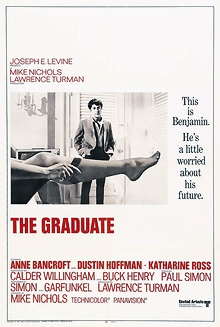
Behind the film
- Year
- 1967
- Director
- Mike Nichols
- Writers
- Calder Willingham, Buck Henry
- Genres
- Comedy drama, Coming-of-age, Drama, Romantic comedy
- Production
- Lawrence Turman
- Country
- United States
- Cast
- Dustin Hoffman, Anne Bancroft, Katharine Ross, William Daniels, Murray Hamilton, Elizabeth Wilson, Buck Henry, Brian Avery
About the film
Contains story spoilers.
Benjamin Braddock comes home to Pasadena after graduating from an Eastern college, where his parents welcome him with a party and a list of expectations. They praise his degree, present gifts and ask what he intends to do next; he can offer no convincing answer. Mrs. Robinson, a friend of his parents and wife of his father's law partner, asks him to drive her home. She tries to seduce him, but the arrival of her husband interrupts the encounter. Benjamin is nervous and unsure how to respond, yet he later calls her and arranges to meet at the Taft Hotel. The affair gives structure to his empty summer without resolving the uncertainty that brought him home.
The hotel meetings are secret and transactional, while Benjamin's days drift around his parents' swimming pool. His mother and father encourage him to take Elaine, Mrs. Robinson's daughter, on a date. He agrees reluctantly, partly to end pressure from his parents and the Robinsons. The first outing goes badly: Benjamin behaves rudely, drives recklessly and takes Elaine to a strip club. He sees her distress and apologizes; the two continue the evening at a drive-in, where their conversation becomes more honest. Elaine's directness and their shared uncertainty about the future appeal to Benjamin in a way the affair has not. Their connection creates a choice he had been avoiding, and their next meetings become increasingly difficult to hide from her mother.
Mrs. Robinson threatens to expose the affair unless Benjamin stops seeing Elaine, so he tells Elaine himself before her mother can. Elaine is shocked and returns to Berkeley, where Benjamin follows her in an effort to repair the relationship. Her mother has falsely claimed he raped her, making Elaine’s rejection depend partly on another account Benjamin has not yet heard. Elaine reconciles with him after learning the accusation is false, but remains uncertain about his push for marriage. Mr. Robinson then intervenes, threatens Benjamin and removes Elaine from college to marry Carl Smith. Benjamin’s new determination has not made the situation simple: he wants an immediate commitment from someone still deciding what to do. His pursuit is entangled with the secrecy, hurt and competing family decisions that brought them here.
Elaine's parents intervene more forcefully as her wedding approaches. Mrs. Robinson refuses to tell Benjamin where the ceremony will take place, and he returns to Berkeley, learns the wedding is in Santa Barbara and drives there until his car runs out of fuel. He reaches the church as the vows are ending and calls Elaine's name from the gallery. She looks toward him, fights off her mother and Carl, and runs from the ceremony. Benjamin uses a large cross to hold back the guests as the two escape. They reach a bus and sit side by side; after the rush of their decision, their faces settle into silence. The film does not give them a plan, only the consequences of the choice they have just made. Its ending leaves a sharp gap between the triumph of getting away and the uncertainty that follows.
Mike Nichols and editor Sam O'Steen shape Benjamin's disorientation through abrupt transitions, changing scale and images that isolate him even in busy rooms. The swimming pool recurs as a place where he floats rather than moves toward a decision. Anne Bancroft gives Mrs. Robinson an exterior control that can hide bitterness and vulnerability; Katharine Ross's Elaine becomes more than a goal when she refuses Benjamin's account of what happened. Dustin Hoffman's hesitant posture keeps the graduate's confidence and immaturity visible at once. Simon and Garfunkel's songs punctuate time passing and bring a musical rhythm to scenes where Benjamin's days otherwise blur together. The soundtrack connects the comic repetitions of his summer to the pressure gathering around Elaine's wedding.
The title points to a social threshold rather than a tidy passage into adulthood. Benjamin has a degree and a family proud of him, but neither gives him a language for choosing a direction. Mrs. Robinson's attention temporarily makes him feel wanted while concealing how little he knows about her marriage or her daughter. Elaine's relationship with him begins after he has hurt her, and the final escape answers that harm only with a sudden refusal to follow the expected wedding script. The bus ride that follows lets the exhilaration ebb in real time: the couple has broken away from the ceremony, and now must face the unspoken question of what comes after.
At the Taft Hotel Benjamin checks in under the name Gladstone, giving the affair a small ritual of concealment. The false surname lets him pass through a public lobby while keeping his identity separate from the Robinson family and the life his parents imagine for him. Repeated hotel visits make the relationship feel organized even as the rest of his summer remains formless. The contrast matters when Elaine enters the story: she is not another anonymous meeting but someone whose name and family tie the secret back to the people around Benjamin. The hotel alias marks the boundary he has been trying to keep intact, a boundary that collapses once he agrees to date her.