
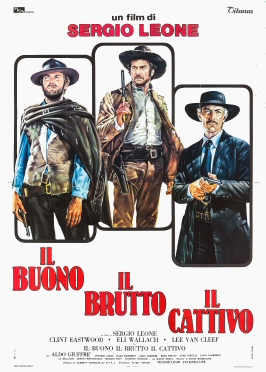
Behind the film
- Year
- 1966
- Director
- Sergio Leone
- Writers
- Agenore Incrocci, Furio Scarpelli, Luciano Vincenzoni, Sergio Leone
- Runtime
- 2h 41m (US theatrical version)
- Genres
- Spaghetti western, Treasure hunt, War, Drama
- Production
- Constantin Film, United Artists, Produzioni Europee Associati
- Country
- Italy, Spain, Germany
- Cast
- Clint Eastwood, Eli Wallach, Lee Van Cleef, Aldo Giuffrè, Luigi Pistilli
About the film
Contains story spoilers.
Sergio Leone’s The Good, the Bad and the Ugly turns a search for buried gold into an uneasy partnership between three men who rarely share a goal for long. Blondie, played by Clint Eastwood, is the quiet gunman often called the Good; Tuco, Eli Wallach’s fast-talking bandit, is the Ugly; Angel Eyes, Lee Van Cleef’s cold mercenary, is the Bad. The Civil War shapes the landscape they cross, but the film is not a lesson in military history. It treats the conflict as an enormous human machine that its small-time schemers move through, exploit and occasionally interrupt. Its interest lies in how the characters bargain for survival when every alliance is temporary.
Blondie and Tuco already know how to profit from each other. Tuco is handed over for bounty, and Blondie collects the reward before rescuing him from the noose at the last moment. They repeat the scheme until Blondie ends it by abandoning Tuco in the desert. Tuco survives and eventually gets his revenge, but an encounter with a dying soldier changes the direction of both men. The soldier tells Tuco that a fortune in Confederate gold is buried at Sad Hill Cemetery and gives Blondie the name of the grave, Arch Stanton. Tuco knows the cemetery; Blondie knows the grave. Their information is useful only if both remain alive, creating a partnership based on need rather than trust.
Angel Eyes enters through a separate trail. He is paid to find Bill Carson, the name used by the soldier who stole the gold, and kills his employer after learning what he needs. He can be patient when money is at stake, but there is little warmth in his method. The film cuts between his pursuit and Blondie and Tuco’s journey, allowing the audience to see how close each man is to the same destination. Angel Eyes’s control of a prisoner-of-war camp gives him another advantage when he encounters Tuco under an assumed name. He tortures Tuco for the cemetery’s location, then recognizes that Blondie cannot be forced to disclose the grave’s name. Rather than continue alone, Angel Eyes temporarily recruits Blondie into his search.
The prison camp and its military band underline the film’s bleakest contrast: soldiers suffer and die while the three leads use the chaos as cover for private profit. Blondie and Tuco eventually escape the arrangement with Angel Eyes and reunite, though their friendship remains threaded with old grievances. They reach a Union camp during a brutal fight around a bridge that blocks the way to Sad Hill. Instead of choosing which army should prevail, the two men arrange to destroy the bridge so that they can cross the river. They exchange their halves of the treasure’s location while preparing the explosives. The small transaction happens amid a mass of wounded men and gunfire, a dark joke about how greed persists even when war has made every surrounding life disposable.
After the armies move on, Tuco races ahead toward the cemetery while Blondie stops to share a cigar with a dying soldier and covers him with his coat. The gesture complicates the labels in the title: Blondie can show compassion without becoming a conventional hero, and Tuco is more than an empty appetite. At Sad Hill, Tuco digs at Arch Stanton’s marked grave and finds a skeleton, not the gold. Blondie admits that the name he supplied was false and claims to write the real location on a stone, making the answer the prize of their confrontation. Angel Eyes arrives and forces his way into the search, bringing the three men into a circular standoff among the graves. The camera and Ennio Morricone’s music stretch the moment until looking, waiting and anticipating become as important as firing.
Before the final standoff, Blondie has secretly unloaded Tuco’s pistol, leaving him unable to fire when they face one another over the graveyard. Blondie shoots Angel Eyes and takes control, then reveals that the gold lies beside Stanton's grave beneath a marker reading Unknown. Tuco digs out the coins. He shares the gold with Tuco but leaves him standing on a grave marker with a noose around his neck, riding away before turning back to shoot the rope. Their bond ends in another trick that still preserves Tuco’s life. The conclusion is comic and unnerving: the two men can care for each other, but neither has stopped treating the other as a rival. Their choices shift between cruelty and generosity without becoming a simple moral transformation.
Leone’s widescreen compositions set small human figures against immense landscapes, battle lines and the crowded geometry of Sad Hill. The editing alternates long stretches of travel with sudden violence, while close views of eyes and hands make the final duel feel like a physical negotiation. Morricone’s score gives the landscape its own voice, building tension without making the Civil War look noble. In the closing image, Tuco is left balanced above the gold while Blondie rides away, a final joke that turns the treasure hunt back into their unstable partnership. Multiple cuts circulate, so the pacing can vary, but the story remains a stylized Western with fictional protagonists rather than a documentary account of the war or its soldiers.