
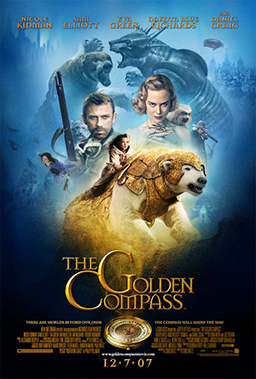
Behind the film
- Year
- 2007
- Director
- Chris Weitz
- Writers
- Chris Weitz
- Genres
- Fantasy, Science fiction, Action
- Production
- New Line Cinema, Ingenious Film Partners, Scholastic Productions
- Country
- United Kingdom, United States
- Cast
- Dakota Blue Richards, Nicole Kidman, Daniel Craig, Sam Elliott, Eva Green, Ian McKellen, Tom Courtenay, Freddie Highmore
About the film
Contains story spoilers.
The Golden Compass gives a familiar childhood question an unusually physical form: what would it mean if the part of you that thinks, fears and loves could walk beside you? In Lyra's world, the soul appears as an animal companion called a dæmon. That idea makes emotional connection visible before any larger mystery needs explaining. A person and their companion belong together, so threats to that relationship carry an immediate meaning. The fantasy can introduce unfamiliar institutions and territories, but its most important stakes remain close enough to understand without a glossary. Someone powerful wants to interfere with what makes a child whole.
Chris Weitz wrote and directed this 2007 adaptation of Philip Pullman's Northern Lights, with Dakota Blue Richards as Lyra and Nicole Kidman as Mrs Coulter. The distinction between the film and its literary source matters. This is an opening adventure in a much larger imagined universe, and it should be approached as that particular piece of the story. Its world invites questions it does not fully answer. There is a difference between understanding the immediate danger and understanding every rule behind it, just as there is a difference between a child uncovering a secret and an institution surrendering its power.
The essential journey follows Lyra north after Roger's abduction. An alethiometer helps her read the truth; Gyptians, witches and the armoured bear Iorek become allies. At Bolvangar, children are subjected to separation from their dæmons. Mrs Coulter is revealed as Lyra's mother and Asriel as her father. Lyra escapes, destroys the separation machine and helps rescue the captives. The film ends with the party travelling on to seek Asriel, with Roger alive. That outline establishes the rescue and the unresolved journey. It does not import the novel's later events into an ending that has chosen to stop earlier.
What gives the setting its character is the relationship between wonder and regulation. A world with extraordinary creatures could easily become a succession of attractions, each introduced because it looks impressive. Here, the more interesting question is who gets to explain those wonders and who gets to suppress an explanation. Knowledge becomes something contested rather than something delivered neatly by a wise guide. Lyra's curiosity is therefore more than an appealing personality trait. It threatens an arrangement in which being young is supposed to mean accepting the account supplied by someone older, richer or officially entitled to give instructions. The instrument’s name can be misleading: the important direction is towards understanding, rather than simply knowing which physical route points north.
The dæmons deepen that argument because their presence makes inner life difficult to dismiss as an abstraction. If a companion can be frightened, comforted or hurt, then the language of protection must be tested against what protection actually does. That is where the story's darker premise sits. An adult institution may describe a procedure as beneficial while the relationship it damages tells another story. The fantasy does not require that argument to be translated into a single real-world equivalent. It works through a child's recognition that a reassuring explanation and a harmful action can belong to the same person.
Mrs Coulter brings that contradiction into the family rather than leaving it entirely in distant authority. Her position makes care difficult to sort from possession. For Lyra, discovering a personal connection does not automatically settle whether the connected person is trustworthy. Family identity supplies information, but it cannot substitute for judging behaviour. This is a useful distinction in an adventure built around hidden truths. A revelation can explain why someone has an interest in you without proving that their interest is good for you. The story's emotional questions survive even when a device can reveal factual answers.
The northern adventure also opens space for relationships that are chosen and earned. Companionship can come from outside the institutions that originally defined a child's place. Reading those allies as a collection of interchangeable helpers would miss the broader possibility they represent: belonging need not depend entirely on official approval. The imaginary world has room for different kinds of loyalty, different kinds of intelligence and different ways of recognising a wrong. Lyra's resourcefulness matters because it allows her to connect with those possibilities. Her importance does not rest solely on being told that she has a special destiny.
The final stretch leaves two scales of responsibility running alongside each other. A rescue can succeed while the wider structure behind the danger remains unresolved. That gives the ending a forward-looking shape, though it also means the film does not offer the closure of a complete saga. The clearest way to understand The Golden Compass is as a fantasy about learning to question authority while maintaining a very practical obligation to other people. Its world is expansive, but the immediate moral demand is simple: curiosity should lead to action when another child's safety depends on it.