
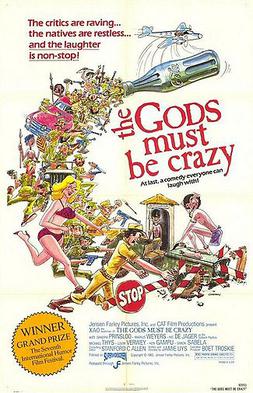
Behind the film
- Year
- 1980
- Director
- Jamie Uys
- Writers
- Jamie Uys
- Genres
- Comedy, Road movie, Adventure, Action
- Production
- C.A.T. Films, Mimosa Films
- Country
- South Africa, Botswana
- Cast
- Nǃxau, Marius Weyers, Sandra Prinsloo, Louw Verwey, Michael Thys, Nic de Jager, Ken Gampu, Jamie Uys
About the film
Contains story spoilers.
The Gods Must Be Crazy starts by giving an ordinary piece of rubbish an extraordinary journey. An empty bottle can seem worthless to the person who throws it away and fascinating to someone encountering it without the same assumptions. The comedy grows from that change of perspective. Something manufactured to be common becomes singular, desirable and disruptive. The premise asks how much of an object's meaning comes from the object itself and how much comes from the habits of the people handling it. That question carries the story even as its route expands into slapstick and a dangerous confrontation.
Jamie Uys wrote and directed the film, first released in 1980, with Nǃxau as Xi, Marius Weyers as Andrew Steyn and Sandra Prinsloo as Kate Thompson. It is a fictional comedy rather than a documentary account of San communities. That boundary matters particularly because its framing can sound explanatory while presenting a deliberately simplified contrast between ways of life. A description of the film should therefore distinguish its invented social arrangement from real people whose histories and experiences extend far beyond the premise. The comic setup is something the movie constructs, not a reliable summary of an entire culture.
Xi takes the troublesome bottle away after it causes conflict at home. His journey crosses Andrew's attempt to bring teacher Kate to a village. Xi is arrested after taking a goat and later works with Andrew and M'pudi. When armed fugitives seize Kate and her pupils, the three help rescue them. Xi eventually throws the bottle from a cliff and returns to his family, while Andrew and Kate's misunderstandings turn toward romance. The intersecting plots bring an isolated object, awkward courtship and organised violence into the same narrative without making them equivalent forms of trouble.
The bottle offers the clearest version of the film's argument about scarcity. Its usefulness does not automatically improve the relationships around it when only one person can use it at a time. Desire becomes a social problem because access must somehow be decided. That is different from claiming that useful technology always damages a community. The premise imagines a specific object becoming a source of competition where the characters had not previously needed the same arrangement. The joke can therefore be read as a question about possession: what matters is not only what a thing can do, but how its benefits are shared.
Andrew's difficulties work from a different gap between ability and appearance. A person can be knowledgeable in one setting and conspicuously inept in another. The comedy treats social confidence as something expertise does not necessarily provide. Kate must interpret the behaviour she sees, while Andrew knows that what he intended and what he appears to have intended are not the same. That difference is a familiar engine of farce. An explanation becomes harder to deliver because every unsuccessful attempt produces more behaviour requiring explanation. The result is a romance built around the problem of being understood rather than simply being noticed.
Xi's encounter with arrest introduces a sharper version of misunderstanding. A legal institution can appear perfectly coherent to the people applying it and bewildering to someone who does not share its account of property. The story stages that collision as part of the journey, but it should not be treated as proof that one society has no understanding of rules or that another has a universal monopoly on reason. What the fiction makes visible is the power held by the institution doing the interpreting. The consequences of an encounter depend on more than whether the newcomer understands what the authorities are saying.
The rescue brings the separate characters together through practical cooperation. Differences that had produced confusion can also supply distinct contributions when people are facing the same urgent problem. Reading the convergence that way avoids making Xi merely an emblem placed beside supposedly modern characters. Within the adventure, he can act and contribute to an outcome rather than existing only as the object of someone else's explanation. Even so, the surrounding framing remains open to criticism for simplifying the people and worlds it contrasts. Enjoying a comic situation does not require adopting every assumption the film uses to arrange it.
The bottle's final removal resolves the particular disturbance that launched the story, not the much larger questions raised by its social contrasts. Returning home gives Xi's journey a circular form, while the other characters' relationships take their own direction. The Gods Must Be Crazy can be understood as a farce about the confidence with which people call their own habits sensible and somebody else's habits strange. Its most useful invitation is to question that confidence. Its limits are equally worth keeping in view: a fictional comparison may provoke thought about modern life while remaining an incomplete, constructed picture of the communities used to make that comparison.