
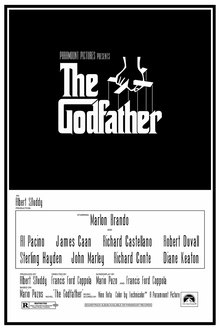
Behind the film
- Year
- 1972
- Director
- Francis Ford Coppola
- Writers
- Mario Puzo, Francis Ford Coppola
- Runtime
- 2h 55m
- Genres
- Epic, Gangster, Crime, Drama
- Production
- Paramount Pictures, Alfran Productions
- Country
- United States, Italy
- Cast
- Marlon Brando, Al Pacino, James Caan, Richard Castellano, Robert Duvall, Sterling Hayden, John Cazale, Diane Keaton
About the film
Contains story spoilers.
Francis Ford Coppola’s The Godfather opens at the wedding of Connie Corleone, daughter of Don Vito. The celebration introduces the family through its rituals and relationships: eldest son Sonny is impulsive, Fredo seems less influential, adopted son Tom Hagen serves as lawyer and adviser, and youngest son Michael arrives with his girlfriend Kay. Michael tells Kay that the family’s criminal business belongs to his father, not him. That distance matters because the film’s central movement is his gradual transformation from a returning war veteran into the person who makes decisions for the organization. Vito’s power is displayed as a network of favors, obligations and fear rather than a public office.
Vito refuses a proposal from drug trafficker Virgil Sollozzo, who wants the Corleones’ political protection for a narcotics operation. Sollozzo has backing from the rival Tattaglia family and arranges an attempt on Vito’s life. Vito survives, but his injury leaves Sonny acting as head of the family. Michael, who had expected to remain outside the conflict, visits his father in hospital and discovers that the guards have been removed, leaving Vito exposed to another attack. He moves his father to a safer room and stands outside to protect him. A corrupt police captain, McCluskey, breaks Michael’s jaw when he interferes. The encounter pushes Michael toward a role no one in the family expected him to take.
Michael proposes killing Sollozzo and McCluskey at a meeting in a restaurant. The family initially treats the plan as unlikely, but they accept it and arrange for a gun to be hidden at the meeting place. Michael carries out the killings and flees to Sicily while New York’s crime families enter open conflict. There he falls in love with Apollonia and marries her. His time away from New York offers a brief life outside the family’s immediate battles, but an attempt meant for him kills Apollonia instead. In the city, Sonny is ambushed and murdered after rushing to defend Connie from her abusive husband Carlo. Vito returns to leadership and calls a meeting to end the fighting.
At the meeting, Vito negotiates peace among the New York families, accepting a controlled narcotics trade in exchange for an end to vendettas and Michael’s safe return. He has concluded that rival Don Barzini, rather than Tattaglia, engineered the wider conflict. Michael comes home, marries Kay and takes over more of the business, promising that he will make it legitimate within five years. The promise gives Kay a picture of a future that Michael may not be able to deliver. He travels to Las Vegas to negotiate with casino owner Moe Greene, who refuses to sell his stake and boasts of his own political backing. Michael reprimands Fredo for siding with Greene against the family, deepening the fracture between the brothers.
Vito warns Michael that one of his own men will offer to arrange a meeting with Barzini and use it to have him killed. Shortly afterward, Vito dies of a heart attack while playing with his grandson Anthony. At the funeral, Sal Tessio offers Michael the predicted meeting, revealing his betrayal. Michael stages his response around his role as godfather at the baptism of Connie’s baby. While he renounces Satan at the church, his men kill the rival family leaders and Greene. Tessio is taken away, and Michael questions Carlo about his part in setting up Sonny’s murder. Carlo confesses; Michael sends him away in a car, where Clemenza kills him. The parallel between sacred ceremony and coordinated murder makes clear how fully Michael has entered Vito’s world.
Connie confronts Michael, accusing him of ordering Carlo’s death. He denies it to Kay, who wants to believe him. After she leaves the room, the family’s senior men enter and pledge allegiance to Michael as Don Corleone. Clemenza kisses his hand, and Kay watches the door close between them. This last image does not need a speech to show the change in Michael: Kay is now outside the room in which decisions are made, while the men who once advised Vito recognize his son as their leader. His claim that the business will become legitimate sits uneasily beside the pattern of killings that has secured his position.
The film’s intimate scenes make the business feel rooted in family even as that closeness becomes a source of pressure. A wedding request, a hospital visit and an argument between siblings can change the balance of power as much as a formal meeting. Gordon Willis’s controlled lighting and Coppola’s measured pacing give the family’s rooms a sense of privacy, then let danger enter without warning. The film follows a fictional crime family adapted from Mario Puzo’s novel; its Corleones and particular events are not a documentary account of a real family. The story ends at the moment Michael’s authority is most complete and his separation from Kay most visible.