
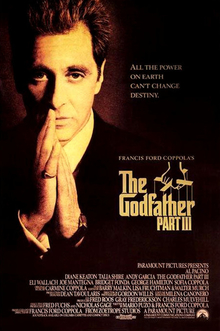
Behind the film
- Year
- 1990
- Director
- Francis Ford Coppola
- Writers
- Francis Ford Coppola, Mario Puzo
- Runtime
- 2h 42m
- Genres
- Crime, Drama, Crime thriller, Epic
- Production
- Paramount Pictures, American Zoetrope
- Country
- United States
- Cast
- Al Pacino, Diane Keaton, Andy Garcia, Talia Shire, Sofia Coppola, Eli Wallach, Joe Mantegna, George Hamilton
About the film
Contains story spoilers.
Francis Ford Coppola’s The Godfather Part III finds Michael Corleone older and visibly tired of the criminal power he built. In 1979, he has donated money to the Catholic Church and seeks a controlling interest in an international real-estate company as a route toward legitimacy. A public reception follows his papal honor, but the family conversations are not settled: Anthony tells Michael he wants to become an opera singer rather than study law, and Kay reveals that she and Anthony know Michael ordered Fredo’s death. Michael’s attempt to move forward begins with the recognition that the people closest to him remember what he has done.
Vincent Mancini, Sonny Corleone’s son, arrives at the reception with a temper and a dispute with Joey Zasa. Connie asks him to settle the conflict, and Vincent bites Zasa’s ear when Zasa insults him. Michael sees Vincent’s loyalty and usefulness but also recognizes that his violence could undo the legitimacy he hopes to gain. He brings Vincent into the family business and starts grooming him for a larger role. Meanwhile, the Vatican deal depends on approval from church officials and becomes entangled in the bank’s financial troubles. The film connects the Corleones’ business to institutions that are supposed to stand outside the criminal world, making legitimacy look like a transaction rather than a clean break.
Zasa resents Michael’s settlement with the Commission and becomes a direct threat. At a meeting in Atlantic City, armed attackers kill several crime bosses in a helicopter assault, while Michael survives. Vincent later strikes at Zasa during a street-feast parade in Little Italy: disguised as a mounted police officer, he and his allies attack Zasa’s guards, and Vincent kills Zasa amid the public celebration. Michael is furious that Vincent acted without permission, because the killing draws him back into violence just as he is trying to leave it. The larger danger is not only a rival gangster. Michael’s proposed purchase of control in Immobiliare rests on Vatican approval, and he discovers that the deal is a swindle engineered by Archbishop Gilday, politician Licio Lucchesi and banker Frederick Keinszig, with Don Altobello helping direct the conspiracy.
Michael’s health crisis forces him to step away, and Kay visits Sicily with Anthony as the family prepares for his opera debut. Michael seeks out Cardinal Lamberto, confesses the murder of Fredo and receives absolution; after the old pope dies, Lamberto is elected as Pope John Paul I and ratifies the Immobiliare agreement. The conspirators respond by poisoning him, while Michael’s network prepares its own retaliation. Vincent takes leadership under Michael’s condition that he end his relationship with Mary. During Anthony’s performance of Cavalleria rusticana, Connie poisons Altobello with a cannolo, Calò kills Lucchesi, Neri shoots Gilday in the Vatican, and Keinszig is strangled and left hanging to resemble a suicide. The parallel attacks unfold against the opera, but they do not prevent the separate assassin Mosca from reaching Michael outside the theatre. Mosca wounds Michael and kills Mary before Vincent shoots him. The sequence closes Michael’s attempt to trade criminal power for institutional legitimacy with another devastating family loss.
The film’s final scene returns to Sicily years later: an elderly Michael sits alone in a courtyard and collapses, with a dog nearby. The ending offers neither a triumphant retirement nor a public account of his death. It strips away the meetings, church ceremony and family performance until only Michael’s body remains, turning the cost of his choices into solitude rather than another negotiated confrontation. Vincent’s succession does not mean the old system has disappeared; it means responsibility has passed to someone shaped by it.
The opera intercut with the assassination attempts gives the climax its shape. Coppola links performance, family legacy and violence without requiring the audience to choose between them: Anthony’s artistry is real, but the people around him use the event to settle criminal accounts. Gordon Willis’s cinematography and the film’s Sicilian locations give the story a formal, ritual quality, while Michael’s illness interrupts his authority at moments when he most wants to control events. The images of ceremony contrast with the practical business of protection, escape and retaliation that continues beneath them. The final image recalls the earlier opera celebration but removes its audience and ceremony. Michael no longer has a meeting to chair or a bargain to make; he is simply an old man in the place where he once tried to direct his future. The quiet ending gives the title's idea of family legacy a bleak, personal consequence.
The 1990 theatrical film closes the Corleone story through a final conflict between Michael’s attempt at legitimacy and a family structure that keeps generating new violence. The distinction from the later re-edit matters here: this version ends with Michael’s physical death, following the loss of Mary and the long collapse of his hopes for the family. Michael’s relationship with Kay and his children provides an emotional measure of what he has lost, while the Vatican plot shows how public institutions can be compromised in the film’s fictional world. This article describes the original theatrical release, whose conclusion leaves Michael alone rather than granting him absolution or a restored family.