
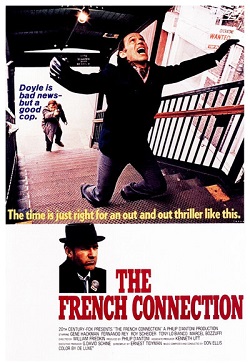
Behind the film
- Year
- 1971
- Director
- William Friedkin
- Writers
- Ernest Tidyman
- Runtime
- 1h 43m
- Genres
- Crime, Action, Crime thriller, Drama
- Production
- 20th Century Studios
- Country
- United States
- Cast
- Gene Hackman, Fernando Rey, Roy Scheider, Tony Lo Bianco, Marcel Bozzuffi, Frédéric de Pasquale, Bill Hickman, Arlene Farber
About the film
Contains story spoilers.
The French Connection puts police work into a city that does not stop for it. Streets, bars, railway platforms and traffic remain busy with people pursuing other purposes, leaving the detectives to pick out a possible pattern from ordinary movement. Jimmy 'Popeye' Doyle notices things and pursues them with an intensity that can look like professional instinct or personal compulsion. Gene Hackman's character is abrasive, impatient and willing to use pressure long before he has a complete account of what is happening. William Friedkin's film keeps that uncertainty close to the action. The audience can know that a smuggling operation exists without every observation Doyle makes becoming reliable, or every action he takes becoming justified by the goal of finding it.
Doyle and his partner Buddy Russo follow Sal Boca and discover connections leading to French trafficker Alain Charnier. Charnier arranges heroin hidden in a visiting television personality's car. Surveillance brings a contest between him and Doyle, including a subway escape. Charnier's associate Nicoli later attempts to kill Doyle, who pursues him beneath an elevated train and shoots him. Police eventually find the drugs inside the car, reassemble it and let the delivery proceed. The raid catches several participants, but Charnier escapes. Pursuing him through a dark building, Doyle accidentally kills a federal colleague and continues searching. The final information confirms that Charnier was not caught and that Doyle and Russo were reassigned.
Doyle and Charnier make contrasting figures in that pursuit. Fernando Rey's trafficker can appear composed and socially at ease in situations where Doyle is uncomfortable, exposed or impatient. The difference is practical as well as visual: a successful smuggler benefits from being able to travel without attracting the wrong attention, whereas surveillance requires the detective to remain close enough to notice what happens. Their encounter in the subway turns that requirement into a contest over timing. Following someone is not a single continuous advantage. It can become a position the person being followed controls, especially when crowds, doors and departures let him decide which movements the watcher must copy.
Russo supplies a different kind of presence beside Doyle. Roy Scheider's partner participates in the same work without making every moment an expression of personal antagonism. The pairing keeps the investigation from depending only on the loudest individual in it. Surveillance, information and procedural cooperation still matter, even when the story foregrounds Doyle's forceful personality. His conflict with federal colleagues adds another pressure: people working towards a related objective can disagree over methods, credibility and how much room one officer should have to act. The case does not unfold inside a single uncomplicated team. It involves overlapping agencies and judgements, leaving Doyle's confidence in himself to collide with other people's responsibility for the risks he takes.
The elevated-train pursuit concentrates those risks into movement. The action occurs along two routes at once: Nicoli is above the street, while Doyle tries to keep pace below. That separation makes the detective's determination visible without giving him clear control over the situation. Traffic, corners and obstacles interrupt the fantasy of a straight line between wanting to catch somebody and catching him. The sequence is also embedded in a film that spends considerable time waiting, watching and following. Its speed has a different effect because the investigation has already established how often activity means remaining in place. When the chase begins, the same city that supplied concealment becomes a dense field of things that can go wrong.
The search of the car provides the opposite kind of suspense. Instead of chasing a moving target, the police have the object in front of them and still cannot immediately find what they believe it contains. Detail becomes the obstacle. The scene makes patience, measurement and the willingness to continue looking as important as a dramatic pursuit. It also shows how a successful discovery can remain incomplete as a victory: finding the shipment does not automatically identify every participant or make the eventual arrest clean. The investigation must continue from the physical evidence into human decisions, where information can be lost and mistakes can have irreversible consequences. Doyle's hunger for a final confrontation grows inside that gap between uncovering a crime and resolving it.
The 1971 film was directed by Friedkin and adapted by Ernest Tidyman from Robin Moore's account of a real investigation. Its characters and events are dramatised, so its street-level texture should not be confused with an unaltered record of police conduct. The ending makes that distinction especially relevant. A film can generate extraordinary momentum around a determined investigator and still leave his objective unfulfilled. The accidental shooting prevents the last pursuit from becoming a simple affirmation of his methods, while the final case outcomes deny a comprehensive triumph. The world goes on after the action stops. Doyle's intensity has carried the story forward, but it has not given him ownership of every consequence or the satisfaction of a fully closed case.