
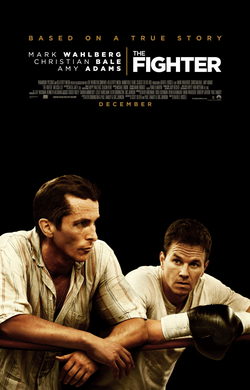
Behind the film
- Year
- 2010
- Director
- David O. Russell
- Writers
- Scott Silver, Paul Tamasy, Eric Johnson
- Genres
- Biographical, Drama, Boxing
- Production
- Relativity Media, Mandeville Films, Closest to the Hole Productions
- Country
- United States
- Cast
- Mark Wahlberg, Christian Bale, Amy Adams, Melissa Leo, Jack McGee, Mickey O'Keefe
About the film
Contains story spoilers.
In Lowell, boxer Micky Ward is managed by his mother Alice and trained by older half-brother Dicky, a former boxer now addicted to crack. A documentary crew follows Dicky, who believes it is recording his comeback. After Micky loses a mismatched Atlantic City bout, he grows close to bartender Charlene and considers training elsewhere. Dicky's failed robbery leads to a police chase in which Micky's hand is broken; Dicky goes to prison, and Micky rebuilds under trainer Mickey O'Keefe. He wins a major fight with Dicky's advice, then earns a title shot. When Dicky returns sober, Micky first refuses to restore him to the team. After conflict, Dicky cuts ties with his drug circle and seeks Charlene's help; the group reconciles and travels to London. Dicky joins Micky's corner for the championship fight, which Micky wins. The brothers celebrate, their partnership reshaped rather than erased by its costs.
The film’s Lowell is not a neutral backdrop for a sports story. Family, work, neighbourhood reputation and boxing are tightly woven together, so a professional decision can feel like a declaration of loyalty. Micky’s career is surrounded by people who have known him since childhood and who regard access to his future as a family right. The crowded domestic scenes make that pressure tangible: conversations overlap, old grievances surface quickly, and the sisters’ collective presence gives the household a social force larger than any one argument. The boxing ring offers a more legible space, but the emotional negotiation outside it determines who is allowed to guide him there.
Micky is defined by a quiet persistence that can be mistaken for passivity. He is willing to wait for a bout, listen to advice and absorb his brother’s authority because Dicky has been both a model and a source of practical knowledge. Yet the film tracks the point at which patience becomes costly. A damaged hand makes that cost literal, interrupting his ability to work and fight, while Charlene’s perspective helps him recognise that devotion does not require surrendering every decision. His independence is not framed as a clean break from his family; it is an effort to be treated as a boxer with a career rather than a supporting character in Dicky’s remembered glory.
Dicky’s charm and volatility are held together rather than separated into a before-and-after portrait. He can teach Micky how to read an opponent and still fail to arrive when his brother needs him. His pride in a past fight is more than vanity: it is the image of himself he wants to preserve while addiction has narrowed his present. The documentary crew’s presence makes that gap public. He imagines he is being recorded as a comeback story, while the footage exposes the consequences he would rather edit away. The film lets that humiliation become a turning point without pretending that one realisation automatically repairs the years of damage.
Alice’s management of Micky grows from a form of protection that has become controlling. She sees the family as a unit and treats his career as a resource she should direct, while Dicky’s past status gives him a parallel claim over training. Their competing authority is not simply a contest between a bad mother and a good brother; the film shows how each relationship contains genuine care alongside self-interest. George, the father, often supplies a quieter counterweight, while Charlene challenges the assumptions that Micky owes his whole future to people who love him. The tensions are specific to this family and do not disappear when Micky achieves a title opportunity.
The boxing scenes focus attention on technique as well as spectacle. A fight is not only a test of toughness; footwork, timing and the ability to respond under pressure can alter the shape of a bout. Dicky’s advice has real value, even when his conduct outside the ring has been destructive, which keeps the brothers’ relationship from collapsing into a simple moral judgment. Micky’s physical restraint and willingness to adjust contrast with the larger personalities around him. The title fight therefore carries a double question: whether he can beat an opponent and whether he can accept help without returning to the old arrangement where others speak for him.
The film is based on real people, but its dramatic design condenses experience into an arc about family, recovery and a boxer’s chance to define his own career. Its focus is not a complete record of every bout or disagreement; it is the particular emotional arrangement of two brothers whose abilities and failures are inseparable in the family’s eyes. The ending gives Dicky a place in Micky’s corner, but it does not erase prison, addiction or earlier harm. Instead, the corner becomes a chosen role with boundaries, and the victory belongs to Micky as a fighter who can value his brother without handing him control of the whole future.
The central performances give those competing claims different rhythms. Mark Wahlberg keeps Micky’s presence comparatively contained, allowing another person’s interruption to become conspicuous before he responds. Christian Bale brings a restless outward energy to Dicky, while Amy Adams and Melissa Leo make the struggle for influence feel like an argument whose participants know exactly where to apply pressure. The contrast means a scene can be crowded without its loyalties becoming indistinguishable. Each person has a different way of occupying attention, and Micky’s challenge includes making room for his own voice within that noise. The film’s family drama remains active because listening, yielding and resisting all have visible consequences before a fight begins.