
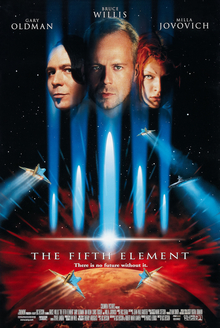
Behind the film
- Year
- 1997
- Director
- Luc Besson
- Writers
- Robert Mark Kamen, Luc Besson
- Runtime
- 2h 1m
- Genres
- Science fiction, Adventure, Comedy, Action
- Production
- Gaumont, Columbia Pictures
- Country
- France
- Cast
- Bruce Willis, Gary Oldman, Milla Jovovich, Chris Tucker, Ian Holm, Tricky, Lee Evans, Luke Perry
About the film
Contains story spoilers.
The Fifth Element opens with a prologue that reaches back to an ancient encounter and then leaps forward to the twenty-third century. The film's central premise is that a great evil returns on a recurring cycle, and that Earth has a means of defence involving four stones and a fifth element. In the future, the stones have to be found and brought together with Leeloo, a mysterious being who arrives on Earth in an unexpected way. The story gives this cosmic problem a very local point of entry through Korben Dallas, a cab driver played by Bruce Willis. He is not introduced as a priest or scientist; he is an ex-soldier trying to get through a workday in a noisy, crowded city.
Leeloo, played by Milla Jovovich, has extraordinary physical ability but begins with little knowledge of the society around her. Her presence makes the old defence relevant to present-day institutions: government officials, religious guardians, military personnel and corporate interests all have pieces of the puzzle, but none controls the whole situation. Father Vito Cornelius, played by Ian Holm, knows the tradition concerning the Great Evil and the elemental stones. Korben becomes involved because the mission and Leeloo's safety cross his path, not because he understands every layer of prophecy. Their partnership keeps the plot accessible: he can navigate the modern city while she carries knowledge and capabilities he cannot supply.
The film's world is built from collision and excess. The futuristic setting is shaped by the comic-book artists Moebius and Jean-Claude Mézières, while costume designer Jean-Paul Gaultier gives its population a distinctive visual range. The city is layered with traffic, screens, service corridors and people moving through different social worlds. Technology is everywhere, but it does not create calm or order; it adds new kinds of congestion and spectacle. Korben's cab is a useful moving viewpoint through this environment, linking street-level work to the grander conspiracy. The setting gives the story space for comedy and action while making the future feel crowded rather than sterile.
The search for the stones becomes a chain of changing locations and alliances. Korben and Leeloo face forces that want to control the defence or use the crisis for their own ends, including the arms dealer Zorg, played by Gary Oldman. Meanwhile, Ruby Rhod, played by Chris Tucker, brings celebrity performance and broadcast culture directly into the group's escape. These characters occupy very different registers: Korben is dry and practical, Leeloo is intensely physical and still learning how this world works, and Ruby turns nearly every situation into a public performance. Their interactions supply the film's comic energy, but they also make it clear that the crisis unfolds amid a media-saturated society where even danger can become spectacle.
Action scenes take advantage of the film's unusually designed spaces. The airborne taxi moves through vertical city traffic, while the journey to the interstellar cruise ship shifts the group into an environment built around leisure and performance. The production combines practical effects, large sets and computer-generated imagery, making the chase move through spaces that have a recognizable physical weight. The mix gives the film a handmade sense of scale: crowds and architecture establish tangible places, while effects open those spaces into futuristic movement and cosmic threat. The climactic alien opera sequence is a key example of the film letting spectacle interrupt the chase. Music, costume and movement become part of the story's emotional release, but the mission remains active around the performance.
The last stage joins the four stones and Leeloo's role in the defence, bringing the story back to the film's opening ideas of elemental balance and recurring catastrophe. Korben's contribution is not based on mastering the prophecy; it comes through a personal bond that gives the mission a reason beyond simply defeating an enemy. The ending ties a huge science-fiction threat to an intimate decision, while the ornate design and comic performances keep the tone buoyant. Luc Besson's film is a space opera whose world is built as much from clothes, sets, vehicles and music as from exposition. Its central rules are simple enough to follow, leaving room for the viewer to enjoy a future that feels playful, noisy and visually distinctive.
The four stones also give the film's scattered adventures a clear objective. Characters can disagree about what the cosmic danger means, but the group still needs to locate the objects and bring them to the right place before the threat arrives. This keeps the elaborate world from becoming a series of unrelated design showcases. Korben's practical skills, Leeloo's strength, Cornelius's knowledge and the others' abilities each matter differently as the mission progresses. The film can pause for an opera performance or a comic interruption without losing the underlying task. That balance between an easy-to-follow goal and a wildly detailed environment is a defining part of its accessible, exuberant space-opera form.