
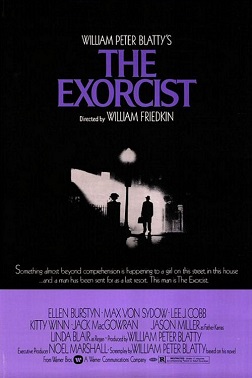
Behind the film
- Year
- 1973
- Director
- William Friedkin
- Writers
- William Peter Blatty
- Runtime
- 2h 2m (original theatrical version)
- Genres
- Horror, Satanic, Mystery, Drama
- Production
- Warner Bros. Entertainment, Warner Bros. Pictures
- Country
- United States
- Cast
- Ellen Burstyn, Linda Blair, Jason Miller, Max von Sydow, Lee J. Cobb, Kitty Winn, Jack MacGowran, William O'Malley
About the film
Contains story spoilers.
William Friedkin’s The Exorcist opens in Iraq, where Father Merrin discovers an ancient amulet and encounters a statue of Pazuzu during an archaeological dig. The film then shifts to Georgetown, where actor Chris MacNeil lives with her daughter Regan while working on a production. Regan begins speaking of an imaginary companion she calls Captain Howdy. Strange noises and movement in the house unsettle Chris, but the first medical explanations focus on stress and neurological illness. The story lets uncertainty grow through repeated examinations: Regan’s behaviour becomes harder to explain, yet her mother keeps asking doctors for a cause that can be treated. The contrast between Merrin’s experience in Iraq and Chris’s domestic life gives the opening a distant foreboding, but the movie does not immediately connect the two storylines for its characters.
Regan’s condition worsens as clinicians run tests that are painful and frightening without producing an answer. Chris watches her daughter become physically aggressive and speak in a voice that seems unlike her own. At the same time, Father Damien Karras, a Jesuit priest and psychiatrist, is questioning his vocation and grieving his mother’s declining health. The film’s parallel stories of doubt bring Chris and Karras together only after she has exhausted ordinary medical routes. A party at the MacNeil house ends in a disturbing episode, and director Burke Dennings is later found dead below Regan’s bedroom window. Detective William Kinderman investigates the death and questions Karras because of his knowledge of possession. Chris is caught between fear that Regan may have caused the death and the stronger fear that something is happening to her child that she cannot reach or understand.
Karras visits Regan and hears her speak with knowledge that unsettles his scepticism, but he initially lacks grounds to ask the Church to perform an exorcism. He tests her with holy water that is only tap water, and Regan reacts as if it burns her; Karras then tells Chris the water was not blessed. Chris finally admits that she suspects Regan pushed Dennings from the window. A tape recording of Regan’s voice, played backwards, contains another voice calling for her death, and marks on the girl’s body spell “Help Me.” These clues move Karras from hesitation toward asking for formal intervention. The film presents his change as a struggle between psychiatric training and religious belief rather than a sudden rejection of medicine. He needs enough proof to act, while Chris’s desperation has already outpaced the explanations available to her.
The Church assigns Merrin to lead the exorcism, with Karras assisting him. Merrin recognizes the danger but tells Karras not to converse with the demon because it will lie and seek leverage. In the bedroom, Regan’s body and voice become the centre of an exhausting ritual as the priests recite prayers and try to force the spirit out. The demon uses Karras’s guilt about his mother to destabilize him and taunts Merrin with the possibility that God cannot love humanity. Merrin, already physically strained, takes medicine to steady himself and continues. Karras is sent away after he begins to falter, but when Chris asks whether Regan will die, he returns to the room and finds Merrin dead. The ritual has not offered an easy solution; it has brought the danger close to the people trying to confront it.
Karras urges the demon to enter him instead of Regan. It does, and Regan collapses as Karras struggles with the possessed force inside his own body. He throws himself through the window and down the steep steps, driving the demon out at the cost of his life. Father Dyer reaches him and hears his confession before he dies. Regan recovers and later appears to remember little of what happened. Chris and her daughter prepare to leave Georgetown; Regan kisses Dyer after noticing his priest’s collar, a small gesture that connects her recovery to Karras’s sacrifice without providing a detailed explanation of what she remembers. Dyer pauses at the steps where Karras died before walking away; the theatrical ending gives the family a departure and leaves him with the memory of his friend. The conclusion brings the film back toward ordinary life, but its quietness is shadowed by the losses required to reach it.
Friedkin’s direction emphasizes physical and sensory detail rather than constant supernatural spectacle. The bedroom is cooled until the characters’ breath shows in the air, making the room’s climate part of the ordeal. The film’s sound design uses mechanical, animal and human noises in unnerving combinations, while long pauses let the audience watch Chris search for an explanation. Karras’s scenes with his mother supply an emotional parallel to Chris’s fear: both characters confront helplessness, though one is a parent trying to protect a child and the other is a priest struggling with grief and belief. Merrin’s measured presence contrasts with Karras’s uncertainty. The exorcism becomes powerful partly because the film has spent so much time in hospitals, bedrooms and streets where nothing overtly supernatural is supposed to happen.
The film adapts William Peter Blatty’s novel, but its ending and emphasis belong to Friedkin’s screen version. It should not be confused with the novel’s precise sequence or treated as a neutral account of an actual case. Editions also differ: the original 1973 theatrical release runs about 121–122 minutes, while the 2000 extended director’s cut runs about 132 minutes and adds scenes, including the digitally restored spider walk. This article follows the theatrical story for its main sequence and does not rely on the later-added scene as if it were part of every version. That distinction matters for viewers comparing descriptions, because certain visual beats and the final details vary across releases. The film’s core conflict remains consistent: Chris’s search for help leads Karras and Merrin into a confrontation that costs both priests their lives and leaves the surviving family with an answer only partly expressed.