
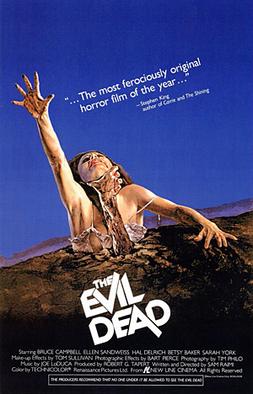
Behind the film
- Year
- 1981
- Director
- Sam Raimi
- Writers
- Sam Raimi
- Runtime
- 1h 25m
- Genres
- Supernatural horror, Zombie, Drama, Fantasy
- Production
- Renaissance Pictures
- Country
- United States
- Cast
- Bruce Campbell, Betsy Baker, Richard DeManincor, Theresa Tilly, Ellen Sandweiss
About the film
Contains story spoilers.
Ash, his sister Cheryl, their friends Scott and Shelly, and Ash’s girlfriend Linda stay at a remote cabin. They discover an old book and a tape of incantations; playing it awakens a demon that begins possessing the group. Cheryl is assaulted by demon-controlled woods, and the friends cannot leave because the route out has been destroyed. As the others become hostile and monstrous, Ash tries to follow the recording’s instructions and survive. The cabin becomes a series of brief refuges that fail one after another. He burns the book, causing the possessed bodies to collapse, but the threat has not ended. At dawn, Ash steps outside, and the demonic force rushes through the woods toward him. The film closes on terror, not a safe rescue or a reassuring victory.
The first Evil Dead is built around confinement rather than the confidence of a conventional action hero. The cabin is isolated, the exits are unreliable, and the woods appear to participate in the threat. That geography narrows the characters’ choices until every room feels temporary. The film’s camera keeps this pressure active, moving through spaces with a restless urgency that suggests the environment itself is watching. Raimi’s technique is not simply a way to make a small production look larger; it gives the location a hostile point of view and turns the landscape into part of the horror.
Bruce Campbell’s Ash is not yet the wisecracking, weapon-wielding figure associated with later franchise entries. Here he is a young man caught in an increasingly desperate situation, reacting before he can understand what the rules are. His ordinary presence gives the escalation a foothold. He does not enter the cabin as a prepared monster hunter, and the movie does not make competence arrive as an instant transformation. Survival is improvised, exhausting and uncertain, which helps maintain the film’s sense that each apparent solution may only buy a little time.
The group’s relationships begin in everyday familiarity, but the supernatural crisis strains those connections rapidly. Friends and partners have to decide whether to trust what they see and how much danger they can tolerate from someone they love. That pressure gives the cabin scenes an emotional dimension beyond the effects. The characters are not a team of specialists; they are people who expected a trip together and find that their assumptions about one another are no longer reliable. Fear changes the meaning of a voice, a gesture or a closed door.
Raimi’s camera is conspicuously physical. Fast tracking movements, abrupt angles and sudden changes in distance make the woods and cabin feel difficult to control. The motion often behaves like an unseen pursuer, giving the demon an energy even when it is not fully visible. That visual idea lets the film suggest a presence moving through space without giving it a stable body. The viewer experiences pursuit through movement itself, which is particularly effective in a story where the characters cannot identify a safe direction for long.
The practical effects and makeup contribute to a handmade intensity. Changes in faces and bodies have a tactile quality that keeps the horror close to the performers rather than smoothing it into an abstract digital image. The effects can look rough around the edges, but that roughness suits a story about physical vulnerability. Bodies are not protected by genre polish; they can be injured, distorted and made unfamiliar. The film’s visual strategy makes the supernatural feel material enough to be frightening while preserving an unstable, almost nightmarish quality.
The assault on Cheryl by demon-controlled woods gives the film’s loss of bodily autonomy a particularly disturbing form. Sexual violence sits within the horror, and the exaggerated effects elsewhere do not turn that assault into a playful incident. Cheryl’s ordeal makes the environment actively invasive: the trees no longer mark the edge of a building or provide a landscape to pass through, but become instruments of violation. Her vulnerability also exposes the limits of the group’s ability to understand what is happening to one of their own. Familiarity offers little protection when the forces around them can seize bodies and change their behaviour. The scene makes the woods unsafe in a way that goes beyond the risk of becoming lost.
The recording gives the danger an unsettling relationship to knowledge. A voice can preserve information about something ancient while also carrying the means of awakening it. Listening therefore becomes consequential before the friends understand what they have heard, and the book is both an object of curiosity and a physical focus for Ash’s desperate response. His decision to burn it supplies an apparent solution, but the ending refuses to guarantee that this act has restored a boundary around the cabin. Morning light changes the appearance of the landscape without establishing control over it. The final rush toward Ash brings the unseen pursuer back into the open after a night in which doors, walls and familiar faces have repeatedly failed to keep him safe. Survival remains a momentary condition rather than a settled achievement. That refusal of reassurance gives the film its bleak final shape, leaving the human figure exposed to a world whose ordinary surfaces have become hostile.