
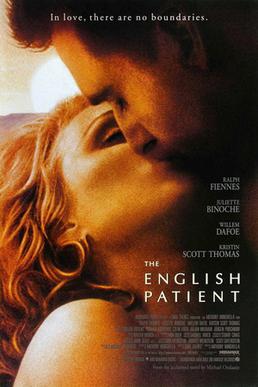
Behind the film
- Year
- 1996
- Director
- Anthony Minghella
- Writers
- Anthony Minghella
- Genres
- Romance, War, Drama, Flashback
- Production
- Miramax, The Saul Zaentz Company
- Country
- United Kingdom, United States
- Cast
- Ralph Fiennes, Juliette Binoche, Willem Dafoe, Kristin Scott Thomas, Naveen Andrews, Colin Firth, Julian Wadham, Jürgen Prochnow
About the film
Contains story spoilers.
Anthony Minghella’s The English Patient opens with a plane crossing a vast desert before it is shot down. In Italy in 1944, Hana, a Canadian army nurse, tends the badly burned survivor, who cannot remember his name and carries Herodotus’s Histories filled with notes and keepsakes. When her hospital unit moves, Hana chooses to remain with him in a bomb-damaged monastery rather than risk transporting a patient unlikely to survive. The place is not a sanctuary from war: unexploded mines still surround it, and Lieutenant Kip Singh is assigned to clear the roads and buildings.
David Caravaggio, a Canadian intelligence operative tortured in German captivity, joins them and asks the patient about his past. The man’s memories return to the late 1930s, when Hungarian cartographer Count László Almásy worked with a Royal Geographical Society expedition mapping the Sahara. Peter Madox is his friend; British couple Geoffrey and Katharine Clifton arrive to make aerial surveys. The group discovers the Cave of Swimmers, where ancient paintings record a landscape that once held water. Katharine and Almásy begin an affair during the expedition, then continue it in Cairo even though she is married.
The film’s present and past are braided through the patient’s book and the objects inside it. Katharine discovers Almásy’s private notes, and the couple’s relationship grows amid fieldwork, desert travel and the group’s social world. Geoffrey eventually realizes she is unfaithful. As war begins, the expedition breaks apart: Madox leaves his plane behind and returns to Britain, while the affair ends without dissolving the feelings that bind them. Later, while Almásy is packing camp, Geoffrey flies into the desert and crashes while attempting to kill himself and Katharine. Geoffrey dies; Katharine is badly injured.
Almásy carries Katharine to the Cave of Swimmers and leaves her with food and his book while he walks for help. He is detained as a suspected spy, escapes during transport and reaches a German unit, trading maps for fuel. By the time he flies back to the cave, Katharine is dead. He is shot down while carrying her body away, and Bedouin rescue him. In the monastery, Caravaggio tells him that Madox shot himself after returning to England. He presses Almásy about the map trade and the Cliftons; the revelation and Almásy’s account do not offer a clean exoneration.
The present-day characters have their own incomplete lives. Hana has lost people she loved and believes she brings danger to those around her, but she forms a relationship with Kip while he clears mines. When Kip works on an unexploded bomb, Hana stays close despite the risk, exposing how little distance she can keep from the people she fears losing. In a quieter scene, he lifts her by rope toward the monastery’s high frescoes, turning the ruined church into a place of fragile beauty as well as danger. Caravaggio seeks revenge on the men who tortured him and searches for the person who supplied maps that let German forces penetrate Cairo. Their routines of care, meals and careful movement through unsafe rooms give the flashbacks a grounded counterpoint.
When the war ends, Kip is reposted and leaves the monastery after he and Hana promise to meet again. Almásy tells Hana he has had enough and pushes several vials of morphine toward her. She is distraught but understands his request and gives him a lethal dose. As he dies, she reads Katharine’s final letter, written while Katharine was alone in the cave. The letter connects the present bedside to the image that opened the film: the plane carrying Almásy and Katharine’s body is shot down over the desert.
The next morning Hana leaves with Caravaggio for Florence, carrying Almásy’s book. His death does not erase Caravaggio’s injuries or make the wartime map trade harmless; Caravaggio has abandoned his search for revenge after hearing the story, but still has to live beyond it. Hana’s departure matters because the monastery had become a place where she refused to move on, convinced that loved ones would die around her. The road out, with ordinary civilians and a child along for the ride, returns her to a world where care can continue without pretending the losses are repaired.
Minghella’s editing lets objects and images bridge the two periods without making the timeline a puzzle for its own sake. The annotated Herodotus book travels between the cave, the monastery and the bedside; its pages preserve Katharine’s words beside Almásy’s maps and keepsakes. The desert flight that opens the film acquires its full context only after the story has returned to it, and the final letter turns the patient’s fragmented recollections into something Hana can hear directly. Present and past remain distinct, but the shared objects show how memory shapes the care happening in the monastery. The cave paintings and church frescoes make the film’s interest in preserving images part of its visual world, not only its remembered romance.