
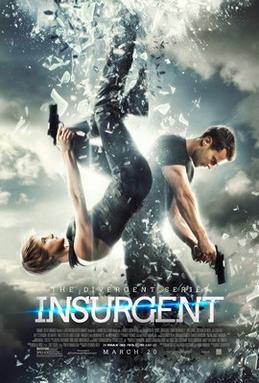
Behind the film
- Year
- 2015
- Director
- Robert Schwentke
- Writers
- Veronica Roth, Akiva Goldsman, Mark Bomback
- Runtime
- 119 minutes
- Genres
- Action, Science fiction, Adventure, Post-apocalyptic
- Production
- Summit Entertainment
- Country
- United States
- Cast
- Shailene Woodley, Kate Winslet, Jai Courtney, Mekhi Phifer, Theo James, Ansel Elgort, Miles Teller, Justice Leak
About the film
Contains story spoilers.
Jeanine declares martial law after the attack on Abnegation. Only Divergents can unlock her box. Tris, Four, Caleb and Peter shelter with Amity before fleeing; Four meets his estranged mother Evelyn among the Factionless. At Candor, truth serum exposes Tris's killing of Will. Jeanine forces her surrender by making captives attempt suicide. Caleb assists the trials, but Peter fakes Tris's death and helps her escape with Four. Tris returns to finish the simulations and opens the box. Its message reveals Chicago as an experiment whose goal was Divergence; people outside await them. Jeanine orders their execution and the box's burial. The Factionless storm in, arrest her and broadcast the message. Tris anticipates leaving the walls. Evelyn kills Jeanine in her cell.
Each faction occupies a different environment. Amity opens the film in warm earth colours, surrounding Tris's nightmare with a sunlit rural setting. Its farm took six weeks to build, with flowers and vegetables planted and existing paving covered in soil. A timber-and-glass dome let the camera move around the space. The Factionless settlement used a four-storey warehouse and its car park, with separate apartment compartments and Evelyn's wooden house inside. Their bright clothing and tattoos expressed personalities outside the faction dress codes. For Candor, Atlanta's merchandise-market roof and a glass-walled interior stood in for the Chicago headquarters described in Veronica Roth's novel.
Jeanine's laboratory required a different kind of construction. The Erudite headquarters filled a soundstage in Atlanta, and its curved walls, ceiling and irregular corners complicated the build. Tris's suspension combined physical cables with effects added afterwards; her movements followed the events inside her mental simulation. Production designer Alec Hammond wanted those experiences visible around her in the laboratory. Thousands of glass tubes changed colour and brightness, with rear projectors marking shifts in perspective and Tris's emotions. Holograms were added in postproduction. The room therefore gave the performers a physical setting whose light could change along with the test.
Producer Todd Lieberman described the sequel as an opportunity to expand a world whose introductions were already complete. The first film had needed to explain the people and faction system to newcomers while meeting readers' expectations of familiar characters. Insurgent could devote more space to action and to the simulations' unstable realities. Lieberman said the team wanted emotional reasons for action in both the real and simulated worlds. Alongside Douglas Wick and Lucy Fisher, he helped hire director Robert Schwentke and writers Brian Duffield, Akiva Goldsman and Mark Bomback, continuing to develop the story together. The producers also cast the new roles, watched the production and reviewed early cuts with Schwentke. Time remained a constraint: shooting began after Memorial Day weekend, with release the following March. Lieberman described keeping the creative direction aligned across that compressed schedule as part of the producers' continuing work.
Returning as Four brought Theo James familiarity with his colleagues, but he said the first scene with Shailene Woodley reminded them that the characters did not simply return without effort. A relaxed set could bring complacency, so the actors had to stay attentive. James wanted a more adult sequel and resisted underestimating young audiences. For an adaptation, he described preparing the character and choosing his performance without letting other people's expectations dictate it. Woodley said the flying tackle on Kate Winslet used both actors' stunt doubles, with their faces replaced because insurance prevented the stars performing it.
Cinematographer Florian Ballhaus separated everyday reality from the simulations through lens choices. Anamorphic photography gave the physical world depth, while spherical lenses subtly marked the simulated spaces. Those scenes also demanded heavy visual-effects work. A spherical image extracted to a 2.40 frame left more room to adjust composition afterwards, making the distinction useful during postproduction as well as on screen. Ballhaus shot with ALEXA XT cameras and used Master Anamorphic lenses, choosing the look after testing. He valued their depth and background falloff while avoiding extreme softness at the edges. Schwentke's interest in symmetry, resolution and detailed wide shots helped guide that choice. Ballhaus described this as his fifth collaboration with the director, with room to experiment beyond straightforward action photography. The decision to convert Insurgent to 3D came partway through production. Its depth was therefore developed from the photographed images through conversion.
Visual-effects supervisor Madigan worked with The Third Floor on concepts before the screenplay details were settled, with less than twelve weeks available for preparation. Their previs explored cities and people disintegrating, developing large-scale dynamics to accompany Tris's emotional journey. Photography and conceptual art also helped the filmmakers imagine the simulations. These designs gave the effects teams material to develop before principal photography began. At Animal Logic, Duncan Elms worked with the team creating interface and hologram elements for more than 150 shots. He described a project lasting about five months, adding another sustained design task to the film's simulated environments.