
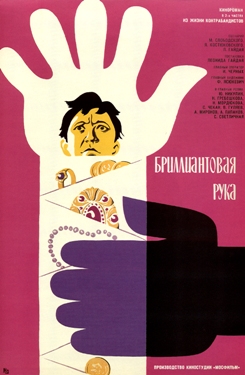
Behind the film
- Year
- 1969
- Director
- Leonid Gaidai
- Writers
- Leonid Gaidai, Yakov Kostyukovsky, Moris Slobodskoy
- Runtime
- 1h 40m
- Genres
- Slapstick, Crime comedy, Parody, Adventure
- Production
- Mosfilm
- Country
- Soviet Union
- Cast
- Yuri Nikulin, Anatoli Papanov, Andrei Mironov, Nina Grebeshkova, Nonna Mordyukova, Leonid Kanevsky, Svetlana Svetlichnaya, Nikolai Romanov
About the film
Contains story spoilers.
On a foreign cruise stop, Semyon Gorbunkov slips and accidentally gives the signal expected from jewellery courier Gesha. Smugglers seal their contraband inside a cast on his arm. Back home, he informs the police and agrees to serve as bait. Gesha and fellow criminal Lyolik repeatedly try to recover the jewels through outings, deception and a drugged encounter arranged by Anna. Gorbunkov's unexplained conduct makes his wife suspect an affair. A supposed taxi journey turns into another attempt to remove the cast, and the gang eventually captures him. The jewels, however, have already been taken out by police. A helicopter pursuit leads to the criminals' capture and a family reconciliation, leaving Gorbunkov with a genuinely injured leg for his next holiday.
The central joke makes criminal sophistication depend on an absurdly fragile assumption. The gang believes it has created a reliable way to recognise its courier, yet the sign can occur in ordinary life for a completely different reason. That gives the plot a useful comic engine: people behave confidently on the basis of information they have misunderstood. Leonid Gaidai's film follows the consequences into a world where appearance and intention keep moving apart. A cast should communicate injury, a friendly invitation should offer company and a taxi should provide transport. Once those familiar signs become unreliable, the ordinary citizen has to learn how much interpretation everyday life requires.
Yuri Nikulin's Gorbunkov is an appealing centre because he does not enter the adventure seeking a criminal identity. His participation develops from an accident and a willingness to cooperate, allowing the film to contrast an unassuming person with an increasingly theatrical set of schemes. Innocence is useful for the comedy, but it does not make him immune to embarrassment or fear. Other people can assign motives to his conduct without understanding what he is doing. The story therefore makes an ordinary reputation strangely vulnerable: behaving responsibly in one context may look irresponsible in another when the explanation has to remain concealed. He has to occupy both versions of himself at once.
Gesha and Lyolik give incompetence different comic personalities. Andrei Mironov and Anatoli Papanov's characters need to keep their operation discreet while repeatedly producing the opposite effect. Their problem is more than a lack of clever ideas; it is the inability to make those ideas survive contact with another person's behaviour. A plan assumes that its target will respond predictably, and every unexpected response demands improvisation. The audience can enjoy that instability while understanding what the criminals want. Clear objectives let the complications become elaborate without making the story confusing. The more carefully they try to manage appearances, the more conspicuous their activity threatens to become.
The arm cast turns an everyday object into a dispute over knowledge and access. To different observers it means recovery, hidden wealth, evidence or a task which needs to be completed. That makes the title's object useful far beyond its initial novelty. A thing can sit in plain sight while its significance remains private, and the effort to control that significance directs people's conduct around it. The body carrying it cannot be separated from the scheme, leaving Gorbunkov caught between other people's demands. The physical joke has a social counterpart: he is being treated as a container for something important, while still having a household and an ordinary life which require their own explanations.
Suspicion at home adds another kind of investigation to the criminal one. Nina Grebeshkova's wife character sees fragments of conduct which do not fit her understanding of her husband, and those fragments invite a plausible but incomplete story. The comedy works because an explanation can be reasonable from one viewpoint and wrong from another. Secrecy protects a police operation while placing strain on a marriage, showing that cooperation does not have the same meaning in every relationship. Gorbunkov cannot satisfy everyone simply by doing the assigned job correctly. He also has to live with the gap between his private intention and the public evidence of what he appears to have done.
The social world around him gives that gap an audience. Nonna Mordyukova's character makes communal attention a source of pressure, while Svetlana Svetlichnaya's Anna introduces another carefully arranged appearance. The film's broad comedy depends on people noticing one another, often before they know enough to interpret what they have noticed. That makes discretion difficult even without a skilled detective nearby. Familiar spaces can become stages on which a person is expected to explain himself at the wrong moment. The resulting embarrassment keeps the crime story close to ordinary experience: maintaining a respectable image can be as exhausting as escaping a dangerous scheme, especially when both demands arrive together.
The resolution restores the family and makes the criminal operation manageable again, but it retains a physical reminder that the adventure was never entirely harmless. The Diamond Arm can turn danger into comic movement without requiring its central man to become a different species of person. He remains recognisably attached to domestic life, which gives the extravagant circumstances a place to return. The film's pleasure lies in watching incompatible explanations collide: criminal calculation, police strategy, marital suspicion and a citizen's desire to get through an extraordinary situation. None controls the whole picture at every moment. A modest holiday becomes a test of how little anybody can safely assume about what the people beside them are doing.