
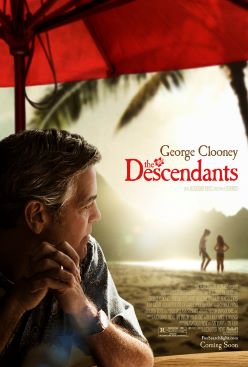
Behind the film
- Year
- 2011
- Director
- Alexander Payne
- Writers
- Nat Faxon, Jim Rash, Alexander Payne
- Genres
- Comedy drama, Drama
- Production
- Searchlight Pictures
- Country
- United States
- Cast
- George Clooney, Shailene Woodley, Amara Miller, Judy Greer, Matthew Lillard, Beau Bridges, Robert Forster, Nick Krause
About the film
Contains story spoilers.
After his wife Elizabeth is left irreversibly comatose by a boating accident, Hawaiian lawyer Matt King must care for daughters Alex and Scottie while deciding whether to sell inherited family land. Alex reveals Elizabeth's affair. Matt finds her lover, Brian Speer, whose connections also intersect with the proposed development. Brian refuses the grand romantic meaning Matt feared, while his wife confronts the damage in her own family. Matt declines to sell the land despite pressure from his cousins. The family says goodbye to Elizabeth, follows her wishes concerning life support and scatters her ashes. The film closes with Matt and the girls sharing a quiet evening at home. Their losses and disagreements remain, but ordinary closeness has become possible again.
The Descendants places family crisis inside a setting often imagined as an escape from crisis. Hawaii's beauty cannot exempt its residents from awkward conversations, unequal responsibilities or the difficulty of understanding people they thought they knew. Alexander Payne uses that contradiction to give the film a particular emotional atmosphere. A striking landscape can remain visible while a person feels entirely unable to enjoy it. The setting is therefore more than an attractive backdrop to grief. It helps expose the assumption that outwardly desirable circumstances should produce an uncomplicated inner life, allowing discomfort to exist without demanding that the world stop looking beautiful around it.
George Clooney's Matt has practical competence without corresponding emotional preparation. He knows how to manage some kinds of responsibility and has allowed other kinds to remain someone else's work. The performance gives that imbalance a slightly awkward physical quality, making the character's attempts to regain control recognisable rather than heroic. He can approach a situation as if finding the right information will make it manageable, only to discover that knowing more can deepen the difficulty. The film's comedy grows from that frustration. A capable adult is suddenly required to develop forms of attention that his professional identity has not taught him to value.
Shailene Woodley's Alex brings anger and insight into the same relationship. Her knowledge does not make her an uncomplicated substitute for the absent parent, and the film allows resistance to coexist with the possibility of cooperation. Amara Miller's Scottie gives the household another emotional timescale: a younger child cannot be expected to understand events through the explanations available to older people. Parenthood becomes the work of recognising these differences rather than delivering one authoritative account to everyone. The girls' responses have their own force, which keeps Matt's development from turning the family into an audience whose chief function is to admire his improvement.
The land question expands inheritance beyond money. A family can possess something valuable without agreeing on what that possession obliges it to preserve. The proposed sale makes collective memory, individual need and commercial opportunity difficult to separate. In the film's Hawaiian setting, that question also carries an awareness that a landscape has a history larger than the owner's current convenience. The story does not function as a legal guide to trusts or land rights. Its dramatic interest concerns the habits through which wealth can make a decision seem available and the responsibilities that might prevent availability from being sufficient justification.
Matthew Lillard's Brian and Judy Greer's Julie interrupt Matt's preferred account of the marital betrayal. Another household has its own version of what happened and its own vulnerabilities, so the search for a rival cannot produce a single clean explanation. Greer gives wounded politeness room to become openly conflicted, making compassion and anger coexist without requiring a polished resolution. The surrounding characters matter because the story's central loss can tempt Matt to treat everyone else as evidence in his private investigation. Encountering another person's pain creates a limit on that approach. Understanding an event involves recognising lives that continue beyond one's own injury.
Payne's tragicomic register allows a social mistake to be funny without making the sorrow surrounding it disappear. People can speak badly, misjudge one another and struggle with ordinary logistics even when a situation has immense emotional weight. That choice protects the film from treating bereavement as a continuous state of elevated expression. Grief must occupy conversations and routines that remain stubbornly imperfect. The screenplay by Payne, Nat Faxon and Jim Rash, adapting Kaui Hart Hemmings's novel, gives that imperfection a family setting in which a moment of connection may be brief, unplanned and more revealing than an eloquent explanation.
The final domestic emphasis changes the scale on which the story measures progress. Matt cannot recover a complete account of his marriage or replace what the girls have lost, and the film does not require those achievements before allowing warmth. Being together has value without becoming evidence that everyone has healed. The title's attention to descent connects that modest possibility with the larger questions of family history and stewardship. What people inherit includes relationships, assumptions and unfinished responsibilities as well as property. The Descendants finds its hopeful direction in becoming more attentive to those inheritances, allowing a changed household to begin sharing the present without claiming to have settled the past.