
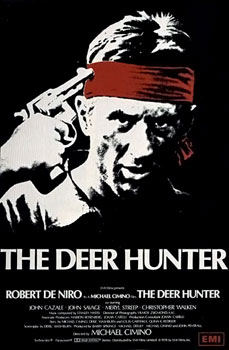
Behind the film
- Year
- 1978
- Director
- Michael Cimino
- Writers
- Deric Washburn
- Genres
- War, Drama, Anti-war, War drama
- Production
- EMI Films, Universal Pictures
- Country
- United States
- Cast
- Robert De Niro, John Cazale, John Savage, Meryl Streep, Christopher Walken, George Dzundza, Amy Wright, Chuck Aspegren
About the film
Contains story spoilers.
The Deer Hunter begins in Clairton, Pennsylvania, where steelworkers Michael, Nick, Steven, Stan and Axel share a working life organized around the mill, the bar, the church and the mountains outside town. Steven is preparing to marry Angela, whose pregnancy and uncertain paternity trouble his mother. At the wedding reception, Nick asks Linda to marry him when he returns from Vietnam; Michael, who is also drawn to her, remains silent. The gathering is noisy and communal, but it carries the knowledge that Michael, Nick and Steven are about to leave for war. The film spends substantial time with this home life before the battlefield appears, making the ordinary rituals part of what is at risk. Stan, Axel and the other friends help define a social world that extends beyond the three men who deploy. Angela’s pregnancy creates tension around the wedding, while Nick’s proposal to Linda gives the departure a promise of return. The choice to linger over the reception, its dancing, and the men’s joking conversation makes the later scenes of speechless shock feel like a rupture in a particular community rather than a general picture of war.
The next morning, Michael leads a deer hunt with Nick, Stan and Axel. His rule is to kill cleanly with a single shot, a belief that expresses both his skill and his desire to keep control over violence. He shoots a buck, and the group later visits a mountain cabin before the men depart. The transition from a familiar hunting landscape to Vietnam is abrupt. Michael, Steven and Nick are caught amid an attack, then captured and imprisoned by Viet Cong soldiers. The film stages the prisoners’ forced Russian roulette as an ordeal that strips away any distinction between the men’s previous confidence and their powerlessness.
At the camp, the captors force the prisoners to take turns pulling a revolver’s trigger. Steven, already injured, breaks down and is beaten before being confined in a watery pit. Michael devises an escape by persuading the guards to load three bullets into the gun; during his turn, he will signal Nick to take a captor’s weapon. Nick is dazed but follows the plan, and the two kill their guards and get Steven out. They float downriver until a helicopter reaches them. Nick climbs aboard, but Steven falls back into the water, and Michael jumps after him. He pulls Steven to shore, then entrusts him to soldiers among a group of refugees, while Nick is evacuated separately.
The aftermath sends the friends in different directions. Nick remains in Saigon, hospitalized but psychologically damaged. He wanders into an underground gambling room where men are made to play Russian roulette for money. Michael returns to Pennsylvania and finds that the welcome party cannot simply restore the old group. He avoids the celebration, stays in a motel, and struggles to speak with Linda, who is still waiting for Nick. Steven has also returned, but he lives in a veterans’ hospital and has lost his legs. Michael visits him and learns that money has been arriving from Saigon, suggesting that Nick is sending much of his winnings home without being able to return himself.
Michael travels back to Saigon to find Nick and enters the same brutal gambling circuit. He locates him at a table, but Nick no longer recognizes the life they shared; Michael’s appeal to their hunting memories briefly draws a smile and recognition, but cannot bring him safely home. In a final game, Nick turns the gun on himself and fires the fatal round. Michael carries his body home. The trip does not become a rescue story, and the men’s friendship cannot reverse the damage. Michael’s return brings him back to the wedding circle, but now the community has to absorb another absence and a loss that cannot be explained away by reunion.
In the last section, the remaining friends gather after Nick’s funeral. Their response is not a speech about victory or a simple promise to move on; they sing together around the table, and Linda, Michael, Stan and the others share a quiet ritual in the aftermath. The film’s movements between wedding, hunting trip, imprisonment, return and funeral make the same social spaces feel changed each time. Its central characters are fictional, and its Russian roulette scenes are a dramatic device rather than a documented account of standard Vietnam War captivity. The movie uses that ordeal to examine how violence persists in memory and behavior after a person has physically come home.
Michael’s hunting principle provides a thread through those changes without becoming a neat cure. In the woods, a clean shot looks like the mark of competence; later, the men face situations in which skill cannot guarantee safety or restore their old selves. The long opening gives the town a distinct life—steel work, family tension, music and friendship—so the war section does not stand alone as spectacle. When Michael returns, familiar places offer both welcome and discomfort. The film’s conclusion holds the friends together for a moment, but it does not suggest that grief has been resolved or that the group can simply resume its life from before the departure. Christopher Walken’s increasingly distant manner makes Nick’s absence felt even when his body is present, while De Niro often gives Michael the effort of appearing functional rather than a clear statement of what he feels. Linda’s waiting adds another kind of uncertainty to that return: care cannot supply the information she lacks. The friends therefore carry the conflict into rooms where nobody is firing a weapon, making damaged conversation and an avoided celebration part of the film’s account of violence.