
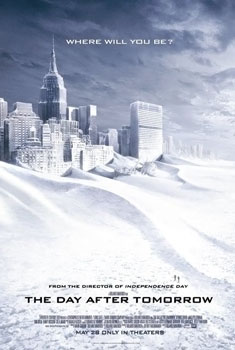
Behind the film
- Year
- 2004
- Director
- Roland Emmerich
- Writers
- Jeffrey Nachmanoff, Roland Emmerich
- Genres
- Disaster, Apocalyptic, Action
- Production
- 20th Century Studios, Starz Entertainment, Centropolis Entertainment
- Country
- United States
- Cast
- Dennis Quaid, Jake Gyllenhaal, Ian Holm, Emmy Rossum, Sela Ward, Dash Mihok, Jay O. Sanders, Austin Nichols
About the film
Contains story spoilers.
The Day After Tomorrow opens with climatologist Jack Hall and colleagues drilling into Antarctic ice, where a shelf breaks away beneath them. The image gives the film a warning before its characters have a public language for what is happening. At a conference, Jack argues that climate disruption could trigger a sudden collapse of the Atlantic circulation and sharply cool the Northern Hemisphere. Officials hear the long-range concern as a reason for research, not emergency action. The movie quickly compresses the forecast: falling temperatures, abnormal storms and ocean surges turn a scientific dispute into a race to get people out of danger.
Jack’s professional concern is tangled with a family distance. His son Sam travels to New York for an academic competition with friends Laura and Brian, while Jack remains at work and has to renegotiate the strained relationship across a phone line. When they speak from the library, Jack warns Sam to remain sheltered against the approaching cold. The warning arrives as travel systems are already failing. Frank, Jack’s colleague, joins the effort to collect field data and help establish whether the circulation has shifted. Their work keeps the climate crisis specific, but the film’s most immediate stakes sit with a group of young people who must make decisions without access to their parents or a reliable route home.
Weather events escalate across several locations at once. Hailstorms strike Tokyo, tornadoes tear through Los Angeles, and a storm surge floods Manhattan. The film uses these separate disasters to show that the danger is not one isolated storm but a rapid pattern that exceeds the normal scale of preparation. New York’s evacuation breaks down as water rises through streets and transport corridors. Sam and his companions reach the public library and climb to higher floors, where people debate whether to stay or attempt escape. The building’s books, windows and reading rooms shift from civic setting to shelter against the cold outside.
Laura cuts her leg during the evacuation, and infection becomes an additional threat after the storm traps the group. Sam, Brian and J.D. venture from the library to a Russian cargo ship that has drifted into the city in search of medicine. They find penicillin, then face wolves that escaped from the zoo. The excursion makes the catastrophe feel perilous at street level: navigation through familiar Manhattan spaces has become a matter of ice, debris and animals. They return to the library before the storm’s eye passes and the temperature plunges, leaving the group to conserve heat and wait rather than assume that the building will protect them indefinitely.
Jack and his team are caught in the collapse of ordinary plans. Frank falls through a snow-covered shopping-mall skylight; with the other men tethered to him and the glass failing, he sacrifices himself to keep them from falling too. Jack and Jason continue and take shelter in an abandoned restaurant as the deadly cold arrives. Their journey cannot reverse the weather or make every rescue possible. Jack is following the promise he made to Sam, even when no ordinary transport remains. The surviving students have meanwhile made their own decisions to stay alive. His determination matters as a father's commitment rather than a guarantee that someone elsewhere will always arrive in time.
Lucy Hall faces another version of that commitment in the hospital. As a pediatrician with patients who cannot simply walk out, she stays behind rather than treat evacuation as a decision everyone is equally free to make. An eventual rescue does not remove the risk she has already accepted. Sela Ward's Lucy gives the family story a second active parent, with obligations beyond waiting for Jack's news. The library offers a similar unequal gathering: students, staff, and people without secure shelter must share one space. Arguments over the books they burn show that survival also involves deciding what can be lost and what someone will still try to preserve.
Jack and Jason reach the library after the storms begin to ease and find Sam's group alive. Their radio call brings helicopter rescue, and other survivors emerge from the surrounding buildings. The destruction has not made the city entirely empty, even where officials believed there was little hope. Farther south, Americans have sought refuge in Mexico. President Blake has died during evacuation, leaving the previously dismissive vice president, Becker, to address the crisis as president. His apology changes the official response but cannot undo what has happened. The rescue resolves Jack's search while the broad view of the frozen hemisphere keeps the world from returning to normal alongside the family's reunion.
Roland Emmerich builds the disaster through escalating shifts in scale. The opening ice-shelf break gives way to dramatic citywide events, then contracts into the library where characters huddle around fires and argue about staying put. The use of digital effects turns Manhattan into flooded and frozen terrain, while the ship lodged in its streets brings maritime danger into a civic landscape. The film simplifies climate science into a fast-moving thriller mechanism, so its speculative chain should be read as a fictional catastrophe rather than scientific forecast. Within that setup, it keeps returning to human choices: whether to listen, leave, share resources or risk a journey for someone else.