
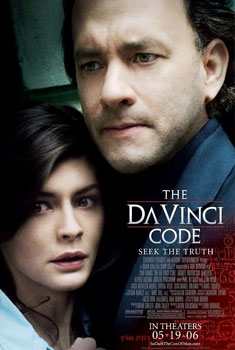
Behind the film
- Year
- 2006
- Director
- Ron Howard
- Writers
- Akiva Goldsman
- Genres
- Mystery, Treasure hunt, Crime, Drama
- Production
- Columbia Pictures, Imagine Entertainment
- Country
- United States
- Cast
- Tom Hanks, Audrey Tautou, Ian McKellen, Paul Bettany, Jean Reno, Alfred Molina
About the film
Contains story spoilers.
The Da Vinci Code turns an academic specialty into a race through museums, churches and private collections. Robert Langdon, a Harvard professor of religious symbology, is in Paris to lecture when Louvre curator Jacques Saunière is murdered. Police captain Bezu Fache summons Langdon to inspect the body, which has been posed like Leonardo's Vitruvian Man and marked with a hidden message. Sophie Neveu, a police cryptologist and Saunière's granddaughter, realizes that the message tells Langdon to find her. The authorities suspect him, so she helps him escape the Louvre and explains that Fache planted a tracker on him. The investigation begins as an effort to evade arrest as much as to decode a crime.
The first clues combine visual art with number puzzles: an out-of-order Fibonacci sequence, hidden writing visible under ultraviolet light and references to Leonardo's work. Langdon deduces that Saunière was connected to the Priory of Sion, and the pair use the sequence to access a safe-deposit box containing a cryptex, a cylinder whose dials must spell a password to preserve the message inside. A bank manager first helps them escape, then attempts to steal the object. The film treats the cryptex as a physical puzzle with consequences: every false move could destroy what they need. Their flight from France to England changes the question from who killed Saunière to which interpretation of the Grail is being protected.
At the home of Langdon's friend, Grail historian Leigh Teabing, Sophie hears a sweeping theory about Mary Magdalene and Jesus. These claims belong to the film's fictional mystery; the story uses them as disputed assertions that propel its characters, not as established religious history. Teabing says the Grail refers to Mary and her descendants, and argues that a secret society has protected that lineage. The monk Silas, who has been killing people while following instructions from someone called the Teacher, continues to pursue them. The group reaches London with Teabing and his butler Remy, following the cryptex clues to the Temple Church, where their interpretation yields no answer.
The shifting loyalties become the main puzzle. Remy reveals that he has been posing as the Teacher and takes Teabing hostage, then brings Silas to an Opus Dei safe house. Teabing, however, is the actual Teacher; he poisons Remy and manipulates events so that the police shoot Silas. His motive is revenge against the Church, and he confronts Langdon and Sophie at Westminster Abbey, demanding that they open the cryptex. Langdon appears to fail, then tosses the device into the air. Teabing catches it, but the vial inside breaks, apparently destroying the message. The apparent accident is Langdon's way of making Teabing expose himself without letting him seize the answer.
Langdon has already solved the final clue and quietly removed the papyrus. He and Sophie follow it to Rosslyn Chapel, where a woman identifies herself as Sophie's grandmother and explains that Sophie descends from Mary Magdalene's line in the story. Langdon returns to the Louvre, where the film reveals that the Grail's final resting place is connected to the museum's pyramid. Rather than ending with a conventional arrest or treasure recovered from a tomb, the film closes on Langdon recognizing the architecture beneath his feet. Ron Howard stages the chase around recognizable European landmarks, turning artworks, inscriptions and church interiors into surfaces that characters read differently as the mystery changes direction.
Silas and Bishop Aringarosa form the other side of the chase. Their loyalty is exploited by a person whose identity they do not know, and their certainty about a sacred mission makes them useful to Teabing's private campaign. Saunière's false lead sends Silas to a church, where a biblical inscription tells him he has reached a dead end. His response is violence rather than doubt, leaving another victim while bringing him no closer to the object he seeks. Teabing later frees himself from both his supposed allies: he poisons Remy and directs the police toward Silas. During the resulting confrontation, Silas accidentally wounds Aringarosa. The network that initially appears coordinated therefore breaks apart through misinformation and betrayal. This parallel pursuit explains why Langdon's expertise alone is not enough to keep him safe. Interpreting an inscription and judging the person supplying it are different problems, and Teabing has taken advantage of the gap between them.
Langdon's final return to Paris completes a visual pattern that has run through the chase: the city and its monuments are treated as a layered text. After he and Sophie part at Rosslyn and he has an epiphany while shaving, he follows the Rose Line back to the Louvre and realizes that the Grail is beneath the inverted pyramid. The closing image does not turn the object into a conventional relic recovered by the hero; Langdon kneels above the hidden chamber, recognizing a presence rather than taking possession of it. By ending at the location where the murder began, the film folds the pursuit back on itself and makes the museum both crime scene and answer, within the thriller's invented mythology. That final gesture closes the film's circular journey through Paris while leaving its Grail legend as a thriller premise rather than historical proof.