
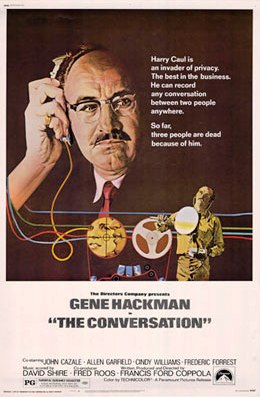
Behind the film
- Year
- 1974
- Director
- Francis Ford Coppola
- Writers
- Francis Ford Coppola
- Genres
- Thriller, Psychological thriller, Drama, Mystery
- Production
- American Zoetrope
- Country
- United States
- Cast
- Gene Hackman, John Cazale, Teri Garr, Harrison Ford, Frederic Forrest, Cindy Williams, Allen Garfield, Robert Duvall
About the film
Contains story spoilers.
The Conversation begins from a distinction that surveillance can make deceptively easy to forget: recording somebody's words is not the same as knowing what those words mean. Harry Caul can isolate sound, remove interference and make an exchange available for scrutiny. His work looks like a movement towards certainty. The film then shows how technical clarity can coexist with a disastrously incomplete interpretation. A clean recording still belongs to people, circumstances and intentions that the listener may not understand. The thriller grows from the gap between what a skilled observer possesses and what he believes that possession allows him to conclude.
Francis Ford Coppola wrote and directed the 1974 film, with Gene Hackman as Harry, John Cazale as his colleague Stan and Harrison Ford as the client's assistant Martin Stett. Frederic Forrest and Cindy Williams play the recorded couple. The story takes place in San Francisco, where a professional assignment becomes entangled with Harry's intensely guarded private life. He wants the benefits of being able to listen without the vulnerability of being listened to. That imbalance establishes the emotional conditions of the film before the assignment's danger is clear. Privacy is something he needs personally while making its violation available professionally.
Harry records a couple in Union Square and fears his client may kill them. The tapes are stolen, and his attempt to intervene leads him towards a hotel encounter he cannot fully understand. He eventually recognises that the couple have killed the client, reversing his interpretation of their apparent fear. Stett then demonstrates that Harry himself is being monitored. Unable to locate the listening device, Harry tears apart his apartment and ends alone among the damage, playing his saxophone. The conclusion does not reveal the device's hiding place, leaving the expert without the assurance his own trade seemed to promise.
Harry's attempt to separate a service from its use is the film's central professional problem. If a client commissions information, can the person gathering it treat every later consequence as outside the job? That claim may be convenient, but convenience does not make it convincing to the person haunted by what has followed earlier work. The story locates responsibility in an uncomfortable space between total control and total innocence. Harry cannot determine every client's decision. Equally, he cannot make his participation meaningless by describing himself as a neutral supplier. His skill places him inside an arrangement whose purpose he would prefer not to know.
Repeated listening turns that uncertainty into a process. The same material can appear to offer a new answer because emphasis, expectation or fear has changed around it. The film therefore makes interpretation active rather than treating it as something completed once a recording becomes audible. Listening again may reveal what was missed, but it may also strengthen an error if the listener keeps asking the same mistaken question. Harry's technical expertise cannot protect him from that possibility. It can even make the mistaken conclusion feel more authoritative, because he knows how much effort went into producing the evidence on which it rests.
His isolation compounds the problem by limiting opportunities for another perspective to interrupt his assumptions. Guarding every detail of a private life can seem prudent to someone who knows how easily details are taken, yet the guard can become a prison of its own. The film invites a reading of secrecy as both defence and deprivation. A man may reduce the number of people who can betray him while also reducing the number who could help him understand what is happening. His professional knowledge has made trust difficult, but distrust does not become a complete substitute for a relationship with the world.
The reversal at the end changes the direction of the machinery without changing its nature. The person accustomed to gathering evidence becomes evidence for someone else. What is frightening is not only the threat attached to that recording; it is the loss of his ability to define the terms of access. The apartment's destruction makes the search for certainty physically visible. If a device might be anywhere, dismantling one object cannot conclusively prove the next object safe. His knowledge of possible methods enlarges the field of suspicion rather than giving him a straightforward way to close it.
The final image leaves a remaining personal act inside that wreckage. Playing music does not restore the room or guarantee that the sound is private, but it continues an activity that belongs to Harry beyond the assignment. The Conversation closes without a reassuring correction that would put the expert back in command. Its account of surveillance is most disturbing when it joins power to misunderstanding: people can gather intimate information, act on it and still fail to grasp what they have heard. The film's uncertainty is consequently an ethical problem as well as a mystery, because mistaken understanding can become part of another person's fate.