
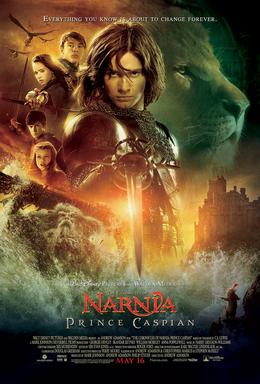
Behind the film
- Year
- 2008
- Director
- Andrew Adamson
- Writers
- Andrew Adamson, Christopher Markus, Stephen McFeely
- Genres
- Fantasy, Action, Adventure, Family
- Production
- Walden Media, Walt Disney Pictures, Mark Johnson
- Country
- United States, United Kingdom, Poland, Czech Republic, Slovenia
- Cast
- William Moseley, Ben Barnes, Anna Popplewell, Georgie Henley, Skandar Keynes, Sergio Castellitto, Peter Dinklage, Pierfrancesco Favino
About the film
Contains story spoilers.
Only a year has passed for the Pevensies when Caspian's desperate use of Susan's horn draws them back to Narnia; there, almost thirteen centuries have elapsed. Miraz threatens his nephew after gaining an heir, and the old Narnians live under Telmarine persecution. Caspian joins them while the siblings discover their ruined kingdom. Peter's attempted castle raid fails, and Edmund prevents the White Witch's resurrection. Peter challenges Miraz while Lucy seeks Aslan. Caspian spares his defeated uncle, but Sopespian kills Miraz and uses the death to provoke battle. Aslan's intervention turns the forest and river against the Telmarines. Caspian becomes king, seeking peace between peoples. The siblings return to England, with Peter and Susan told that their time in Narnia has ended. Victory restores a future, rather than the exact world they remember.
That difference in elapsed time gives the return an unusually painful texture. The children's memories remain recent, but the places attached to those memories have become ruins and legends. Their personal sense of continuity is no longer shared by the world around them. A familiar landscape can therefore feel like evidence that they belong and evidence that they are strangers at the same time. The sequel makes homecoming an encounter with change. Having once mattered somewhere does not guarantee that your old position remains available, or that others will understand your experience as you do. The fantasy setting allows that ordinary problem to become immense: a childhood adventure has acquired the distance and uncertainty of ancient history.
Peter's difficulty is bound up with the difference between remembering leadership and practicing it under new conditions. A former title can encourage certainty without providing an accurate account of the present. His impulse to act has understandable urgency, but urgency does not protect the people who must follow him. Caspian has a competing claim shaped by immediate danger and the need to win trust. Their friction is more consequential than a disagreement over who is most impressive. When authority becomes a contest of identities, the practical needs of a vulnerable alliance can be pushed aside. The film gives leadership a cost measured in other lives, making the willingness to listen as important as the willingness to stand at the front.
Caspian's position also complicates the simple idea of taking back a kingdom. He belongs to the people who have dominated the land, while depending on those who have suffered under that domination. His claim cannot become just merely by being older than his uncle's preferred succession. It needs a different relationship to the inhabitants. That makes the political promise of the story larger than restoring a family line. A kingdom can change rulers and remain oppressive unless the basis of belonging changes too. Caspian's challenge is to turn an inherited entitlement into a responsibility that others have reason to recognize. The alliance offers him that possibility, but it also makes him answerable to people whose history is not his own.
Lucy supplies another way of understanding the landscape. Her attention is less invested in recovering a public position, leaving her more open to guidance the others find difficult to accept. The conflict over what she can perceive turns belief into a problem within a family, not just between believers and enemies. Trusting a sibling can require taking her experience seriously before possessing the same evidence. Yet the story also gives that trust urgency: uncertainty is not a space outside events, and refusing to choose has consequences alongside choosing badly. Lucy's role keeps faith connected to attentiveness rather than prestige. She does not need to make herself the group's most forceful speaker to offer the understanding it most needs.
The world beyond the human rulers matters because Narnia's threatened inheritance includes different kinds of beings. The talking creatures and magical landscape make political exclusion visible as the shrinking of an entire living world. Forests cease to be background scenery when they can participate in events, and animal characters cannot be treated simply as decorative companions. That changes what restoring the country might mean. A human throne is only one part of the relationship between its inhabitants. The fantasy gives the environment a voice and an agency that the occupying order has difficulty acknowledging. It makes the loss of wonder more than a sad change of atmosphere: it represents a reduction in who and what can count within public life.
The sequel's military scale creates a sharper contrast with the children's ordinary origins. Armor, fortifications and organized forces make their return feel less like discovering a private secret and more like entering a history already underway. An adventurous choice can now place others in a coordinated danger. The settings reinforce that change, moving between ruined grandeur, sheltered assemblies and spaces designed for power. The story's magic remains important, but it does not make judgment irrelevant. Help arrives within a conflict whose failures still matter. That balance allows spectacle to carry an ethical pressure: the size of an action is not proof that it was wise, and being brave does not automatically make a leader careful.
Departure gives the victory its final limitation. Growing up cannot always mean gaining unrestricted access to the place where you once felt most extraordinary. Peter and Susan face a future that asks them to carry what they learned beyond the world that taught it. That is a different emotional reward from being allowed to remain rulers forever. The country itself also needs room to develop without depending on returning visitors to preserve an ideal version of their past. The ending joins those two forms of letting go. A successful return can help a place acquire a future, while leaving the returning person unable to recover the life they expected. The continuing value of the adventure lies in changed responsibility, not permanent possession.