
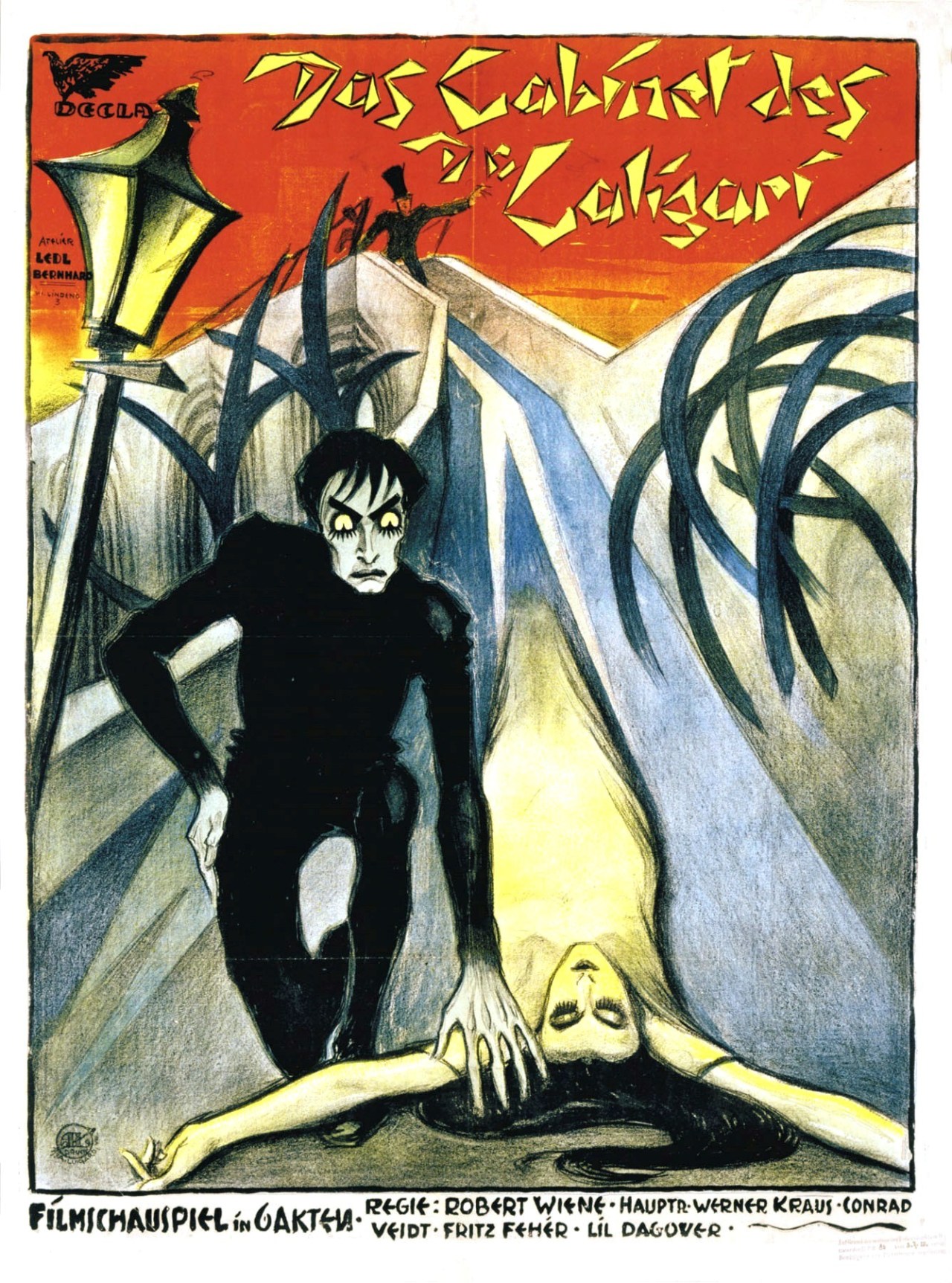
Behind the film
- Year
- 1920
- Director
- Robert Wiene
- Writers
- Hans Janowitz, Carl Mayer
- Genres
- Silent, Horror, Crime, Art
- Production
- Decla-Film
- Country
- Germany
- Cast
- Werner Krauss, Conrad Veidt, Friedrich Feher, Lil Dagover, Hans Heinrich von Twardowski, Rudolf Lettinger, Elsa Wagner, Rudolf Klein-Rogge
About the film
Contains story spoilers.
The Cabinet of Dr. Caligari turns the setting of a mystery into one of its most unsettling participants. Streets and buildings do not offer the comfort of a stable world in which a strange incident has occurred; their sharp, distorted forms make the whole environment feel precarious. Robert Wiene directs the silent film, with Werner Krauss as Caligari and Conrad Veidt as Cesare, the figure displayed in his cabinet. Hans Janowitz and Carl Mayer wrote the screenplay. The fairground premise connects spectacle with control: an audience gathers to watch a person whose sleeping body appears to conceal an extraordinary capacity. The attraction makes vulnerability look like entertainment.
Franzis recounts how his friend Alan visited Caligari’s show and received a prediction of death before being killed. Investigating, Franzis suspects Cesare, who later abducts Jane. A dummy conceals Cesare’s absence, and the pursuit leads Franzis to an asylum whose director appears to be Caligari. His account exposes the director’s obsession with controlling a sleeper to commit crimes. The frame then changes the explanation: Franzis is an asylum patient, Jane and Cesare are patients too, and the director says he understands how to treat him. That reversal makes the preceding story an account to reassess, rather than leaving the apparent investigation securely resolved.
The cabinet gives Cesare an identity defined by another person’s presentation of him. He is revealed when the showman chooses, and the audience receives him through the terms the showman supplies. That relationship makes the spectacle troubling before the later crimes establish a more direct danger. The person being displayed has little visible command over how he is understood. Veidt’s physical presence intensifies that condition, placing a human figure inside an arrangement that makes him both fascinating and subject to control. The horror grows from the possibility that another person can organise someone’s body and actions while claiming the authority to explain what those actions mean.
The painted environment extends the feeling of imbalance beyond that relationship. A conventional street can help a viewer judge where characters stand and what surrounds them. Here, the exaggerated angles unsettle that practical assurance. The world does not seem to rest comfortably around its inhabitants. Its design gives fear a visible form without requiring each image to contain an immediate threat. The look is connected with German Expressionism, but the effect can be felt without knowing that term: the surroundings appear shaped by pressure. A mystery that might otherwise ask who committed a crime also asks what kind of reality can be trusted to contain the answer.
As a silent film, Caligari communicates through the relation between written information, movement and composition. The absence of recorded spoken dialogue places particular importance on how a figure occupies a space or enters another person’s attention. Gestures do not merely replace conversation; they participate in the image’s overall pattern. A body can appear constrained by a doorway, exposed against a backdrop or caught in another figure’s presentation. That makes looking itself an active part of following the story. The viewer has to read an environment whose distortions resist being treated as a neutral background, and a face whose stillness can become more troubling than a spoken threat.
Franzis’s investigation offers a familiar route through that uncertainty. A grieving friend seeks an explanation, and evidence seems to draw the story towards a hidden misuse of authority. The viewer can follow that movement because the motive for investigating is immediately understandable. The frame complicates the resulting confidence by changing the position from which the investigation was narrated. Information that seemed to disclose someone else’s secret becomes part of an account attributed to the narrator’s disturbed understanding. The change does not undo the experience of the earlier images. It requires the viewer to hold that experience beside a new explanation of where it came from.
The director’s final statement also concentrates interpretive power in one person. He can describe Franzis’s condition and announce what should be done about it, while Franzis no longer controls the account through which he was initially understood. Within the ending, that authority offers the prospect of care. Seen alongside the story just told, the transfer of authority can also feel uncomfortable. The film makes those positions difficult to disentangle because the person who now supplies reassurance resembles the figure through whom the earlier danger was organised. Its tension lies in that change of credibility, rather than in treating an asylum setting as proof that someone is inherently threatening.
The ending leaves the viewer with an altered relationship to the entire film, including the spaces and people that initially seemed to form a coherent mystery. Caligari’s cabinet contained an alarming spectacle, but Franzis’s story has also been a spectacle presented for someone else to interpret. The Cabinet of Dr. Caligari draws its power from connecting those acts of presentation. Someone tells, displays or diagnoses; someone else accepts the terms until another account interrupts them. Its horror has a creaturelike human presence and a striking designed world, yet the most persistent uncertainty concerns who gets to make the final explanation of what that world means.