
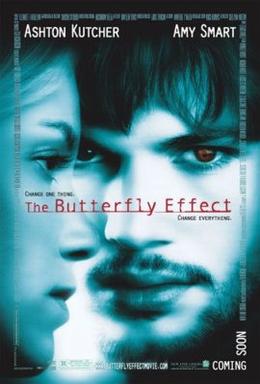
Behind the film
- Year
- 2004
- Director
- Eric Bress, J. Mackye Gruber
- Writers
- Eric Bress, J. Mackye Gruber
- Genres
- Science fiction, Fantasy, Crime thriller, Drama
- Production
- BenderSpink, FilmEngine, Katalyst Films
- Country
- United States
- Cast
- Ashton Kutcher, Amy Smart, Melora Walters, Elden Henson, William Lee Scott, Eric Stoltz, Callum Keith Rennie, Ethan Suplee
About the film
Contains story spoilers.
The Butterfly Effect gives a familiar wish an unstable mechanism: Evan Treborn can go back, but he cannot simply take the present he wants with him. His childhood contains gaps in memory, and the records he kept to help understand them become entrances into earlier moments. The film treats those gaps as both a mystery and a source of dread. What Evan does not remember has shaped the people around him, and recovering access does not make that history easy to change. Ashton Kutcher's adult Evan approaches the past with a belief that a better choice might repair everything. The story keeps distinguishing that belief from the much narrower knowledge available to someone acting inside one moment.
Evan and his friends grew up amid abuse and violent incidents. At university, reading his journals sends him back into his younger body. After Kayleigh's suicide, he changes their past, but each intervention produces another damaged present: a violent Tommy, imprisonment, an institutionalised Lenny, or Evan's own severe injuries. Trying to prevent one harm keeps redirecting consequences towards somebody else. In the theatrical ending, Evan uses a home movie to revisit his first meeting with Kayleigh. He frightens her away so she and Tommy grow up with their mother instead of their abusive father. Evan then destroys the records that enabled his interventions. Years later he and Kayleigh pass in the street without resuming the relationship he originally hoped to save.
The journal is a particularly important choice of object for that power. Ordinarily, a record fixes an account of what somebody has already experienced. Here, reading becomes an action capable of undoing the life in which the record was produced. Evan cannot rely on memory in the usual way because his changing present gives the same people different histories. A familiar face can therefore become evidence of something unfamiliar rather than reassurance that he has found his way home. The film's returning settings and relationships create a comparative structure: we see how an intervention alters what has developed around it. The change is not always announced by a completely new world. It can arrive through a person's attitude, health, circumstances or relationship to Evan.
Kayleigh is central to his desire to intervene, but that desire can contain competing motives. He wants her safe and wants a life with her, and the film makes those objectives increasingly difficult to combine. A version of reality that gives him the relationship he hopes for may shift harm to somebody else. Another can spare others while costing him the position from which he imagined helping them. The problem becomes larger than finding the right action to produce one happy couple. Evan has to confront the fact that people he loves are connected to lives he cannot fully supervise. Their wellbeing cannot be treated as a set of separate outcomes he can adjust without changing the relationships among them.
Tommy and Lenny help expose those connections. The same childhood group can emerge into different adult arrangements depending on how violence, fear and protection have been redistributed. The film does not need to present these outcomes as a realistic psychological formula for the devices to work dramatically. They belong to its speculative rules. Its treatment of abuse and trauma is often disturbing, and the repeated return to childhood makes that disturbance part of the structure rather than a piece of background quickly left behind. Evan's attempt to fix the past can demand that he revisit what he most wants to erase. Access becomes its own burden: being able to enter a painful event is not the same as being able to control every consequence of leaving it differently.
The adult timelines also change how Kutcher's character is situated within a scene. Evan may retain the intentions that prompted his intervention while finding himself judged by a history he has not lived in the same continuous way as everyone else. That mismatch creates isolation. Explanations that make sense within his experience sound implausible in the reality around him, leaving him without an easy way to ask for understanding. The people nearby cannot share his accumulated comparisons simply because he needs them to. The thriller's tension therefore includes more than the possibility of a frightening new outcome. It includes the loss of a common account of events, the ordinary basis on which people decide whom to trust and what kind of help to offer.
Eric Bress and J. Mackye Gruber wrote and directed the 2004 film. Its title invokes the idea that a small change can have far-reaching consequences, but the movie's time travel is a fictional device rather than a demonstration of scientific chaos theory. The theatrical ending turns away from Evan's attempt to keep everything he wants. Preserving Kayleigh's different life requires accepting a distance between them and closing his own route back into the past. A director's cut supplies a substantially different final intervention, so the version matters when discussing the outcome. In the theatrical account, the last encounter leaves two people able to continue separately. The sacrifice is the shared future Evan had imagined, rather than another attempt to force that future into existence.