
Behind the film
- Year
- 2007
- Director
- Rob Reiner
- Writers
- Justin Zackham
- Runtime
- 1h 37m
- Genres
- Buddy, Comedy, Drama, Tragicomedy
- Production
- Warner Bros. Entertainment
- Country
- United States
- Cast
- Jack Nicholson, Morgan Freeman, Sean Hayes, Rob Morrow, Beverly Todd, Alfonso Freeman, Rowena King, Verda Bridges
About the film
Contains story spoilers.
The Bucket List begins where ordinary plans have lost their assumed timetable. Carter and Edward face a future that can no longer be treated as an indefinitely available place to put things off. The list makes that change practical. Instead of remaining a general wish to live differently, it gives their remaining time things they can name and attempt. Yet the film's journey gradually complicates the idea that a life can be completed by collecting experiences. A checked item can record an event without settling what the event meant, and an impressive destination cannot automatically repair a relationship waiting somewhere less spectacular.
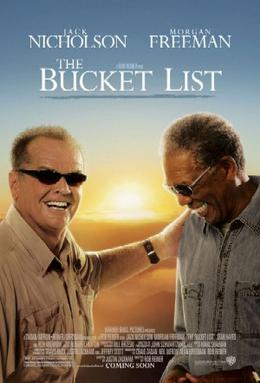
Rob Reiner directs the 2007 comedy-drama, written by Justin Zackham. Morgan Freeman plays Carter Chambers and Jack Nicholson plays Edward Cole, with Sean Hayes as Edward's assistant and Beverly Todd as Carter's wife Virginia. The hospital places the men together before they have chosen one another, making companionship begin through circumstances rather than shared habits. Their differences give conversation somewhere to go. One can offer resources the other does not possess, but neither has a private exemption from the uncertainty that brought them into the room. That common limit makes their friendship more substantial than a simple arrangement between a wealthy benefactor and a grateful travelling companion.
Carter and Edward receive terminal diagnoses and leave on a journey financed by Edward. Adventure brings conversations about family and regret, but Carter's attempt to reconnect Edward with his daughter causes a rupture. Carter returns home, then becomes seriously ill; the men reconcile before he dies. Edward subsequently reunites with his daughter and meets his granddaughter. He lives for years afterwards, and their ashes eventually share a mountain resting place. The ending completes the list through friendship and family as well as travel, letting the survivor carry something that the journey's purchases alone could not have supplied.
Money changes what becomes possible without changing everything that matters. Edward can remove logistical obstacles and turn a plan into immediate movement, making the difference between the men's means visible throughout the premise. The film does not need to deny that advantage for the story to ask what remains beyond it. Paying for an experience cannot determine how a person will respond to it, and paying for proximity does not produce reconciliation on demand. The journey's resources give the characters time together in unfamiliar places, but the relationship created through that time becomes something whose value cannot be reduced to the cost of arranging it.
Carter's attachment to home gives the adventure a tension that the list alone cannot contain. Leaving can feel like claiming a postponed part of life while also troubling people whose lives have been built around his presence. That makes the trip more complicated than a simple opposition between courage and routine. A familiar life can contain genuine love alongside regret, just as travel can contain pleasure without becoming a permanent answer. The film allows returning to matter because the decision does not have to mean the journey was worthless. An experience can change somebody's understanding of home rather than prove that home was merely an obstacle to living.
Edward's estrangement makes a different limit visible. An opportunity to reconnect can be offered, but the person receiving it may experience the offer as an intrusion into something painful and private. Carter's intervention therefore risks the trust that made their closeness possible. The disagreement gives friendship a demanding form: concern for another person does not guarantee permission to organise their life. The later reconciliation matters because it has to survive that distinction. Caring can involve a wish to help while still requiring recognition that the other person decides how and when to face a relationship whose history a new companion cannot wholly understand.
The list changes meaning as the story moves from conspicuous experiences towards ordinary contact. A phrase written in advance can acquire a significance its writer did not anticipate, particularly when another person becomes part of fulfilling it. That gives the device more flexibility than a schedule whose only question is whether every destination is reached. The film's emotional movement depends on recognising that an achievement may be relational rather than spectacular. Being known, making peace or meeting somebody newly important can matter as much as being carried into an unfamiliar landscape, even though these experiences cannot be guaranteed by the same practical arrangements that make travel possible.
The ending preserves loss rather than allowing the journey to cure it. Its fictional medical course is part of the drama, not a forecast for people facing illness, and friendship does not grant both men the same amount of time. What survives is an altered relationship to the life that remains. The Bucket List uses a clear, portable idea to begin its adventure, then asks that idea to make room for responsibilities and attachments it cannot easily itemise. Its most consequential completion is not simply doing more before death. It is allowing another person to change what counts as a life well attended to, with the survivor carrying that understanding beyond the trip itself.