
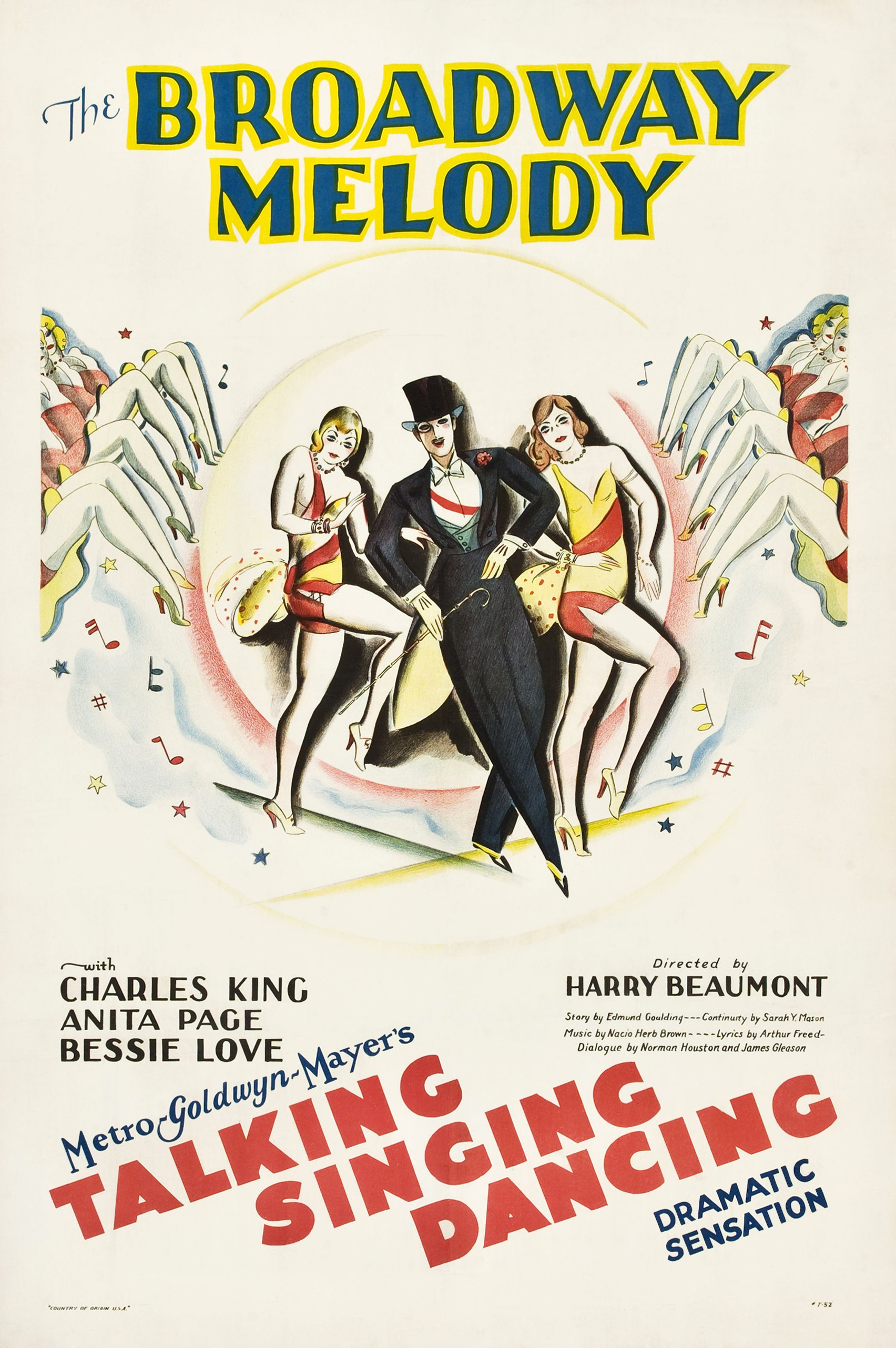
Behind the film
- Year
- 1929
- Director
- Harry Beaumont
- Writers
- Edmund Goulding, James Gleason, Norman Houston, Sarah Y. Mason, Earl Baldwin
- Genres
- Musical, Romance
- Production
- Metro-Goldwyn-Mayer
- Country
- United States
- Cast
- Bessie Love, Anita Page, Charles King, Edward Dillon, Jed Prouty, Kenneth Thomson
About the film
Contains story spoilers.
Eddie Kearns helps his sweetheart Hank Mahoney and her sister Queenie audition for Broadway producer Zanfield. Queenie secures employment for both, but the attention her beauty attracts unsettles their partnership. Wealthy Jock Warriner pursues her while Eddie falls in love with her. Hank conceals her pain and urges Eddie to choose Queenie. When Warriner becomes threatening, Eddie intervenes and Queenie chooses him. The couple marries and leaves the stage, inviting Hank to live with them. Hank refuses and travels west with another performing partner, keeping her own hope of returning to Broadway.
Harry Beaumont’s film is built around a world where a person’s worth is constantly being auditioned. The sisters bring a practiced act and years of vaudeville experience, but the Broadway producer sees their entrance through a commercial lens: can they fill a role, draw attention and fit a revue’s image? The movie gives that conflict a small-scale intimacy through the sisters’ shared rooms, then widens it to the stage and the city. Success is not a single prize they can both hold in the same way; it reshapes the bond that brought them to New York.
Hank’s ambition is bound up with care. She wants a career, but she also feels responsible for keeping Queenie safe from people who may use the younger woman’s beauty as a shortcut to fame. Bessie Love gives Hank a quick, comic surface that can turn into hurt when her own sacrifices go unnoticed. Her refusal to accept a road booking is not simple stubbornness; she believes their act deserves a chance in the place where the largest opportunities are. Yet the film also shows how her protective role can restrict Queenie’s ability to decide for herself.
Queenie’s beauty is treated as an asset by the entertainment business, but Anita Page plays her with more than passive charm. Her choice to win a place for both sisters demonstrates loyalty, while her attraction to Eddie gives her a desire that cannot be absorbed into Hank’s plans. The character is pulled between gratitude and independence: she loves the sister who has looked after her, but she does not want that history to decide whom she may love or what kind of life she may choose. The film’s romantic plot therefore doubles as a negotiation about sisterhood and adulthood.
Charles King’s Eddie occupies a middle position between the sisters and the producer. He can write songs, speak the language of show business and get a meeting, but he does not control who receives the spotlight. His affection complicates the professional help he offers, and the story makes his jealousy a liability rather than a heroic proof of devotion. The three leads give the triangle distinct emotional tempos: Hank’s brisk practicality, Queenie’s guarded warmth and Eddie’s sometimes impulsive confidence. Their performances help the film turn backstage ambition into something personal without losing the mechanics of the revue.
The distinction between performing for an audience and performing for a decision-maker gives the backstage world a particular unease. A number may look complete once it reaches the stage, but the people within it have passed through negotiations that an audience cannot see. Being noticed is only useful if the attention produces an opportunity rather than another condition to satisfy. The film lets spectacle carry that double meaning: display is the work the sisters want to do, and it is also a process through which other people decide what they are worth. Applause cannot reveal every concession involved in reaching the place where applause becomes possible.
Broadway’s promise depends on visibility, yet visibility can make a performer easier to misunderstand. A face becomes an attraction before the person behind it has obtained much control over how that attraction will be used. The sisters’ differing treatment makes the problem personal, because a career is also the thing they have learned to pursue together. Recognition offered to one can feel like erasure to the other, even when neither sister has deliberately caused the imbalance. Beaumont’s musical world therefore gives ambition a relational cost. The wish to be seen cannot be separated entirely from the fear that success will require becoming unfamiliar to someone who knew the act before it mattered.
The family bond creates obligations that no professional contract can settle. Gratitude may make a person reluctant to claim a separate future, while care may tempt another person to define separation as rejection. The film’s interest lies in how difficult it is to distinguish those feelings without making affection seem false. A shared ambition can remain important after the participants stop pursuing it in the same form. What matters is whether loyalty allows another person to choose, rather than demanding that the relationship continue unchanged as proof of love. The title can hold the sisters within one musical world without requiring that their futures remain one performance.