
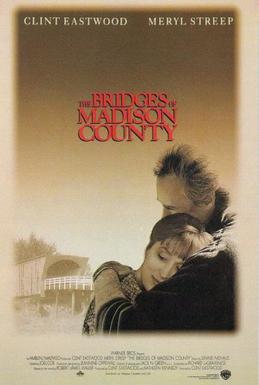
Behind the film
- Year
- 1995
- Director
- Clint Eastwood
- Writers
- Richard LaGravenese
- Genres
- Romance, Flashback, Drama
- Production
- Warner Bros. Entertainment, Malpaso Productions, Amblin Entertainment
- Country
- United States
- Cast
- Clint Eastwood, Meryl Streep, Annie Corley, Victor Slezak, Jim Haynie, Phyllis Lyons, Debra Monk
About the film
Contains story spoilers.
After Francesca Johnson dies, children Michael and Carolyn discover her request for cremation and scattering at Roseman Covered Bridge. Her diaries and mementos reveal a four-day affair in 1965. Photographer Robert Kincaid, working for National Geographic, sought directions while her family was away. Their connection led Francesca to consider leaving, but she stayed for her husband and children, also doubting how their spontaneous romance would endure. Years later, after her husband died, she tried unsuccessfully to locate Robert. His belongings eventually reached her after his death; his ashes had been scattered at the bridge. Her children reconsider the mother they thought they knew and honour her wishes. The revelation also prompts them to examine their own marriages, giving the remembered encounter consequences beyond the lovers' lives.
The film uses the children's discovery as a frame for an intimate story that was never intended as family history. Michael and Carolyn begin with a practical disagreement about their mother's final request, but the letters turn the question of burial into an encounter with the limits of what children know about a parent. Their shock is not simply that Francesca loved someone else. They must imagine her as a person with a past and desires that existed alongside her role as wife and mother. Their reaction gives the narrative a second emotional register: the 1965 affair is lived in the present of the flashbacks, while the children slowly learn how to read it from the documents she left.
Francesca's farm establishes a world shaped by routine and distance. Her days include household work, meals and the responsibilities of a small rural home, while Robert arrives carrying the mobility of a photographer who follows assignments from place to place. The contrast is not presented as a simple opposition between confinement and freedom. Francesca understands the people who depend on her, and Robert's movement has its own solitude. Their time together is partly made possible by ordinary interruptions: directions, weather, food, conversation and the temporary absence of her family. The film gives those small encounters room, letting attraction emerge through attention rather than through a succession of dramatic declarations.
Clint Eastwood's restrained direction supports the story's concentration on faces, rooms and pauses. The covered bridge is a real destination in the characters' daily geography, but it also organizes their meetings and their eventual separation. The camera does not turn every landscape into a grand romantic emblem; it keeps the Iowa roads, farmhouse and modest interiors present as the setting Francesca must return to. The photography by Jack N. Green uses a softer, reflective look for the past without making it feel detached from the children's contemporary scenes. The result is a visual conversation between remembered intimacy and the lives that continued around it.
Meryl Streep's performance gives Francesca a careful balance of self-command and emotional discovery. She is not written as someone waiting to be awakened by Robert; she is alert to what their connection means and to what it would cost. Her accent, domestic ease and changes in composure help define the character's specific place in the community, while small pauses show the work of thinking before acting. Eastwood plays Robert as an observant visitor rather than a conventional forceful suitor. His photography gives him a reason to notice details, but the film also shows how little that mobility can promise. The pair's chemistry grows through talk and shared attention instead of through an elaborate romantic backstory.
The letters shape how the film thinks about memory. They are not neutral records: Francesca has selected what to preserve and what her children will be able to know after she is gone. The film lets objects carry meaning without converting every object into a clue. A message, a photograph or a remembered route can make a private life newly visible, but no archive can fully reconstruct what a decision felt like at the time. Michael and Carolyn begin to see their mother differently, yet the movie does not suggest that a single revelation explains every part of a long marriage. They inherit a story, not a complete substitute for the person.
The children inherit a responsibility that is more difficult than merely discovering an unfamiliar fact. Understanding someone does not require making every aspect of their life fit one's own preferred account, and affection may ask for respect where approval remains uncertain. The film allows that distinction to become meaningful across generations. A parent's life can contain commitments and longings that coexist without resolving into a single explanation. What the children gain is therefore less a verdict than a more spacious way of remembering. Their mother's complexity need not invalidate the relationship they had with her, even as it changes its meaning. The final emotional movement concerns the ability to carry another person's wishes seriously without pretending that those wishes have made the whole person transparent.