
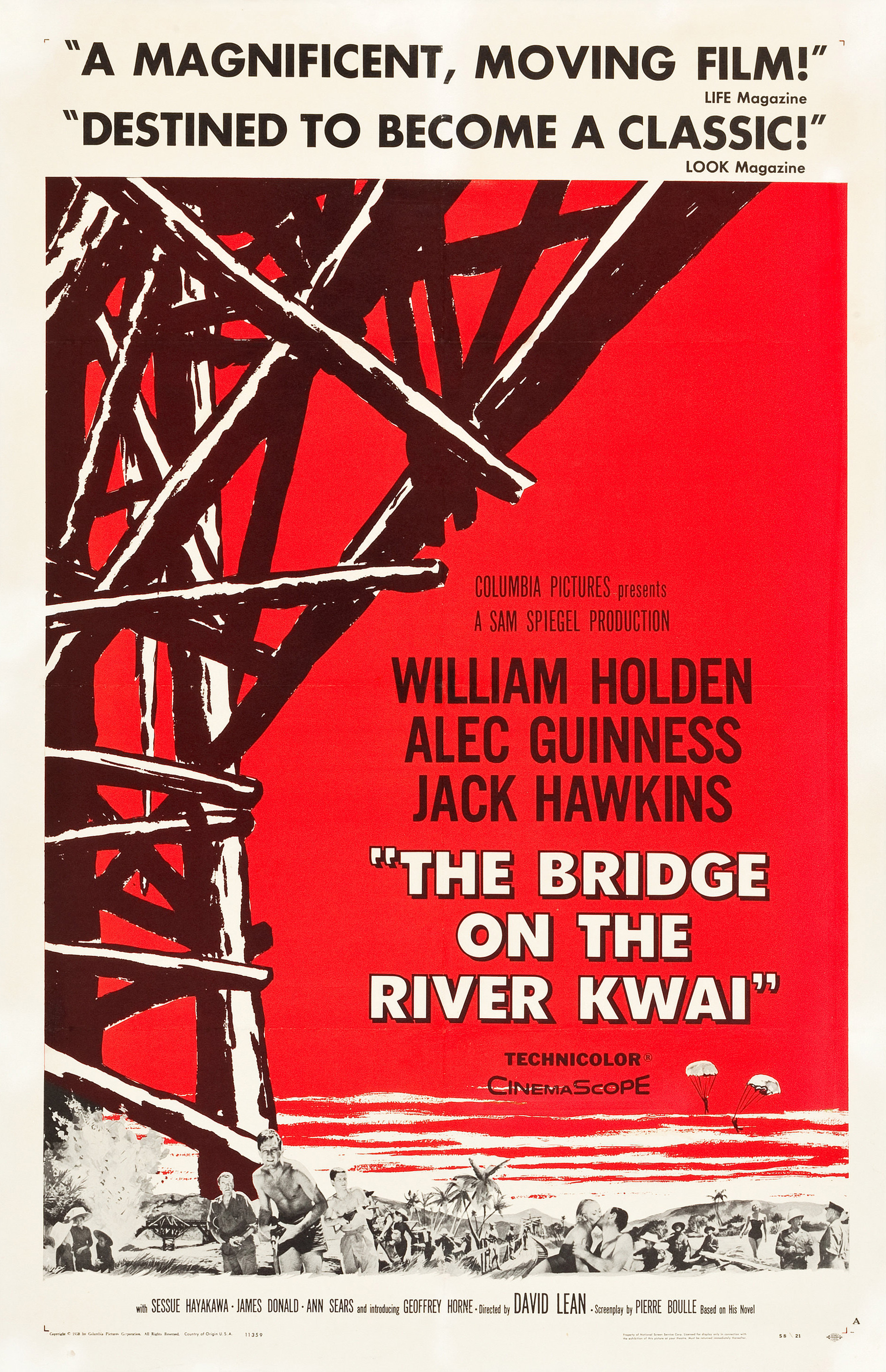
Behind the film
- Year
- 1957
- Director
- David Lean
- Writers
- Carl Foreman, Michael Wilson, Calder Willingham, Pierre Boulle
- Runtime
- 2h 41m
- Genres
- Drama, War
- Production
- Horizon Pictures
- Country
- United Kingdom, United States
- Cast
- William Holden, Alec Guinness, Jack Hawkins, Sessue Hayakawa, James Donald, André Morell, Geoffrey Horne, Percy Herbert
About the film
Contains story spoilers.
The Bridge on the River Kwai places its story in a Japanese prisoner-of-war camp in Burma during the Second World War. Colonel Nicholson and his British troops arrive in formation, whistling their regimental tune, while American sailor Shears watches from the infirmary. Camp commandant Colonel Saito announces that every prisoner, including officers, will work on a railway bridge connecting Bangkok and Rangoon. Nicholson refuses on the ground that officers are exempt from manual labor under the Geneva Convention. Saito responds with threats and punishment, but Major Clipton, the camp’s medical officer, witnesses the confrontation and protests that the killings would have witnesses. The initial conflict is over law and military discipline, yet it soon becomes an argument about who can command respect inside captivity.
Nicholson’s refusal is not simply a matter of protecting his officers. He believes that obeying orders and maintaining the army’s standards preserve the identity of his unit, even after surrender. When the prisoners encourage him, his stand becomes a source of pride to the camp. Shears sees something else: the colonel is treating military procedure as more important than survival. Earlier, Shears had bribed a guard to move from the burial detail to the infirmary and argued that escape is the only sensible response to forced labor. He and two others slip away, but Japanese guards kill the others and shoot Shears as he dives into the river. Believing him dead, they leave him behind; he survives, is found by villagers and eventually reaches a hospital in Ceylon.
Saito’s bridge project is behind schedule, and he eventually relents by freeing Nicholson from the punishment hut and exempting British officers from manual labor. Nicholson interprets this as a victory for his men. He inspects the work, sees weaknesses in the design and takes over the planning with advice from Captain Reeves, who worked as a civilian engineer. The original bridge site sits on soft mud, so the plan shifts downstream to solid bedrock. Nicholson increases work quotas and urges the Japanese soldiers to help. His officers begin to cooperate, and morale improves; to Nicholson, a sound bridge proves that his regiment can still do excellent work. But the bridge will serve the Japanese war effort, and Clipton warns that this collaboration risks crossing into aiding the enemy. Nicholson has become so focused on the unit’s achievement that he fails to see how completely the project serves Saito’s military purpose.
Shears is later taken to a hospital, where Major Warden recruits him for a British commando mission to destroy the bridge. Shears is reluctant: he wants to return to civilian life and admits that he had been impersonating an officer in the camp. Warden explains that the U.S. Navy knows about the deception and has authorized his transfer to the British commandos. Shears accepts, and the team prepares to infiltrate Burma. Young Lieutenant Joyce joins them despite his fear of killing. Their route through the jungle is grueling, Warden is wounded in the ankle during a skirmish, and the squad receives word that a troop train will inaugurate the bridge on the thirteenth. The timing means they must plant explosives and wait for the train rather than simply destroy the structure at any moment.
Back at the camp, Nicholson’s commitment deepens. He tells Clipton that officers and wounded prisoners have volunteered to work, though the film shows that his ambition to finish the bridge is now driving the labor. The commandoes reach the site as Nicholson commemorates the achievement with a plaque. Shears, Joyce and local bearers float a raft of plastic explosives to the bridge and attach them beneath it. Joyce takes cover with the detonator while Shears swims across to wait for the train. At daybreak, the river has fallen, exposing the wires. Nicholson notices them and follows their path with Saito, not realizing that the commandoes are there to sabotage the structure. The risk of discovery shifts from a distant possibility to a moment where his loyalty and judgment are tested.
Joyce kills Saito and tells Nicholson that the bridge is to be destroyed. Nicholson attacks him rather than let him carry out the mission. Shears swims back to help, and the Japanese troops open fire. Joyce dies, then Shears is mortally wounded. Nicholson finally recognizes the consequences of his obsession, but a mortar shell wounds him and he falls onto the detonator. The explosives go off as the train approaches, collapsing the bridge and sending the train into the river. Clipton, watching from the hillside, looks upon the wreckage and calls it madness. The conclusion makes the destruction inseparable from the disorder that Nicholson’s own misplaced pride helped create.
The film is adapted from Pierre Boulle’s novel, but its characters and plot are fictional; the wartime railway is a historical setting rather than a documentary account. The central contrast is between Shears’s survival instinct and Nicholson’s rigid faith in military honor, with Saito caught between a failing deadline and his authority over the camp. The bridge itself becomes a visible measure of Nicholson’s changing priorities: first he resists the work as a violation, then he makes it a monument to the British unit. The film’s final act brings that contradiction into focus when the colonel, confronted with sabotage, cannot distinguish the men’s interests from his pride in the structure.