
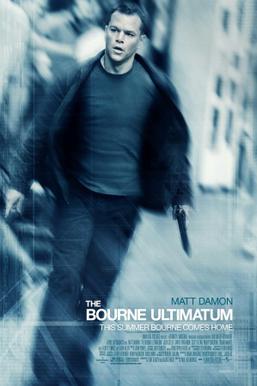
Behind the film
- Year
- 2007
- Director
- Paul Greengrass
- Writers
- Tony Gilroy, Scott Z. Burns, George Nolfi
- Runtime
- 1h 55m
- Genres
- Action thriller, Spy, Mystery, Action
- Production
- Universal Pictures, The Kennedy/Marshall Company, Ludlum Entertainment
- Country
- United States, Germany
- Cast
- Matt Damon, Julia Stiles, David Strathairn, Scott Glenn, Paddy Considine, Édgar Ramírez, Albert Finney, Joan Allen
About the film
Contains story spoilers.
The third film picks up in the aftermath of the Moscow chase, then moves forward six weeks, with Bourne still moving through a world where a border crossing, phone call or glance at a camera can expose him. In London, journalist Simon Ross has learned about Blackbriar, a secret CIA program beyond the already discredited Treadstone. Bourne recognizes the danger in Ross's reporting and tries to guide him through Waterloo Station without showing himself. The station's crowds, escalators and glass corridors become part of the suspense: both men must interpret a changing field of sight faster than the people hunting them. Their brief contact offers a new trail, but an operation already watching Ross turns it into a trap.
Noah Vosen, the official directing Blackbriar, orders the surveillance team to eliminate Ross before the story spreads. Bourne cannot prevent the killing, but he retrieves a notebook and uses Ross's notes to locate a Madrid contact. At the same time, CIA officer Pamela Landy presents evidence from Abbott's confession about Treadstone, pressing director Ezra Kramer to account for the agency's earlier conduct. These parallel investigations give the film a structure of competing information: Bourne moves through physical spaces to find sources, while Landy works within the bureaucracy to make records and testimony matter. Neither route is safe, and each depends on deciding which official is acting honestly. Ross's reporting turns a private pursuit into a potential public record. Yet the station's cameras, agents and commuters make the act of meeting a source inherently unstable; information can travel farther than either man can safely control.
In Madrid, Bourne finds Nicky Parsons, a former Treadstone colleague still connected to the station's operations. She helps him understand that the clues point toward Daniels, the Madrid station chief. When a team arrives, Bourne and Nicky escape separately. In Tangier, assassin Desh kills Daniels before Bourne reaches him, and Nicky becomes the next target. Bourne saves her during a pursuit through apartments, rooftops and crowded streets, where Nicky's local knowledge and his practiced movement briefly work together. The sequence makes rescue more than a sentimental gesture: Bourne repeatedly spends time and tactical advantage protecting someone whom the operation has marked expendable. The confined apartment fight with Desh makes the chase tactile: windows, doors and ordinary household objects become obstacles, and Bourne’s skill does not prevent exhaustion.
New York brings the investigation back toward the people who shaped Bourne’s earlier life. Landy tells him his real name, David Webb, and gives an apparent birth date that conceals the address of the old training facility. He also exploits the agency’s confidence in its surveillance, drawing Vosen away and entering his empty office to obtain the Blackbriar files. A car pursuit ends with Bourne able to kill the injured assassin Paz, but he chooses to leave him alive. That restraint becomes more important than another escape: it gives an operative accustomed to following orders evidence that the man he is hunting can choose something different. Bourne passes the documents to Landy before confronting Dr. Albert Hirsch, who oversaw Treadstone’s conditioning programme. The former recruit’s name is now clear, but the question of how he became capable of killing remains inside the building he has finally reached.
Hirsch’s account challenges Bourne’s memory of being forced into everything. Webb volunteered for the programme and killed an unknown man as part of proving his commitment. The revelation gives the recovered identity moral weight, while leaving the institution responsible for the system it created and continued to use. Bourne does not complete the encounter by executing Hirsch; he rejects the role and leaves. On the roof, Paz confronts him and asks why he was spared. Bourne pushes the question back toward the purposes behind the assassin’s orders, and Paz lowers his weapon. Vosen appears and fires as Bourne jumps into the East River. The sequence turns the pursuit’s final moments around decisions about killing rather than superior marksmanship: Bourne’s earlier restraint has made room for Paz to hesitate, and that interruption opens the possibility of escape.
Nicky later watches a report about the exposure of Blackbriar, the arrests of Hirsch and Vosen, and the investigation of Kramer. The absence of Bourne’s body brings a smile, followed by an image of him swimming that confirms his survival. Paul Greengrass’s restless handheld framing and rapid editing have kept the audience among crowds, traffic and interrupted sightlines throughout the pursuit. Oliver Wood’s photography gives those places a practical texture, while John Powell’s music binds movement to urgency. Matt Damon plays Bourne’s alertness as habitual effort rather than pleasure in danger; Joan Allen’s Landy gives the internal challenge to the agency a steadier counterpoint. The ending joins survival to the evidence trail without claiming that exposure can undo every consequence. Bourne has learned a name and confronted a choice from his past, then demonstrated that neither requires him to continue killing on command.