
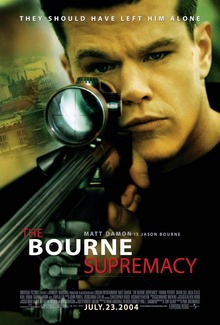
Behind the film
- Year
- 2004
- Director
- Paul Greengrass
- Writers
- Tony Gilroy
- Genres
- Action thriller, Spy, Action, Thriller
- Production
- Universal Pictures, The Kennedy/Marshall Company
- Country
- United States
- Cast
- Matt Damon, Franka Potente, Brian Cox, Julia Stiles, Karl Urban, Gabriel Mann, Joan Allen, Marton Csokas
About the film
Contains story spoilers.
Jason Bourne and Marie have made a fragile life in Goa, but recovered memories still intrude on it. He records fragments of his past while trying to remain outside the organization that trained him. In Berlin, a CIA purchase of information ends with two deaths and planted fingerprints pointing to Bourne. The frame connects a hidden financial crime to a man the agency already knows how to fear. An assassin then reaches India and kills Marie during the couple's escape. Bourne survives the crash into the water, but survival no longer means returning to the life they had begun together. The investigation that follows is shaped by grief as well as self-preservation.
Pamela Landy approaches the Berlin attack as an intelligence problem. She finds a connection to Treadstone and questions Ward Abbott, whose knowledge of the program gives him a useful position from which to influence the inquiry. Bourne approaches it from the opposite direction, deliberately allowing himself to be identified in Naples before obtaining information from an official's phone. A visit to another former operative, Jarda, in Munich ends in a lethal struggle rather than an explanation he can trust. By the time he reaches Berlin, Bourne has more reason to suspect the agency's interest, but not a complete understanding of who arranged the attack or why.
Bourne forces a meeting with Nicky Parsons, using surveillance of Landy's office to demonstrate that the people looking for him are themselves exposed. Nicky can supply information about the organization, but she does not possess the answer to every memory he brings to her. He releases her and returns to the Berlin hotel associated with an early mission. There he recalls killing Vladimir Neski and, when Neski's wife arrived, killing her and staging a murder-suicide. The memory changes the investigation's moral direction. Bourne has been framed for the recent operation, but that innocence cannot be extended backward to everything he did as an assassin. Recovering a fact means recognizing somebody else's loss inside it.
Danny Zorn notices a weakness in the evidence against Bourne, placing him in danger from the person who should be supervising him. Abbott kills him to keep the inconsistency from reaching Landy. Bourne obtains a recording that exposes Abbott's connection to Russian oligarch Yuri Gretkov and the stolen money. Confronted with the scheme, Abbott expects Bourne to answer through violence. Bourne refuses to kill him, invoking what Marie would have wanted rather than allowing the confrontation to dictate the response. Abbott subsequently takes his own life when Landy closes in. The recording lets her pursue a conspiracy whose protection has depended on controlling what colleagues are allowed to know.
Bourne goes to Moscow to find the Neskis' daughter, Irena, but Kirill reaches him first. Wounded, he escapes in a taxi, and the pursuit compresses the conflict into streets, traffic and a tunnel. Bourne forces Kirill's vehicle into a concrete barrier and leaves the injured assassin alive. He then reaches Irena and tells her that the account of her parents' deaths was false: he killed them. The apology cannot restore the family, and the scene makes no attempt to turn her response into a certificate of forgiveness. Later, a call to Landy in New York provides his original name, David Webb. Knowing it supplies a piece of identity without undoing the actions attached to the identity he has been using.
Paul Greengrass gives the chase an unstable visual texture, keeping attention close to a person who must react before a room or street can be comfortably surveyed. Movement is interrupted by bodies, vehicles and the edges of the frame. That approach makes Bourne's preparation noticeable in a different way from a polished panoramic action scene: a quick look at an exit or a phone becomes useful because the following seconds leave little room to reconsider. Matt Damon keeps the performance relatively contained around that motion. Bourne can act with extraordinary speed and still struggle to say what has happened to him. The mismatch prevents his competence from becoming a complete account of his character; he knows how to escape an immediate threat more reliably than how to live with a recovered memory.
Joan Allen's Landy has to revise her reading of the evidence while continuing to direct people who expect decisions. Her authority is practical rather than merely an obstacle for Bourne to evade. Brian Cox's Abbott draws on the confidence of somebody who knows the institution's habits and assumes he can use them to keep a question from developing. Their exchanges turn procedure into a contest: who can define the relevant history, and whose interpretation will become an instruction? Julia Stiles's Nicky occupies a more vulnerable position between those official demands and Bourne's urgency. Karl Urban's Kirill supplies a quieter physical threat, pursuing his assignment without the personal history that makes Bourne hesitate. The characters therefore do not all participate in the same kind of chase, even when their decisions bring them to the same city.
Tony Gilroy's screenplay links espionage information to private responsibility. Documents and recordings expose the financial scheme, while memory exposes an act that no successful investigation can reverse. Marie remains important after her death because the life Bourne attempted with her offers a measure against which his later choices can be judged. Refusing an execution and acknowledging the Neskis' deaths are different actions, but both interrupt the habit of treating a person as a problem to eliminate. The film takes its title from Robert Ludlum's novel while constructing its own screen story. Its closing contact with Landy leaves Bourne moving independently, with more knowledge and fewer illusions about what that knowledge can repair.