
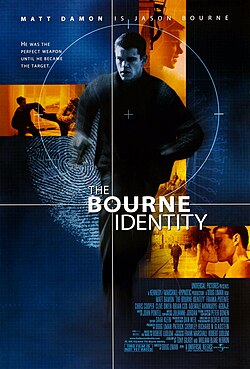
Behind the film
- Year
- 2002
- Director
- Doug Liman
- Writers
- Tony Gilroy, William Blake Herron
- Genres
- Spy, Action thriller, Action, Thriller
- Production
- Universal Pictures, The Kennedy/Marshall Company, FilmColony
- Country
- United States, Germany, Czech Republic
- Cast
- Matt Damon, Franka Potente, Chris Cooper, Clive Owen, Brian Cox, Adewale Akinnuoye-Agbaje, Gabriel Mann, Julia Stiles
About the film
Contains story spoilers.
The film opens with a body pulled from the Mediterranean by an Italian fishing crew. The wounded man has no name he can remember, but two bullets and a tiny laser projector implanted beneath his skin suggest someone prepared him for a clandestine life. His first days are a series of practical discoveries: he speaks several languages, reacts to danger before he can explain why, and cannot tell whether these abilities belong to a rescuer or a threat. The contrast gives the amnesia a physical shape. He is not simply missing a biography; his instincts keep supplying evidence that his forgotten self may be dangerous. The fishermen's decision to treat him as a patient rather than a suspect gives the opening a modest human counterweight to the spy machinery that follows. Even the bank's orderly drawers become unsettling because each object is useful but none explains who selected it.
A Swiss bank provides the first map. The safety deposit box opens to reveal cash, passports in several names, a handgun and a document bearing the surname Bourne. The man takes the money and papers, but leaves the weapon behind. At the American consulate in Zurich, an attempted arrest turns into a violent escape, demonstrating how efficiently he can read a room and use its architecture. Marie, an expatriate who needs money, agrees to drive him to Paris. Their arrangement starts as an exchange of practical favors, yet their unequal knowledge makes every stop a negotiation: Bourne cannot explain what he is running from, while Marie has reason to doubt that his calm competence is harmless. Marie is not introduced as a trained partner; her willingness to drive is tied to money and mobility, and the story keeps that practical origin visible. The pair's changing trust is expressed through small choices about where to sleep, when to stop and whether to tell the truth.
The danger becomes clearer through the people sent after him. In Paris, the assassin Castel breaks into Bourne's apartment; Bourne's unexpected resistance leads Castel to take his own life rather than be captured. Marie now sees the wanted notices and understands that the stranger beside her is linked to a broad manhunt. The film also shows the operation from the other side. Conklin, who runs the CIA's Treadstone program, coordinates agents including the Professor and Manheim, while deputy director Ward Abbott watches the political consequences of an earlier failed mission. Their offices and phone calls make the pursuit feel administrative as well as physical: orders, surveillance and clean-up sit behind the spectacular escapes. Treadstone's agents are not presented as interchangeable action figures: Conklin's control-room decisions and the field operatives' separate tactics show a program that divides planning from consequence. That structure makes Bourne's escapes feel like pressure on a network, not merely a string of duels.
Bourne and Marie flee to a country house where Eamon and his children briefly give the fugitives an ordinary domestic setting. That quiet interval does not erase the danger; it lets the characters test what a life outside the chase might look like. The Professor eventually tracks them there. Bourne defeats him, but the confrontation ends in a conversation rather than a victory lap. The dying assassin recognizes that the two men have been shaped by the same machinery. Bourne lets Eamon and the children leave safely, choosing to separate them from the consequences of his presence instead of treating refuge as a permanent solution.
A memory returns in fragments as Bourne revisits the failed attempt on the exiled African leader Wombosi. He had entered Wombosi's yacht intending to kill him, then hesitated when he saw the man's children and was shot while escaping. The recollection links the film's present pursuit to the original operation and explains why Treadstone regards him as a liability: he abandoned the assignment and survived. Back in Paris, he confronts Conklin at the program's safe house but refuses to continue the cycle of retaliation. Abbott has Manheim kill Conklin and then has the program dismantled, after Bourne insists he is walking away from the work that made him. His recovered memory is not a triumphant flashback that restores certainty; it confirms a terrible choice and leaves the moral weight with him. The film lets the memory alter his next decision, so the past functions as an immediate problem rather than an explanatory dossier.
The ending keeps the answer to Bourne's deepest question incomplete. He locates Marie on the Greek island of Mykonos, where she runs a small scooter-rental business, and the two reunite without a new mission immediately taking over their lives. He has recovered a decisive memory and rejected Treadstone, but the film does not yet reveal his birth name or turn the fragments into a full biography. That restraint suits a thriller built around observation: identity emerges through choices as much as paperwork. Doug Liman's movement between European streets, institutional interiors and improvised hideouts keeps the action close to Bourne's uncertain point of view, while the shifting passports make every apparent answer feel provisional.