
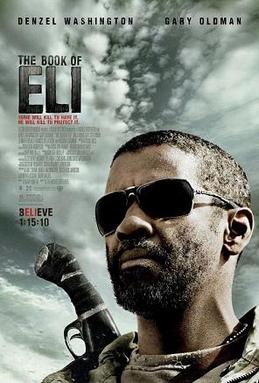
Behind the film
- Year
- 2010
- Director
- Allen Hughes, Albert Hughes
- Writers
- Gary Whitta
- Genres
- Action, Post-apocalyptic, Thriller
- Production
- Silver Pictures, Alcon Entertainment
- Country
- United States
- Cast
- Denzel Washington, Gary Oldman, Mila Kunis, Ray Stevenson, Jennifer Beals, Frances de la Tour, Michael Gambon, Tom Waits
About the film
Contains story spoilers.
The Book of Eli imagines a world where a surviving text can matter as much as food, water or a weapon. Its value is not that everyone agrees about what it means. The danger comes from the opposite condition: different people can recognise its power and want to use it for incompatible purposes. Eli carries the book as a responsibility, while Carnegie sees a means of command. That conflict lets the post-apocalyptic journey concern more than reaching a safe place. It asks what ought to survive a ruined society and whether preserving a cultural object requires preserving the possibility of reading it without being ruled by the person who owns it.
Eli travels west after nuclear devastation, carrying what he believes is the last Bible. Carnegie, who controls a settlement, wants it to influence the population. Solara accompanies Eli as pursuit turns violent. Carnegie eventually takes the book and leaves Eli wounded. Solara gets him to Alcatraz, where a community preserves cultural works. Eli, revealed to be blind, has memorised the text and dictates it before dying. Carnegie's copy is Braille, which he cannot read, and his authority is collapsing. A new edition is printed at the sanctuary; Solara takes Eli's belongings and heads home. Possession and preservation have turned out to be very different achievements.
The wasteland makes literacy a form of unequal power. In a functioning society, a book may exist among thousands of copies, competing interpretations and opportunities to learn. When those supports disappear, access can become scarce enough to control. Carnegie understands that words can organise people, giving authority a language that sounds larger than the person speaking it. The film's conflict is therefore not a claim that a particular text is automatically harmless or automatically dangerous. It concerns who is allowed to interpret it, what they want from that interpretation and whether others have the means to challenge what they are told.
Denzel Washington's Eli gives that argument an outwardly self-contained central figure. He travels with an objective that other people do not fully share, so encounters become tests of how much he will allow another person's needs to alter his course. Conviction can sustain him while also encouraging separation. The role has to connect physical competence with a mission whose importance cannot be measured only through physical success. Fighting can protect the book, but fighting alone cannot establish what will happen to it afterwards. The destination matters because the journey would be incomplete if its only result were a more successful individual owner.
Gary Oldman's Carnegie represents the competing possibility of culture as an instrument. His desire is not simply to add something rare to a collection. The book could help him turn personal force into apparently legitimate authority. That makes his antagonism different from wanting the traveller's weapons or supplies, even though those things would also be useful. He wants a way for obedience to seem meaningful. The film's damaged world gives that ambition room to grow because people need explanations and some form of order. Carnegie's willingness to use those needs reveals a distinction between providing guidance and manufacturing dependence on the person who claims to provide it.
Solara keeps the journey connected to a future that is not only Eli's. Mila Kunis's character begins within the settlement's relationships and coercions, bringing an immediate human reason to care about how its power operates. Her movement alongside Eli creates another kind of continuity: a person can learn from a traveller without becoming a copy of him. The story's eventual direction gives her a choice about where to go rather than assigning her a permanent place beside the older hero. That matters to a film about preservation. Something can be carried forward through conduct and decision, as well as through the continued existence of an object.
The final revelation rearranges the meaning of the book's physical survival. Carnegie has acquired the thing he wanted but cannot unlock what he hoped to use. Eli has lost the thing he carried but can still transmit its contents. This is a pointed reversal of the assumption that ownership equals control. The text survives through memory, language and cooperation, then becomes available for reproduction rather than remaining a prize held by one man. The sanctuary's purpose gives that reversal an institutional setting. Preserving culture is presented as ongoing work that can include different works, rather than a final victory requiring one voice to silence the others.
The film leaves its religious conviction within a wider question about the uses of inheritance. A devastated society could rebuild around the habits of domination that helped make people vulnerable, or it could create places where knowledge can be kept and shared. The journey cannot guarantee the second outcome forever, but it can contribute something to it. Eli's death makes the contribution distinct from personal survival. The work reaches beyond the person carrying it, while Solara remains able to choose an action of her own. The Book of Eli ties its action-film movement to that possibility: a future needs more than objects rescued from the past; it needs people deciding what those objects will be allowed to do.