
Behind the film
- Year
- 1980
- Director
- John Landis
- Writers
- Dan Aykroyd, John Landis
- Genres
- Musical, Comedy
- Production
- Universal Pictures
- Country
- United States
- Cast
- John Belushi, Dan Aykroyd, James Brown, Cab Calloway, Ray Charles, Aretha Franklin, Matt Murphy, Steve Cropper
About the film
Contains story spoilers.
Jake leaves prison, and Elwood collects him in the Bluesmobile. At their childhood orphanage, Sister Mary explains that the building faces closure unless it pays a $5,000 county tax bill. She rejects stolen funds, so the brothers reform their band to raise the money honestly. They track down former players, now occupied with other work, while a determined former fiancée pursues Jake. Their route brings them to a church, a country bar and a concert, where the reunited band earns the needed sum. Police and other pursuers follow them through a succession of Chicago chases. The brothers reach the county office in time to pay the bill, then are arrested and finish the story performing for fellow inmates.
The story's unlikely engine is a small, concrete debt. The orphanage does not need saving through a grand moral gesture; it needs a precise amount before a deadline, and Sister Mary insists that the money be earned. That condition gives Jake and Elwood a reason to turn their scattered past into a working band. The pair do not become earnest reformers in the usual sense. They approach the problem with the same flat confidence they bring to everything else, moving from one conversation to another as if a plan will take shape merely because they are already in motion. Their deadpan delivery makes the absurdity readable: they rarely stop to admire the scale of what is happening around them.
Music gives the story a social life beyond the brothers' immediate needs. James Brown, Aretha Franklin, Ray Charles and Cab Calloway bring distinctive presences whose performances deserve attention in their own right. The pleasure is not limited to recognising a famous face; it comes from allowing a performer to set the rhythm and authority of a scene. The brothers may have a practical reason for moving on, but the film can stay with a voice or an ensemble long enough for the performance to become the event. That creates a generous tension inside the comedy. A world assembled around a ridiculous mission still contains people doing something demanding and expressive, with the music making skill, confidence and collective effort audible rather than merely asserted.
The Chicago setting has a tactile, local quality. The brothers cross streets, bridges, shopping areas and municipal interiors, while the camera keeps the city's infrastructure close to the action. The Bluesmobile becomes a comic extension of Elwood's ability to make unlikely circumstances seem ordinary; its battered appearance contrasts with the impossible demands placed on it. The film's car sequences escalate through visible physical consequences: traffic is blocked, vehicles pile up, and a crowded city becomes a giant obstacle course. The jokes depend on geography and momentum, as well as on the contrast between a casually driven old sedan and the increasingly elaborate response it provokes.
John Landis moves between musical performance and broad physical comedy without pretending they are the same kind of spectacle. A song can hold the film still long enough to let a singer command attention; a chase pushes bodies and machines through a space until the orderly world of traffic and authority collapses. The transition between these modes is part of the pleasure. A performance may be followed by a new pursuit, but the songs are not merely fuel for another gag: they make the brothers' musical mission credible in the strange terms of the film. The large-scale car choreography then turns that mission into a public event that no longer fits inside the club or rehearsal room.
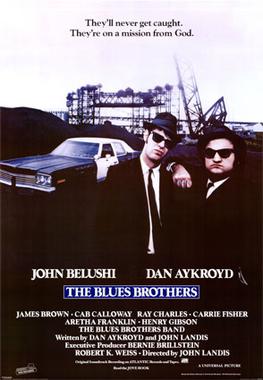
Jake and Elwood's brotherhood is expressed through their shared uniform, matched suits, hats and sunglasses, but the visual sameness does not erase their differing energies. Jake is the released performer whose absence has interrupted the band; Elwood has kept moving and assembled a life around the car and their old contacts. Their coordination often looks less like discussion than a practiced duet. Even when their choices are reckless, they show a particular loyalty to the people who once made music with them and to the institution that sheltered Jake as a child. The film finds warmth in this narrow circle of obligation rather than asking the brothers to become broadly sentimental.
The brothers' devotion creates an amusing limit to their otherwise reckless behaviour. They can take a particular obligation seriously without becoming models of responsibility in every other respect. That inconsistency makes the affection feel specific rather than ceremonial. Someone who is exasperating to a whole city can still be loyal within a narrower circle, and the film finds warmth in that selective commitment while preserving the surrounding chaos. Its musical purpose gives the extravagance a direction, but does not magically erase the consequences of getting there. The comedy allows achievement and trouble to occupy the same ending. What matters is that the brothers have found a reason to act together, with their shared rhythm remaining recognisable even when the environment insists on imposing its own order.