
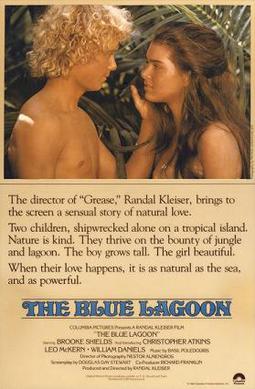
Behind the film
- Year
- 1980
- Director
- Randal Kleiser
- Writers
- Douglas Day Stewart
- Genres
- Romance, Teen, Coming-of-age, Drama
- Production
- Columbia Pictures
- Country
- United States
- Cast
- Brooke Shields, Christopher Atkins, Leo McKern, William Daniels, Alan Hopgood, Gus Mercurio
About the film
Contains story spoilers.
The Blue Lagoon imagines an island that can supply the means of survival without supplying the knowledge needed to understand a life. Richard and Emmeline have food, shelter and one another, yet their isolation removes the ordinary network through which growing children ask questions and learn what changes mean. That difference shapes the film's premise. The landscape may appear generous, but the absence of other people leaves a kind of scarcity that abundance cannot solve. Randal Kleiser's story combines an island adventure with a coming-of-age fantasy, presenting home as something the characters gradually make in a place where their original society has become almost unreachable.
Richard, Emmeline and cook Paddy survive a wreck in the South Pacific. Paddy teaches them basic rules before dying, leaving the children to grow up together. They form a household and later have a child, but remain uncertain about many ordinary changes in life. Their attachment to the island complicates opportunities for rescue. Eventually their boat drifts away without its oars, and they eat berries they believe fatal after finding their son has eaten them. Richard's father's ship finds them; an officer reports that they are sleeping rather than dead. The film closes on discovery after years of isolation, without showing the full process of returning to the wider world.
Paddy's early presence makes the loss of instruction particularly clear. Rules can be remembered after the person explaining them has gone, but remembering a warning is different from understanding all the conditions that gave it meaning. The children have to interpret the island through a small stock of inherited information and their own encounters. The film's imagined isolation therefore involves more than not knowing how to contact a ship. It leaves questions about danger, home and the body's ordinary development without a dependable person to answer them. Survival can continue while comprehension remains partial, making the apparent simplicity of the setting misleading.
The landscape creates a tension between beauty and exposure. Water, vegetation and open space can look like freedom from social demands, yet those same surroundings contain hazards and make communication difficult. A place can be visually welcoming without being organised for the safety of the people who live there. The story's island is a fantasy construction rather than an instruction in real survival, and its scenic appeal should not be mistaken for evidence that isolation is harmless. Read as a dramatic setting, it allows the audience to see two different meanings of paradise: a place that appears to offer everything, and a place whose missing relationships only become clear over time.
Brooke Shields and Christopher Atkins play the older versions of Emmeline and Richard, with Leo McKern as the adult whose limited teaching precedes their solitary life. The characters' shared history makes companionship both essential and unusually confined. They do not have the range of relationships that would normally help a person compare experiences, find advice or establish distance after an argument. Their dependence on one another consequently belongs to the premise, rather than serving as proof that two people need nobody else. The story can present attachment as sustaining while also making visible how few alternatives exist when a disagreement arises.
The question of rescue changes as the island becomes home. From outside, finding survivors would seem an uncomplicated good. From inside, return means entering a society that exists mostly through incomplete memory. This is a useful way to understand the film's uncertainty about departure without treating every decision as practical wisdom. A home can become familiar through repeated living even when it remains dangerous, and familiarity can make an unfamiliar opportunity difficult to recognise. The characters' attachment to place expresses that emotional process. It does not erase the knowledge and care that remain unavailable there, or make the original loss of community something they freely selected.
Adapted by Douglas Day Stewart from Henry De Vere Stacpoole's novel, the film also inherits the limitations of an outsider's tropical-island fantasy. Its treatment of the people associated with another part of the island serves the protagonists' fear rather than offering a developed account of another community. That imbalance is part of the constructed world, and the story's imagery should not be treated as reliable information about Pacific cultures. The island has been arranged around what isolation means for Richard and Emmeline. Keeping that perspective visible allows the central survival premise to be considered without mistaking the setting for an impartial picture of the region or its inhabitants.
The final discovery brings an outside observer back into a story that has largely been organised by the pair's limited understanding. Their belief about the berries and the officer's assessment do not match, showing again that what they know is not everything there is to know. The ending offers survival without making the years of isolation easily reversible. A ship can find a family, but the film leaves the adjustment to another life beyond its closing moment. The Blue Lagoon's central contrast remains the difference between having a place to live and having a wider world in which to understand that life, with the beauty of its imagined refuge unable to remove the importance of connection.