
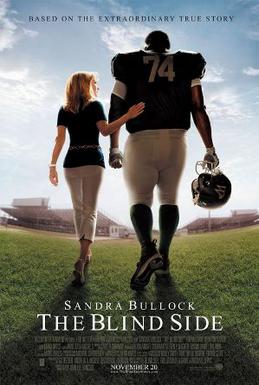
Behind the film
- Year
- 2009
- Director
- John Lee Hancock
- Writers
- John Lee Hancock
- Genres
- Comedy drama, Drama, Biographical, American football
- Production
- Alcon Entertainment, Fortis Films
- Country
- United States
- Cast
- Sandra Bullock, Tim McGraw, Quinton Aaron, Kathy Bates, Jae Head, Lily Collins, Ray McKinnon, Kim Dickens
About the film
Contains story spoilers.
The Blind Side is a sports drama that locates much of its emotional action away from the field. Meals, bedrooms, schoolwork and conversation establish the conditions through which its version of Michael Oher's future becomes possible. John Lee Hancock adapts material from Michael Lewis into an accessible story of belonging, with Quinton Aaron playing a young man whose quietness is frequently interpreted by the people around him. That interpretation is central to understanding the film. Michael is the person whose life changes, but other characters often explain what those changes mean. The account here concerns the drama's construction of that life, rather than treating a scripted performance as a complete biography of the real athlete.
Michael enters a private school with little academic support and an insecure living situation. Leigh Anne Tuohy offers him shelter after finding him out in the cold, and he becomes increasingly involved in her household. Her husband Sean, children Collins and SJ, and tutor Miss Sue help form the film's network of encouragement. Michael's school performance improves alongside his football prospects, attracting college recruiters. His choice of Ole Miss leads an NCAA investigator to question whether the Tuohys influenced him for their own benefit. Michael confronts Leigh Anne about her motives before explaining his decision as an expression of belonging. He leaves for college, and the closing material connects the dramatised journey to his entry into professional football, giving the film's family story a sporting endpoint.
Sandra Bullock's Leigh Anne gives the narrative its most forceful movement. Her decisiveness can cut through social hesitation, and the film presents that quality as a practical advantage when others are prepared to leave an uncomfortable situation alone. Bullock makes concern sound like something that expects a result, not simply a sentiment expressed at a distance. Yet this emphasis also shapes the perspective of the drama. A character who takes charge can become the person through whom the audience understands everyone else. The story's warmth therefore sits beside a question about narrative ownership: helping someone and becoming the chief interpreter of his experience are different actions, even when the film places them closely together.
Aaron's Michael offers a quieter counterweight. The performance allows pauses and uncertainty to register without requiring every feeling to become an explanatory speech. That reserve can give the character dignity, but it also makes it important to notice when other people fill the silence for him. An inspirational story often needs to demonstrate visible progress, whereas a person's interior life need not follow an equally tidy sequence. The film moves between these demands. Athletic improvement supplies moments an audience can recognise quickly; the more difficult question is what Michael understands about the relationships supporting that improvement. Belonging gains meaning only if it includes room for a person's judgment, rather than just acceptance of the opportunities arranged around him.
The household provides the drama with a scale for examining that distinction. Tim McGraw's Sean and the children make support look like an accumulation of ordinary contact instead of a single grand gesture. A family routine involves time, habits and the assumption that someone will still be present tomorrow. Those elements can matter as much to the film's emotional logic as a moment of decisive intervention. The contrast between insecurity and continuity gives domestic space its force. It also exposes how much an audience may take continuity for granted when a story begins with people who already possess it. Comfort is not merely an attractive setting here; it is a resource distributed unevenly between the characters.
Kathy Bates's Miss Sue brings learning into that picture of support. Tutoring makes effort less spectacular than a successful play but no less necessary to the route the film describes. The classroom and the field both judge performance, although they demand different forms of preparation and recognition. A sports narrative can make talent look like destiny, yet this one repeatedly places the future inside systems that decide who qualifies and who receives access. Coaches, teachers and recruiters are not simply background figures. Their expectations affect what a young person is permitted to attempt. The film's practical details therefore matter beyond the uplifting arc: opportunity depends partly on being legible to institutions that already have their own measures of promise.
The recruitment conflict turns that opportunity into a question of motive. A generous act can produce advantages for more than one person, which makes the relationship harder to describe through a single reassuring word. The film introduces doubt within its otherwise affirmative family account, briefly allowing Michael to ask whether the story he has accepted is the whole story. That moment is important because gratitude can become a pressure to avoid difficult questions. Affection need not disappear when a person asks who benefits, and support need not become meaningless when it is examined. The drama's answer belongs to its chosen emotional structure; it should not replace independent attention to the fuller lives of the people whose names it uses.
Hancock keeps the storytelling focused on recognisable gestures, clear contrasts and a future that can be pictured through sport. That clarity makes the film's promise easy to follow: stability and sustained attention can help a young person move toward possibilities previously out of reach. It also creates the limits of the portrait, since a coherent inspirational arc cannot contain every ambiguity of a real relationship. The film is most usefully approached with both aspects visible. Its scenes invite emotional investment in a version of support and belonging, while its selection of perspective invites questions about voice, agency and the difference between being included in a household and being allowed to tell one's own story.