
Behind the film
- Year
- 1915
- Director
- D. W. Griffith
- Writers
- D. W. Griffith, Frank E. Woods
- Genres
- Drama, Historical, Silent
- Production
- David W. Griffith Corp.
- Country
- United States
- Cast
- Lillian Gish, Mae Marsh, Henry B. Walthall, Miriam Cooper, Ralph Lewis, George Siegmann, Walter Long, Robert Harron
About the film
Contains story spoilers.
D. W. Griffith's 1915 silent epic follows the Northern Stonemans and Southern Camerons from the years before the Civil War through Reconstruction. Phil Stoneman visits his friend Ben Cameron in South Carolina, and the families form romantic bonds across the coming divide: Phil courts Ben's sister Margaret, while Ben becomes attached to Elsie Stoneman through her portrait. Their closeness gives the film a melodramatic frame for national conflict, but its perspective is profoundly racist. The movie romanticizes the Confederacy and presents Black political participation as a threat to white society. That is a constructed white-supremacist narrative, not reliable history of emancipation or Reconstruction; the film's invented framing should not be confused with the historical record.
War separates the young men into opposing armies. The film gives their friendship sentimental weight even as it stages battles on a grand scale: Tod Stoneman and Duke Cameron die together, the Cameron home is raided, and Ben is wounded during the fighting around Petersburg. Phil rescues him, and Ben is taken to a Washington hospital, where he meets Elsie while she works as a nurse. These linked encounters let the movie cut between intimate romance and historical spectacle. The families' suffering is made central, while the broader realities of slavery, Black military service and emancipation are reduced or filtered through Griffith's distorted viewpoint. The relationship between Phil and Margaret also becomes a channel for the story's reconciliation of its white northern and southern characters.
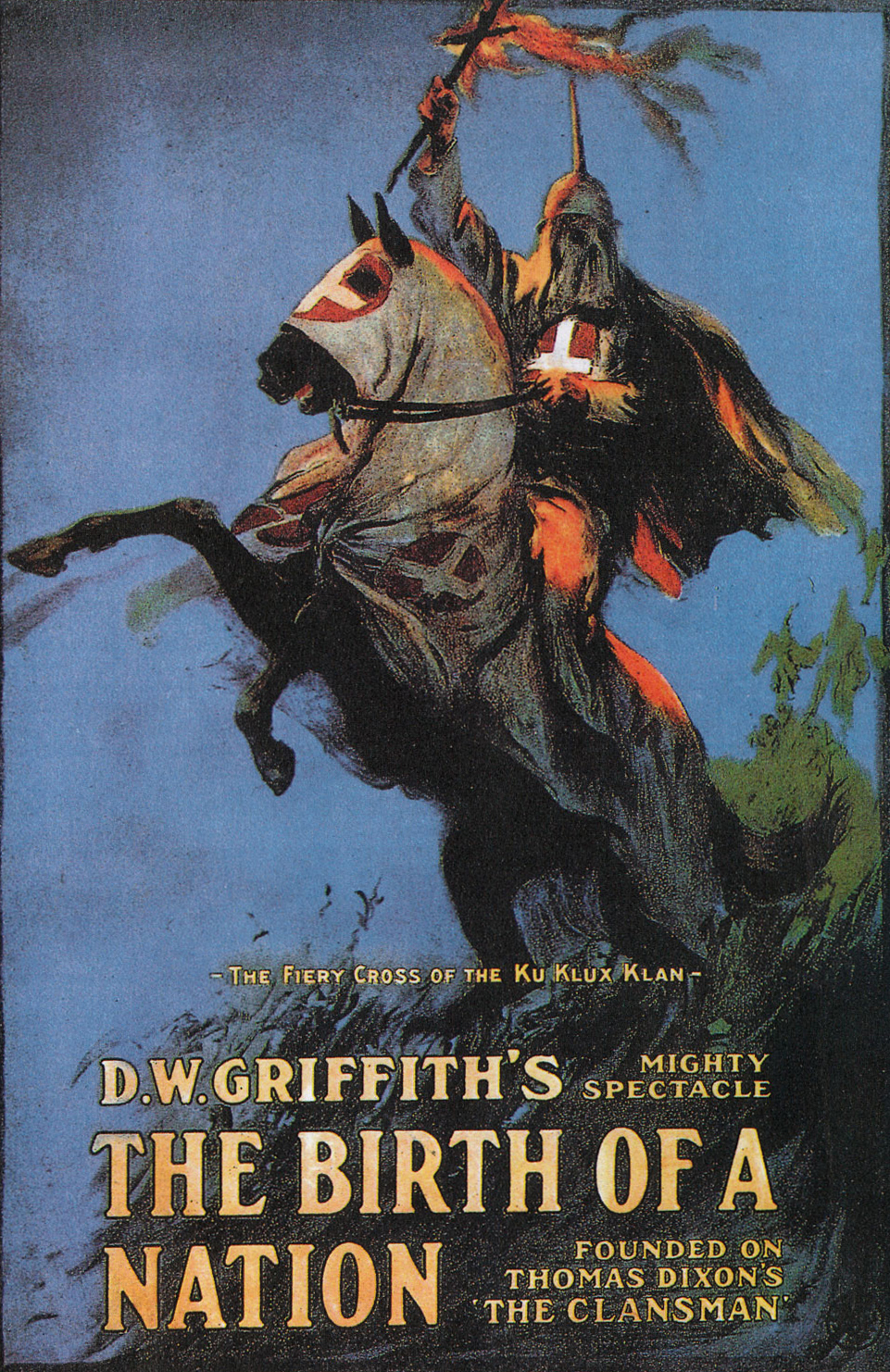
After Lincoln's assassination, the film shifts to Reconstruction and depicts congressman Austin Stoneman sending his protégé Silas Lynch to South Carolina. It falsely frames Black voters and officeholders as corrupt usurpers, using caricatured images of the legislature and courts to suggest that political equality is disorder. Ben responds to what the film calls injustice by forming the Ku Klux Klan. In reality the Klan terrorized Black communities and their supporters; the movie's image of it as a force for rightful restoration is propaganda. Its intertitles and melodramatic staging encourage the audience to accept that reversal of fact. Cuts between domestic fears and political scenes make those fears appear to explain why other citizens’ rights should be curtailed.
The film's melodrama then turns on two women in danger as framed by its racist mythology. Gus, a Black soldier, approaches Flora Cameron in the woods and asks her to marry him; the movie presents his presence as a sexual threat, and Flora runs from him and falls from a cliff. The scene is not evidence about Black soldiers or freed people; it is a fabricated device that the story uses to justify white violence. Ben's group captures and kills Gus. Elsie also breaks her engagement to Ben when she learns he is a clansman, while Lynch later seeks to force her into marriage after gaining political power. Both plot lines make white women's peril the rationale for racist violence.
The final movement crosscuts the Klan's ride with danger at Elsie's home and the entrapment of other Cameron family members. The mounted riders arrive to rescue Elsie and Stoneman, then free the other family members. The film presents the Klan's suppression of Black political rights as the path to peace. Phil and Margaret and Ben and Elsie are united in two marriages; an allegorical epilogue turns the reunion of white North and South into a vision of national harmony. That resolution rests on exclusion and threat, not reconciliation among all Americans. The story's triumphant ending is therefore also its most explicit claim about the Klan, a claim that conflicts with the documented history of racial terror and the struggle over Reconstruction.
The movie's historical impact includes organized opposition. The NAACP challenged its distortions and protested screenings soon after release; Those protests made the film part of a public political struggle over its representation of the past. Griffith's large-scale editing, parallel action and movement between intimate scenes and crowded battle tableaux helped shape feature filmmaking, but formal innovation cannot be separated from the political force of the images. White actors in blackface perform several Black characters, whose roles are written through demeaning stereotypes. The film can be studied as a landmark of silent-era technique and as a damaging work of propaganda; neither fact cancels the other. It depicts a false version of the past with enough visual authority to make its omissions and fabrications part of its historical legacy.
The film's personal plot repeatedly uses portraits and family recognition to connect its divided story. Elsie's image first becomes an object of Ben's attention when he takes the locket, and the film carries that association forward through separation, war and the later reunion. Margaret's marriage to Phil offers a second path through the same years, organized around a different family bond and a harsher change in circumstance. Such devices make the paired romances easy to follow in a silent epic with a large cast, but they also direct sympathy toward the film's white characters while Black characters are reduced to racist caricatures. The melodramatic design is inseparable from that distorted point of view.