
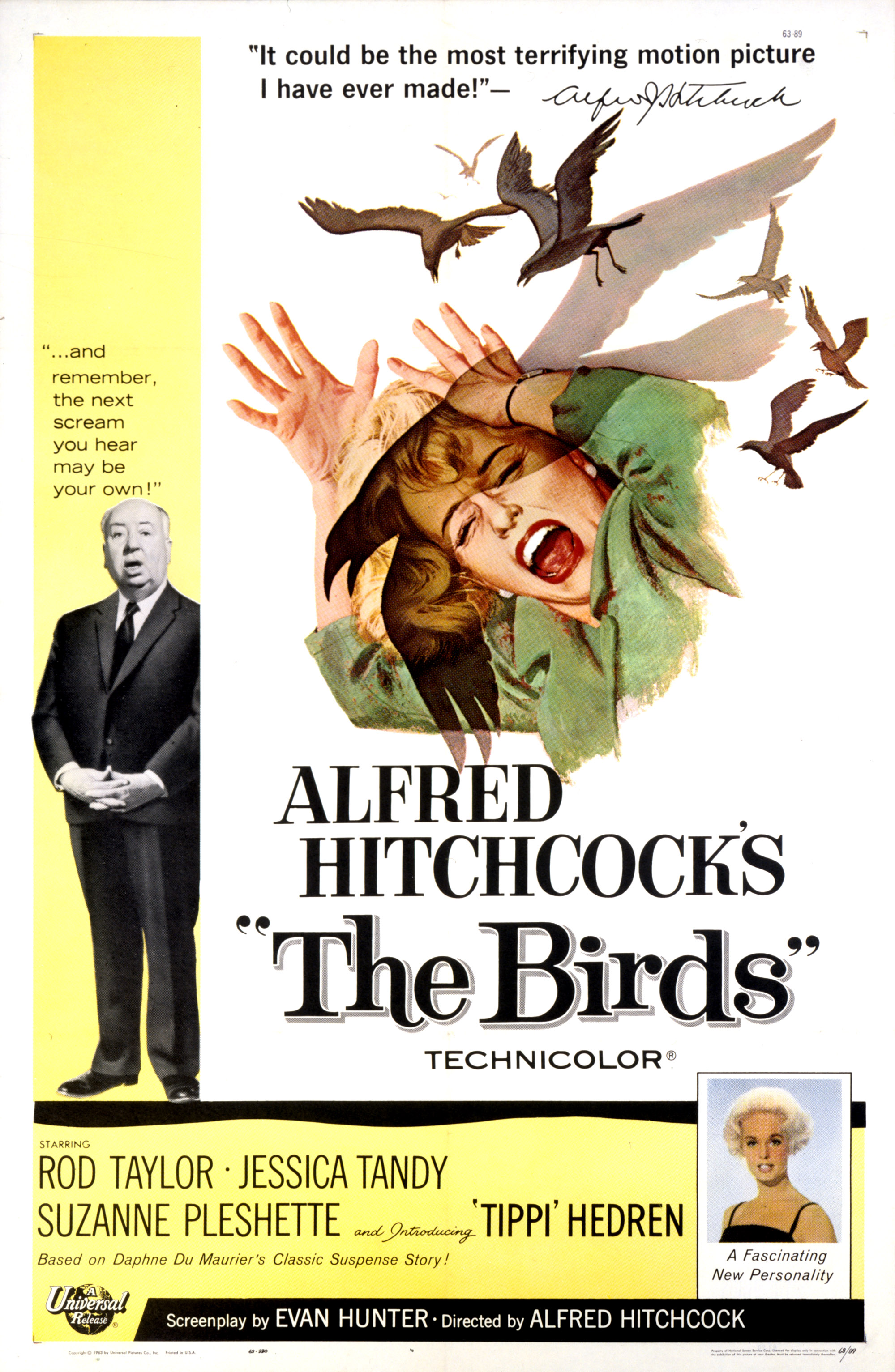
Behind the film
- Year
- 1963
- Director
- Alfred Hitchcock
- Writers
- Evan Hunter
- Genres
- Adventure, Horror, Mystery, Natural horror
- Production
- Universal Pictures
- Country
- United States
- Cast
- Rod Taylor, Jessica Tandy, Suzanne Pleshette, Tippi Hedren, Veronica Cartwright, Charles McGraw, Ruth McDevitt, Ethel Griffies
About the film
Contains story spoilers.
The Birds does not begin as an account of catastrophe. Melanie Daniels meets lawyer Mitch Brenner in a San Francisco pet shop, where he recognizes her and plays along with her attempt to act like an employee. Their exchange is a contest of social confidence, with attraction mixed into the irritation. Learning that he wants lovebirds for his young sister, Melanie buys a pair and travels to Bodega Bay to deliver them without warning. The effort is elaborate enough to reveal how interested she has become, while allowing her to present it as a joke. Her arrival in the town is therefore tied to a relationship rather than an investigation of anything supernatural.
A gull strikes Melanie as she returns by boat from leaving the gift at the Brenner house. The incident is unsettling but still small enough to seem isolated. Mitch helps her, and she finds reasons to stay, taking a room with schoolteacher Annie Hayworth. Annie once had a relationship with Mitch and has chosen to remain in the town after it ended. She understands his family better than Melanie does, especially his widowed mother Lydia's fear of being abandoned. These conversations establish emotional tensions that are recognizable without the birds: a newcomer attracts attention, an older relationship still matters, and a household is unsure what her presence might change.
At Cathy's birthday party, the attacks stop looking like an individual accident. Birds descend on the children, interrupting an event built around play and reassurance. Later, birds come down the Brenner chimney, carrying the threat directly into a domestic space. Lydia's visit to a neighboring farmer brings a still more terrible discovery, confirming that the danger can kill rather than merely frighten or wound. Alfred Hitchcock allows the scale of the problem to emerge through places and people the characters already know. A garden, a living room and a farm are not exotic settings; their familiarity makes the sudden loss of control harder to absorb.
One of the film's most sustained sequences begins while Melanie waits outside the school. The children are singing indoors, and she sits near the playground without noticing how many crows are gathering behind her. The audience can recognize the growing number before she turns to see what has happened. When she warns Annie, protecting the children becomes a choice between remaining in a vulnerable building and attempting to move them through open space. Their escape produces another attack, transforming the route away from school into a place of pursuit. The scene makes watching and not watching matter: danger accumulates during an apparently uneventful wait, and noticing it does not supply an easy solution.
In the diner, people try to explain events through competing kinds of certainty. An expert rejects the idea that birds would behave this way, another person reaches for a prediction of disaster, and a frightened mother associates the attacks with Melanie's arrival. None of those reactions becomes the film's authoritative answer. Outside, spilled fuel catches fire during another attack, expanding the destruction without requiring the birds themselves to understand machinery. Melanie takes refuge in a telephone booth that lets her see the chaos while offering only limited protection from it. The transparent enclosure captures the predicament: she is close enough to recognize what is happening but unable to make the outside world safe.
Mitch and Melanie find that Annie has died protecting Cathy. The loss removes someone who had been both a possible rival and a practical source of support, leaving the surviving group more dependent on one another. Back at the Brenner home, Mitch boards openings and prepares for the next assault, but the birds test the house rather than respecting its boundaries. Melanie later investigates a sound upstairs and is trapped in a room where birds have entered through the roof. Mitch rescues her after a severe attack. Her earlier ease with playful risk has disappeared, and the family must now consider how to move an injured, traumatized person through a landscape they cannot control.
The ending refuses the usual satisfaction of identifying and defeating an enemy. Morning brings a pause, not proof that the attacks are over. Birds cover the surrounding ground while Mitch prepares the car, and the radio suggests that the disturbance extends beyond this one house. Cathy takes the lovebirds with her, retaining the small gift that began Melanie's visit even though birds have become the source of terror. The group moves carefully into the car and drives away under the watch of the gathered flocks. Their immediate escape is possible, but the film does not show a cure, explain the cause or promise that the route ahead will remain open.
Evan Hunter's screenplay reshapes Daphne du Maurier's premise around this California community, and the performances make its changing relationships as important as its physical danger. Tippi Hedren's Melanie gradually loses the composure she brought to town, while Jessica Tandy gives Lydia's apprehension a more intimate place inside the crisis. Rod Taylor and Suzanne Pleshette supply different forms of practical care as Mitch and Annie. The soundtrack works without a conventional dramatic score, relying on silence, ordinary voices and the electronic bird sounds associated with Oskar Sala and Remi Gassmann. There is no reassuring musical explanation for when danger has passed. The quiet at the end can be heard as relief, but it is also another interval whose duration nobody knows.