
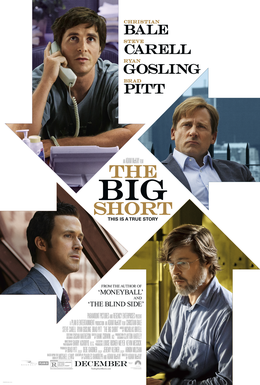
Behind the film
- Year
- 2015
- Director
- Adam McKay
- Writers
- Adam McKay, Charles Randolph
- Runtime
- 2h 10m
- Genres
- Biographical, Drama, Crime, Comedy drama
- Production
- Plan B Entertainment, Regency Enterprises, Paramount Pictures
- Country
- United States
- Cast
- Christian Bale, Steve Carell, Ryan Gosling, Brad Pitt, John Magaro, Finn Wittrock, Marisa Tomei, Rafe Spall
About the film
Contains story spoilers.
The film follows investors who spot danger in the US mortgage market before the 2008 crash. Michael Burry buys credit-default swaps against mortgage bonds; Jared Vennett learns of his bet and pitches it to Mark Baum's skeptical team. Young traders Charlie Geller and Jamie Shipley find the pitch and enlist retired trader Ben Rickert. Their investigations uncover weak loans, misleading ratings and products whose risks are obscured. Burry's clients challenge him over premiums, while Baum's team searches for evidence in Florida. Even as defaults climb, the bets lose value for months, testing the investors' resolve. When the housing market collapses, their positions pay off as banks fail. Baum delays selling before taking profit; Burry, Vennett, Geller, Shipley and Rickert leave with different responses to the consequences. The ending notes that similar financial products return under another name.
The film makes a difficult financial mechanism legible by treating it as a chain of incentives rather than a lecture in vocabulary. Mortgages become bonds, bonds become layered products, and those products are assigned reassuring grades by institutions paid by the companies they rate. The characters do not discover one secret switch that causes everything; they follow a series of choices that make each participant's risk look manageable in isolation. That structure is essential to the story's tension. A loan can be unsound, but the danger becomes systemic when the loan's weakness is hidden inside instruments that are sold as diversified or protected.
Its central figures have distinct ways of looking at the same evidence. Burry is patient and numerical, willing to endure months of being treated as wrong because his calculations tell him the market's confidence is misplaced. Baum begins from moral disgust at the financial industry and has to decide whether disgust is enough to justify a trade that profits from other people's losses. Vennett is a salesman who sees the opportunity as well as the pitch. Geller and Shipley are young enough to regard a massive bet as an adventure until Rickert forces them to consider the consequences beyond their fund. The ensemble works because none of these stances is identical to simply being clever.
Rickert's presence changes the film's moral temperature. He has stepped away from trading and does not share the younger pair's appetite for proving themselves in a financial contest. He understands that a successful short position is a wager on economic damage, not an abstract win on a screen. His caution does not make him a moral judge standing outside the system, since he helps them execute the investment, but it gives the story a character who insists on naming the social reality behind the payoff. The film uses that difference to keep its protagonists from appearing like uncomplicated heroes merely because they identified a failure before others did.
The movie's explanations are also part of its style. It interrupts dramatic scenes with direct-to-camera asides and short demonstrations that translate specialist language into everyday analogies. These breaks acknowledge that the characters and audience are navigating a system whose jargon can be used to obscure rather than clarify. Celebrity cameos do not simply decorate the film; they signal a temporary change of register, letting an explanation arrive as a deliberately artificial performance instead of pretending that every viewer already understands the terms. The device creates comic release while reinforcing a serious point: opacity itself is one of the market's advantages.
Adam McKay's restless editing turns finance into a physical feeling of acceleration. News footage, market screens, conference rooms and private conversations cut against one another as the bets are placed and then appear to fail before they mature. The waiting is dramatic because the characters have taken positions that lose money for a long time before they become valuable. That delay prevents the story from reducing risk to instant insight. A trade can be intellectually right and still feel disastrous while the surrounding market continues to reward the opposite belief. The film's momentum comes from holding that contradiction in view rather than making discovery equal immediate vindication.
The setting moves between the polished spaces where the products are sold and the places where the underlying loans are originated. Those changes of scale matter: conference rhetoric and financial abstraction are brought into contact with empty developments and people seeking mortgages. The film's argument is not that every homeowner or every market participant acted from the same motive. It shows how the contracts and incentives make broad vulnerability possible while allowing individual firms to claim that their own slice is safe. That is why a technical instrument becomes a social subject in the story, not just a clever betting vehicle.
By the end, the winnings do not settle the characters' different questions. Some close their positions and withdraw from the work; others continue in finance or leave with a changed sense of what their success represents. The final note about new products appearing under a different name resists a comforting idea that exposure alone repairs a system. The film's humor keeps it moving, but its deepest structural choice is to make explanation and consequence inseparable: once the audience understands how the wager functions, it also understands why being right about the collapse cannot feel like a clean triumph. This is a dramatized account of the crisis, with characters and incidents arranged for a narrative; it does not offer a complete historical record or instructions for investing.