
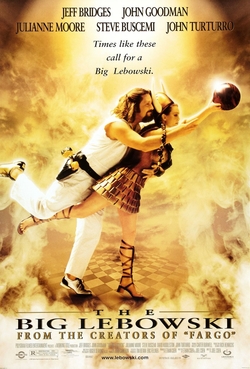
Behind the film
- Year
- 1998
- Director
- Joel Coen
- Writers
- Ethan Coen, Joel Coen
- Runtime
- 1h 57m
- Genres
- Comedy, Crime, Comedy of error, Film noir
- Production
- Working Title Films, PolyGram Filmed Entertainment
- Country
- United States, United Kingdom
- Cast
- Jeff Bridges, John Goodman, Julianne Moore, Steve Buscemi, John Turturro, David Huddleston, Philip Seymour Hoffman, Ben Gazzara
About the film
Contains story spoilers.
The Dude's life in Los Angeles is built around modest routines: bowling with Walter and Donny, listening to music, and avoiding responsibilities that seem larger than the day requires. That rhythm is interrupted when two thugs enter his apartment, mistake him for another Jeffrey Lebowski, and soil his rug while demanding money connected to the wealthy man's wife. The rug matters because it gave the shabby room a small measure of comfort, not because it represents a fortune. The mistaken identity sets the plot in motion, while the Dude's relaxed response to an absurd intrusion establishes the film's comic scale: people around him treat every inconvenience as a crisis or a conspiracy.
The Dude visits the other Lebowski at his mansion to ask for compensation. The older man is wheelchair-bound, guarded by assistant Brandt, and treats the request as an insult rather than a reasonable grievance. The Dude leaves with a replacement rug, but the encounter also pulls him into the story of Bunny, the rich man's wife, who is believed to have been kidnapped. Brandt and Lebowski want him to deliver ransom money, hoping that his connection to the first mistaken visit will make the exchange workable. The Dude accepts the job without becoming a detective in the conventional sense; he is a reluctant courier whose main qualification is that he has wandered into the right room. The wealthy Lebowski's grand interior and clipped manners contrast sharply with the Dude's cluttered apartment, but neither setting makes its occupant more competent. The replacement rug transfers Maude's property into the Dude's home and accidentally gives her a reason to seek him out.
Walter turns the proposed exchange into his own operation. A Vietnam veteran who sees clear rules in a disorderly world, he insists that the kidnappers receive a briefcase containing dirty laundry rather than the money. The drop goes wrong, and the case is taken; later the Dude's car is stolen with the ransom inside. A severed toe arrives as proof that Bunny is in danger, leading Walter to treat the crisis as a military problem and the Dude to ask increasingly basic questions. The contrast between them supplies much of the comedy: Walter's certainty creates new trouble, while the Dude's refusal to adopt anyone else's urgency keeps him from noticing how many people are using the case for their own ends. Walter's insistence on rules feels almost plausible because he can explain each tactic with confidence. He treats the failed exchange as proof that others have violated his logic. The comedy comes from watching a coherent plan meet people who have not agreed to play by it, especially when Donny's gentle questions expose how much Walter ignores.
The investigation spreads to Maude Lebowski, the rich man's adult daughter, who reveals that the replacement rug belonged to her and wants it back. She suspects her father has diverted money from a charity connected to her late mother, so Bunny's disappearance may be useful to him. The Dude visits pornographer Jackie Treehorn, who offers another version of events and drugs his drink, sending him into one of the film's extended dream sequences. Elsewhere, the nihilists who claim responsibility for the kidnapping threaten him, while a private investigator appears to be watching the same circle. The recovered car brings another lead through a teenager’s homework. Walter’s confrontation with the boy ends with him destroying a neighbour’s car after mistaking it for the teenager’s, illustrating how decisively he can act on a false assumption. Maude's account shifts the case toward inheritance and charity, while Treehorn's account turns it into a low-rent noir maze. The film lets these versions coexist long enough for the Dude to be confused without making the audience believe every speaker has equal insight.
Walter and the Dude eventually discover that Bunny has returned from a trip and was never kidnapped. The nihilists were bluffing, and the Dude concludes that the case he received never held the promised ransom: the wealthy Lebowski has used the supposed kidnapping to divert charitable funds. Walter accuses the wheelchair-bound man of faking his disability and dumps him from the chair, but the wealthy Lebowski's disability is real. These revelations untangle the apparent crime while preserving a smaller, more human frustration: the Dude's car is gone, his rug has been abused, and Walter's insistence on controlling events has cost them far more than it solved. Their response to the nihilists' final attack leads to Donny's fatal heart attack, shifting the comic case into a brief moment of genuine grief.
At the beach, Walter and the Dude scatter Donny's ashes, though Walter's attempt at a solemn military speech blows the ashes back across them. The awkwardness does not erase their affection; it shows how poorly Walter's rituals fit the people he is trying to honor. The film then returns to the bowling alley, where the Stranger's frame story and Maude's pregnancy place the Dude's drifting days inside a larger, deliberately loose circle. Joel Coen's detective-story structure keeps offering clues without rewarding the expectation that each one will lock into a clean solution. Bowling, dream imagery and sun-bleached Los Angeles locations give the confusion a steady texture, so the plot can wander while the characters remain unmistakably themselves. The bowling alley links the separate episodes through familiar faces, recurring competition and the unhurried pace of a neighborhood ritual. Its steadiness lets the film move between slapstick, fantasy and mourning without pretending those tones have become one simple mystery.