
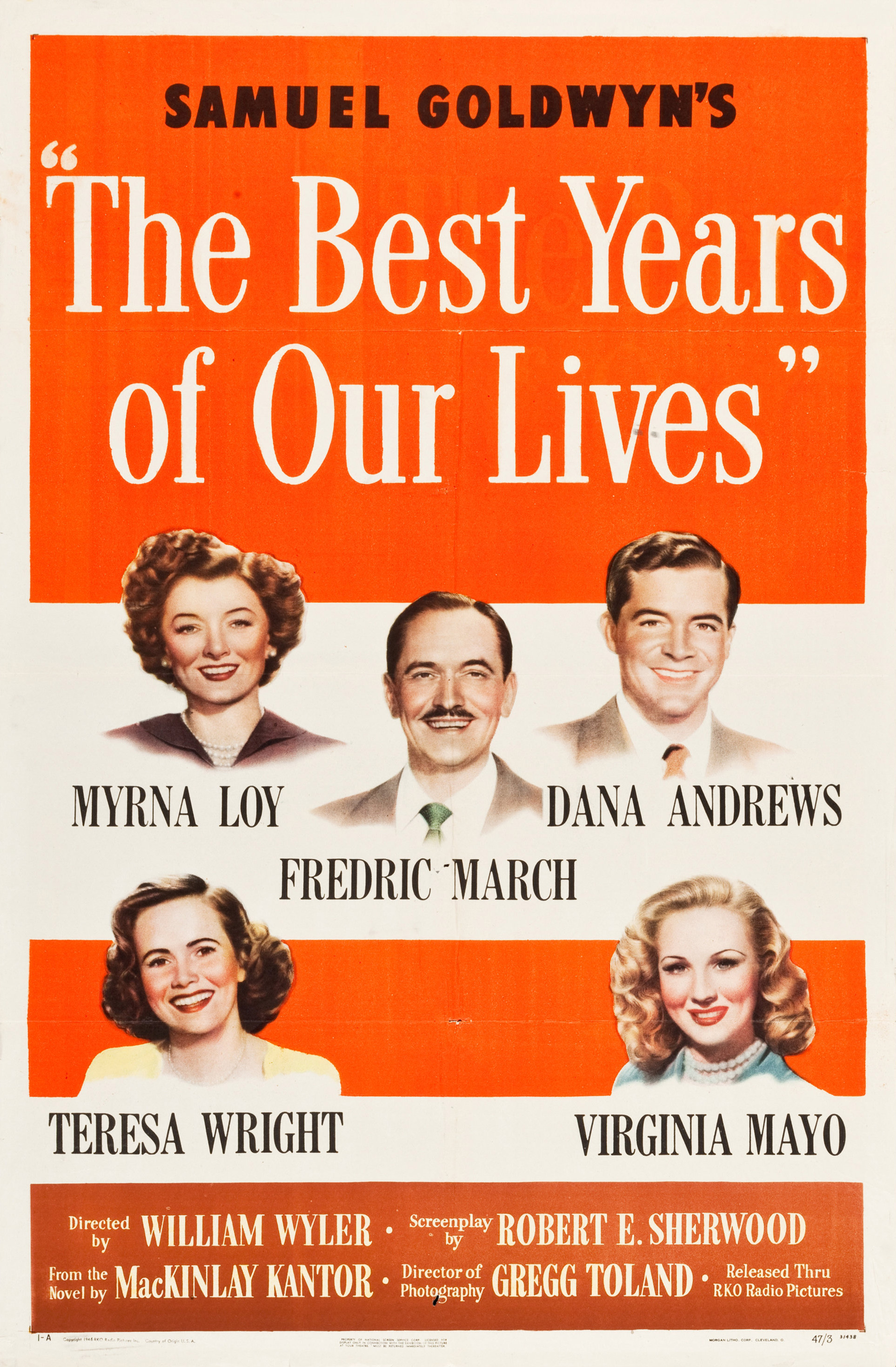
Behind the film
- Year
- 1946
- Director
- William Wyler
- Writers
- Robert E. Sherwood
- Genres
- War, Drama
- Production
- Samuel Goldwyn Productions, RKO Pictures
- Country
- United States
- Cast
- Myrna Loy, Fredric March, Dana Andrews, Teresa Wright, Virginia Mayo, Cathy O'Donnell, Harold Russell, Hoagy Carmichael
About the film
Contains story spoilers.
Three servicemen meet on their flight home to Boone City: banker Al Stephenson, former soda jerk Fred Derry and sailor Homer Parrish, who has lost both hands and uses prosthetic hooks. Their homecomings are uneven. Al finds his family changed by his long absence; Fred discovers that his wife Marie has moved out and struggles to find work; Homer worries that Wilma will not accept his disability. Al takes a risk on a veteran seeking a loan, while Fred and Al’s daughter Peggy grow close. Homer eventually lets Wilma see the practical limits of his independence, and she chooses to stay. Fred’s marriage ends, but a job dismantling surplus aircraft gives him a new direction. At Homer and Wilma’s wedding, Fred and Peggy acknowledge their love with a kiss, leaving their future open but hopeful.
William Wyler builds the film around return rather than battle. The war appears through what the men bring home: habits, injuries, memories and expectations that do not fit neatly into the rooms waiting for them. Their shared plane ride makes an effective starting point because it gives people with different ranks and backgrounds a brief common space before they disperse into separate families and jobs. The narrative then follows how the same national event produces sharply different private adjustments. No one’s experience stands in for all veterans; the film gives three particular lives enough room to remain distinct.
Al’s story exposes the gap between a respectable public position and the private unease that can accompany it. Fredric March plays him as a man accustomed to responsibility, but his return disrupts the routines that made that responsibility feel natural. His work at the bank places him within a system that values collateral and caution, while his experience has made him think about what people deserve when conventional measures fail. The film avoids treating his wartime service as a guarantee of wisdom; Al still has to learn how his choices affect the family and community to which he has returned.
Fred’s troubles are shaped by class as well as trauma. He enters civilian life with fewer resources than Al, and his wartime status cannot immediately secure a job or repair his marriage. Dana Andrews gives Fred an appealing reserve, but the character’s restraint also hides disorientation and anger. He has imagined a modest home and steady work as the reward waiting after service; finding that the world has moved on makes that dream feel almost embarrassing to admit. His route toward a new occupation is less a triumph than a chance to build a life from available materials.
Homer’s return makes the film’s attention to disability concrete and unusually sustained for its period. Harold Russell, who lost both hands in military service, brings a practical knowledge of the hooks that an ordinary casting choice could not reproduce in the same way. The character’s central worry is not whether he can perform a single task, but how intimacy and daily dependence might change his relationship with Wilma. The film treats adaptation as skill rather than miracle. Homer’s capacity and vulnerability coexist, and the question of marriage turns on whether a partner can understand both without pity replacing affection.
The supporting relationships give each veteran a different measure of home. Myrna Loy’s Milly and Teresa Wright’s Peggy are not merely witnesses to Al’s adjustment; they have also lived through his absence and developed their own expectations. Virginia Mayo’s Marie complicates the romantic image of a homecoming, while Cathy O’Donnell’s Wilma expresses commitment without pretending that practical care is effortless. These women do not all respond in the same way, and the film’s emotional world depends on those differences. Home is a set of relationships that must be renegotiated, not a place preserved untouched until a serviceman returns.
Gregg Toland’s black-and-white photography supports the film’s attention to ordinary spaces. Offices, family rooms, bars and discarded aircraft are made visually specific, allowing the characters’ circumstances to register through setting rather than explanatory speeches alone. The image can hold people in a shared frame while keeping their emotional distances visible. That restraint suits the story’s episodic design: a household conversation or a workplace decision can matter as much as a public milestone. The production’s Midwestern town is fictional, but its streets and institutions give the men’s return an everyday texture.
The film leaves room for hope without making successful adjustment a test that every returning person ought to pass on schedule. Its imagined town can welcome its veterans and still fail to understand the lives they have brought back. That tension gives the title more than one possible meaning: cherished years can also contain absence, and peace does not automatically restore what war interrupted. The story's attention to relationships makes rebuilding look like shared work. A household, a workplace or a romance can change the conditions of somebody's future without removing every difficulty. Its generosity rests in taking those ordinary possibilities seriously, allowing progress to be modest rather than demanding a spectacular cure for everything the men have lost.