
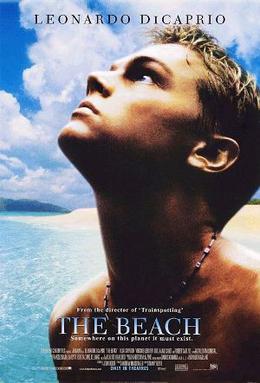
Behind the film
- Year
- 2000
- Director
- Danny Boyle
- Writers
- John Hodge
- Runtime
- 1h 59m theatrical cut
- Genres
- Psychological thriller, Drama, Adventure, Melodrama
- Production
- 20th Century Studios
- Country
- United Kingdom, United States, Thailand
- Cast
- Leonardo DiCaprio, Virginie Ledoyen, Guillaume Canet, Tilda Swinton, Robert Carlyle, Paterson Joseph, Peter Youngblood Hills
About the film
Contains story spoilers.
In Bangkok, American traveller Richard receives a map from Daffy, who then kills himself. Richard copies it for other travellers before joining Françoise and Étienne on the search for an isolated beach community. Sal leads its residents, whose secrecy depends on an agreement with the island's cannabis farmers. Richard begins an affair with Françoise, then becomes involved with Sal. A shark attack leaves Christo badly injured; he resists returning to the mainland, while Sal refuses to bring a doctor to the island. Richard is sent to watch for the travellers who received his copied map. Farmers kill the newcomers, and Richard later smothers the suffering Christo. The farmers confront the community and demand that Sal shoot Richard or everyone leave. She pulls the trigger on an empty chamber. Her choice destroys the residents' trust, and they abandon her and the island. Richard eventually receives a photograph of their former life together.
The beach begins as a traveller’s fantasy of escape. Bangkok is crowded, noisy, and full of chance encounters; the map promises a place outside the ordinary circuit. Yet the island is not untouched nature. It is a managed community with rules about labour, food, secrecy, and membership. Its residents have made a society, not discovered a blank space. Richard’s attraction is partly curiosity and partly a desire to become the person who has found something rare. Leonardo DiCaprio plays that mix of openness and self-dramatization, letting Richard’s confidence feel energetic while hinting that his account may be incomplete.
Sal gives the settlement its political shape. Tilda Swinton plays her as practical, charismatic, and increasingly invested in control. Her rules initially seem necessary: a hidden community cannot survive if it becomes a tourist attraction. But secrecy gradually hardens into exclusion, and her decisions reveal who is expected to absorb the costs. Richard is welcomed because he can contribute, yet also because he renews the group’s sense of adventure. Sal’s authority relies on preserving a shared fantasy, even when the facts on the ground make that fantasy difficult to defend.
Richard’s narration is one of the film’s central formal choices. He filters events through references, imagined scenarios, and the language of games. That voice makes him an engaging guide while revealing his tendency to turn consequences into stories about himself. When the island stops matching his imagined adventure, the gap between narration and reality becomes part of the drama. He wants to believe he can observe danger without being implicated in it. The plot steadily removes that distance: his choices affect the community, and his understanding is shaped by the desire to remain a hero in his own account.
Desire unsettles the community's claim to be an uncomplicated refuge. Richard wants belonging, novelty and the freedom to follow attraction, but those wants do not necessarily fit together. Françoise and Étienne give the social world an intimacy that Richard's adventurous narration tends to flatten. Other people cannot remain supporting figures in his ideal version of himself. The film's unease grows from that resistance: a place can feel liberating while relationships inside it become possessive. Sal's authority adds another layer, because intimacy and leadership are difficult to separate in such a small group. The characters have escaped some ordinary restrictions, yet have brought expectations about status, loyalty and entitlement with them. Their surroundings cannot resolve those expectations on their behalf.
Care becomes the sharpest test of the settlement's values. Self-sufficiency sounds attractive when it means avoiding a timetable or an overcrowded resort; it becomes much harder to defend when another person needs something inconvenient. The film asks what happens when maintaining the group's mood takes precedence over attending to suffering. That is a question about the daily operation of the community, rather than an abstract objection to beautiful places. People have to decide whose needs deserve space, and how much disruption they will accept. Boyle allows the lush surroundings to remain visible through that discomfort. Beauty does not vanish when a decision becomes cruel, which makes it a poor excuse for ignoring the decision.
The island also complicates the idea that a secret place can remain innocent simply by staying hidden. The residents regulate access and decide which outsiders can be absorbed; Richard’s arrival is both a personal adventure and a challenge to their arrangements. Once he shares the map, the boundary between discovery and trespass becomes impossible to ignore. The film connects tourism’s appetite for the undiscovered with the community’s own wish to possess an exceptional place. Its concern is not that travel itself is corrupting, but that fantasies of escape often erase the people already living within them.
Richard's wish to possess an exceptional experience is inseparable from his wish to tell a good story about it. The narration gives that impulse energy, but also lets us notice where a flattering self-image fails to account for other people. His adventure is therefore an uneasy way into the film rather than a completely reliable measure of its world. The landscape encourages the same mistake: an image of paradise can appear to explain a place before its social arrangements have been considered. Boyle keeps returning to the space between the attractive image and the work of living together. The movie's deeper concern is what people are prepared to exclude to keep that image intact. A private refuge still has neighbours, rules and consequences. Freedom that depends on making those consequences somebody else's problem becomes a form of possession. The setting remains memorable because its appeal is allowed to survive the argument, leaving desire and responsibility in uncomfortable proximity.