
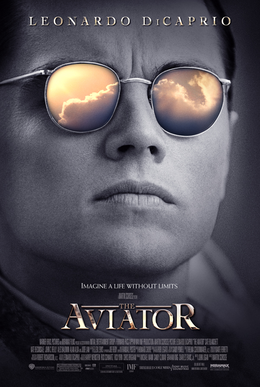
Behind the film
- Year
- 2004
- Director
- Martin Scorsese
- Writers
- John Logan
- Genres
- Biographical, Drama, Historical, Thriller
- Production
- Intermedia
- Country
- United States
- Cast
- Leonardo DiCaprio, Cate Blanchett, Kate Beckinsale, John C. Reilly, Alec Baldwin, Alan Alda, Jude Law, Gwen Stefani
About the film
Contains story spoilers.
The film begins with young Howard Hughes in Houston, where his mother teaches him about quarantine during a bath. It then jumps to 1927, when the adult Hughes is directing Hell’s Angels, a large aviation picture financed with his inherited fortune. He hires Noah Dietrich to manage the business behind the spectacle but insists on overseeing the film himself. When talking pictures arrive, Hughes reworks the production for sound, extending an already costly shoot before its premiere. The early sequence establishes the combination that defines his life in the film: technical ambition, immense resources and an inability to accept a result he considers imperfect.
Hughes’s interests extend from filmmaking into aircraft design. He works with engineer and pilot Glenn Odekirk on the H-1 Racer, pushing it to a speed record before it runs out of fuel and crash-lands in a beet field. Three years later, Hughes flies around the world in record time and buys a majority stake in TWA. These achievements bring public prestige but increase the scale of his financial commitments. Dietrich tries to keep the enterprises organized, while Hughes repeatedly places new engineering and business goals ahead of stability.
Katharine Hepburn becomes an important companion during this period. She understands some of Hughes’s rituals and helps ease his fears, but his obsessive-compulsive symptoms and germ phobia continue to worsen. Work dominates their time, and she eventually leaves him for Spencer Tracy. Hughes later dates Ava Gardner, though his attachment to Hepburn remains. The relationships are not separate from his ambition: he tries to manage even private matters through surveillance and influence, including an effort to suppress reports about Hepburn and Tracy. Gardner resists being controlled and eventually sends him away.
The aviation business brings a more public conflict. Hughes contracts with the Army Air Forces to develop aircraft, including a reconnaissance plane and a large transport. In 1946 he test-flies the XF-11; a mechanical failure develops and the aircraft crashes in Beverly Hills, leaving him severely injured. The military cancels its order for the H-4 Hercules, but Hughes commits his own resources to finishing it. Dietrich warns that the company cannot indefinitely fund both TWA and the flying boat. Hughes orders him to mortgage airline assets rather than abandon the aircraft.
Hughes’s behavior grows more erratic as he withdraws into an isolated, germ-free room and becomes increasingly paranoid. Senator Ralph Owen Brewster, allied with Pan Am chairman Juan Trippe, pushes a bill that would give Pan Am exclusive international routes and applies pressure over Hughes’s wartime contracts. Brewster privately offers to drop charges if Hughes sells TWA to Trippe. Hughes refuses, but his worsening condition makes it uncertain whether he will appear at the Senate investigation. Gardner visits and helps prepare him, restoring enough composure for him to confront the senator in public.
At the hearing, Hughes answers Brewster’s accusations and turns the questioning back on him, alleging that the senator has accepted money from Trippe. He also commits to completing the H-4 and says he will leave the country if he cannot make it fly. Brewster’s bill is defeated. The film presents the exchange as a major public reversal, contrasting Hughes’s private confinement with his ability to command a room when the project itself is threatened. The result does not cure his illness or settle the strain with Dietrich; it protects the immediate future of his aircraft and airline interests.
Hughes completes the H-4 Hercules and takes it on a brief flight, proving that the enormous flying boat can leave the water. Afterwards he discusses a future jetliner with Dietrich and Odekirk, but a renewed episode of compulsive repetition overtakes him. Hidden in a restroom while Dietrich fetches a doctor, Hughes repeats “the way of the future” as the film returns to an image of his childhood. The film ends before that next design becomes a finished project. Its final movement keeps accomplishment and vulnerability together rather than offering a simple recovery after the public triumph.
This is a dramatized account of the real industrialist and aviator, not a complete biography. Scorsese moves across roughly two decades, using films-within-the-film, aircraft tests, corporate negotiations and the Senate hearing to show how Hughes’s public accomplishments and private compulsions develop at once. Leonardo DiCaprio’s performance anchors the changing scale, while the recurring focus on cleanliness, repetition and enclosed spaces gives the aviation sequences a personal counterpoint. The ending leaves Hughes looking toward another invention, but his repeated phrase also shows how ambition can become a loop he cannot easily escape. His battles over The Outlaw put the film business alongside aviation rather than leaving it behind as an early accomplishment. Hughes confronts the censorship restrictions surrounding Jane Russell’s appearance and the film’s release, treating interference as another challenge to his authority. That episode belongs to the same pattern as his expensive aerial filming: he wants to decide how something should be made and shown, even when institutions, colleagues or finances stand in the way. The scale can change from a movie scene to an enormous aircraft, but the demand for control persists. Other people must negotiate the consequences when that determination becomes impossible to moderate.