
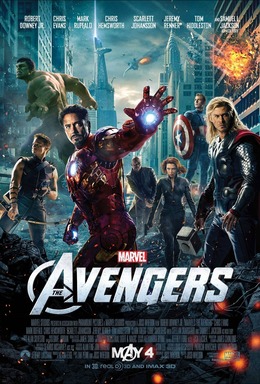
Behind the film
- Year
- 2012
- Director
- Joss Whedon
- Writers
- Joss Whedon
- Runtime
- 2h 26m
- Genres
- Action, Science fiction, Crossover fiction, Superhero
- Production
- Marvel Studios, Paramount Pictures
- Country
- United States
- Cast
- Robert Downey Jr., Chris Evans, Mark Ruffalo, Chris Hemsworth, Scarlett Johansson, Jeremy Renner, Tom Hiddleston, Clark Gregg
About the film
Contains story spoilers.
Joss Whedon’s The Avengers begins with the Tesseract, a powerful cube kept under S.H.I.E.L.D. observation. When it activates, Loki appears at the research facility, steals the device and uses his scepter to take control of scientist Erik Selvig and agent Clint Barton. Director Nick Fury responds by restarting the Avengers initiative. Natasha Romanoff retrieves Bruce Banner from India because his understanding of gamma radiation may help locate the Tesseract; Fury approaches Steve Rogers, while Phil Coulson visits Tony Stark with material on the Tesseract and Selvig's research. Thor arrives separately to bring Loki back to Asgard, while Fury sees the crisis as a reason to keep the new team together. These introductions establish that the group is assembled through urgency, not shared purpose.
The first attempts at teamwork are awkward. Steve asks for discipline, Tony questions orders and Bruce tries to keep his anger under control. Natasha and Barton already have history, but Loki’s influence has turned Barton into a threat before his teammates can reach him. When the team captures Loki in Germany, Thor interrupts the transport and argues that his brother should be returned to Asgard. The disagreement becomes physical before the heroes return to S.H.I.E.L.D.’s flying Helicarrier. There, Loki’s escape plan succeeds in part because he has counted on the Avengers’ suspicion of one another. Stark and Banner uncover that Fury’s people are studying the Tesseract as a weapon, and the revelation sharpens tensions that were already building around authority and trust.
Loki’s scepter and the pressure inside the Helicarrier turn the team’s conflict into a disaster. Barton attacks the vessel, and the damage forces the heroes to divide their attention between repairing the ship and stopping Loki. Loki lures Thor into the containment cell and triggers its release from the carrier, sending Thor plunging away in the chamber. Elsewhere, Banner transforms into the Hulk amid the chaos. Loki mortally wounds Coulson. After the attack, Fury presents Coulson's bloodied Captain America cards to the Avengers, turning the agent's admiration for Rogers into an appeal for the divided heroes to work together. Natasha frees Barton from the scepter’s control, and the two regroup. Fury uses Coulson’s death to push the others toward action, although the moment also makes his manipulation plain. The team’s formation is a decision to take responsibility after seeing what their isolation has allowed.
The Tesseract opens a portal above Stark Tower, giving Loki’s Chitauri army a path into New York. The Avengers converge on the city, where the film finally lets their abilities work together in one continuous battle. Steve directs responders and sets priorities on the ground; Natasha fights through the streets; Barton covers the team from above; Thor confronts the Chitauri with lightning; and Hulk becomes a blunt force against the invading machines. Tony and Steve coordinate to keep the fight moving, while Banner returns as the Hulk and smashes Loki aside. The shifting focus among heroes makes the city feel large without losing track of the immediate tasks: civilians need routes to safety, the portal must be closed, and the enemy’s force is multiplying faster than conventional defenses can respond.
As New York’s destruction worsens, the World Security Council orders a nuclear strike, treating the city as expendable. Fury opposes the decision, but the missile is launched. Stark intercepts it and redirects it through the portal toward the Chitauri command ship, destroying the ship before the missile’s force can devastate Earth. His damaged armor carries him back through the portal and begins to fall toward the city. Only then does Natasha use the scepter to close the portal. Hulk catches Stark as he drops, and the team’s immediate danger ends. Thor then takes Loki and the Tesseract back to Asgard. This resolution gives every Avenger a distinct contribution, but it also leaves a visible cost in the damaged city and in Fury’s willingness to deceive his own people to get the team into action.
The film’s appeal depends on making a crowded cast legible without flattening its differences. Rogers is a soldier displaced from his own era, Stark resists being managed, Thor thinks in family and obligation, Banner fears his own strength, and Natasha and Barton carry the habits of spies into a crisis that cannot be solved by secrecy alone. Whedon’s dialogue moves between conflict and humor, often using a sharp exchange to reveal how each character defends a vulnerability. The set pieces similarly alternate spectacle with small acts of coordination. A shot can follow a single hero through a street fight before pulling back to show how the others cover different parts of the city. The scale works because action repeatedly returns to team choices.
The Avengers is a 2012 Marvel Studios film directed and written by Whedon, with Zak Penn also credited for story. Its plot brings separate character histories into a single confrontation but keeps each character’s earlier film context visible rather than retelling it. The ending closes the immediate threat and sends the group back toward their separate lives, while leaving the Avengers as a functioning alliance for later stories. The film’s central question is less whether these people can be powerful together than whether they can accept responsibility for each other’s blind spots. Their victory follows from disagreement being turned into coordination, a change the film earns through conflict instead of assuming from the team name.