
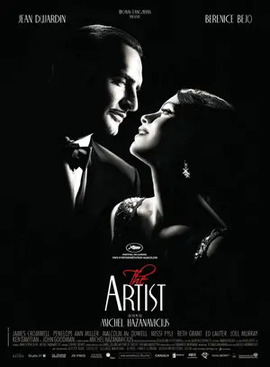
Behind the film
- Year
- 2011
- Director
- Michel Hazanavicius
- Writers
- Michel Hazanavicius
- Runtime
- 1h 40m
- Genres
- Romantic comedy, Drama, Romance, Comedy drama
- Production
- France 3, Wild Bunch, La Petite Reine
- Country
- France, Belgium
- Cast
- Jean Dujardin, Bérénice Bejo, James Cromwell, John Goodman, Penelope Ann Miller, Missi Pyle
About the film
Contains story spoilers.
The Artist begins in Hollywood in 1927, when silent-film star George Valentin is enjoying the attention around his latest picture. Outside the premiere, a young extra named Peppy Miller bumps into him, and George turns the awkward moment into a playful photo opportunity. The publicity puts Peppy in the papers, and she uses the attention to win a place in a Kinograph Studios production. George spots her at an audition and insists that studio boss Al Zimmer give her a role. Their first scenes together show an easy chemistry, but the film sets their careers on separate tracks from the start: George is established and adored, while Peppy is learning how to turn a brief chance into a lasting job.
George helps Peppy rise, even drawing a beauty mark on her cheek as a distinctive screen look. She becomes a star through a series of larger parts, while he remains confident that the silent movies that made him famous will continue to dominate. Two years later, Zimmer announces that Kinograph will stop producing silent films. George dismisses sound as a passing novelty. A dream in which he hears sounds but cannot speak foreshadows what he refuses to accept: cinema is changing in ways that his familiar performance style cannot control. He leaves the studio to finance, direct and star in his own silent feature, believing that audiences will still choose him.
George’s film, Tears of Love, opens on the same day as Peppy’s new sound picture and the 1929 stock-market crash. Audiences flock to Peppy’s film while George’s theatre remains nearly empty. His investment collapses with the industry and economy, and his wife Doris throws him out. George moves in with Clifton, his loyal chauffeur and valet, and the dog that has been a part of his screen work. Peppy becomes one of Hollywood’s leading sound stars. The film makes the transition visible without turning it into a lecture: one performer’s voice is now a market advantage, while another performer’s confidence has become an expensive bet.
George’s fortunes worsen until he has to auction his possessions. He gives Clifton his car after realizing that he has not paid him in over a year, then dismisses him. Alone and drunk, George sets fire to his old film reels, but the nitrate burns out of control and smoke overwhelms him. His dog attracts a nearby policeman, who rescues him and gets him to hospital. Peppy visits and sees that George has managed to save the reel showing the two of them dancing together. She offers to take him to her home while he recovers, and Clifton is now working for her. Her help is generous, but it also places George in the uncomfortable position of being cared for by the star he once helped.
George wakes in Peppy’s house and learns that she wants him to return to movies. He initially refuses, offended by the idea of being offered a role out of pity. When he discovers that she has moved his possessions into her home, he storms out and returns to his own place. Peppy arrives there to find him on the verge of suicide. She tells him they can work together, and the two rehearse a dance number that makes use of the skills he has not lost. Their solution is a musical sequence rather than an attempt to restore silent cinema as it was: the performance changes form, and George is willing to step into it.
The closing scene moves from silent gesture to spoken sound. During the successful dance take, the director calls for another, and George answers with a French accent, revealing the one voice the film has withheld from him and the audience. The camera pulls back to reveal the working film set, leaving the couple ready for another take. The Artist tells this story mostly through black-and-white images, expressive faces, title cards and a score, using the form of silent cinema to make George’s changing fortunes legible. Its final spoken words arrive only when he has found a place in a new kind of film. The ending does not return him to his old leading-man status; it gives him a new role beside Peppy.
The film’s silent presentation makes small gestures carry information that dialogue would usually explain. A glance across a set, Peppy’s position at George’s premiere and the growing space between them convey shifts in status without narration. Intertitles are used sparingly, and the score supplies much of the emotional rhythm. When sound first enters George’s dream, everyday objects make noise while he cannot answer aloud; later, Peppy’s success in talkies makes that limitation an economic problem too. The movie is not a documentary about Hollywood’s transition, but its black-and-white image, nearly square frame and physical acting let the characters’ changing fortunes play out through the visual grammar George knows.