
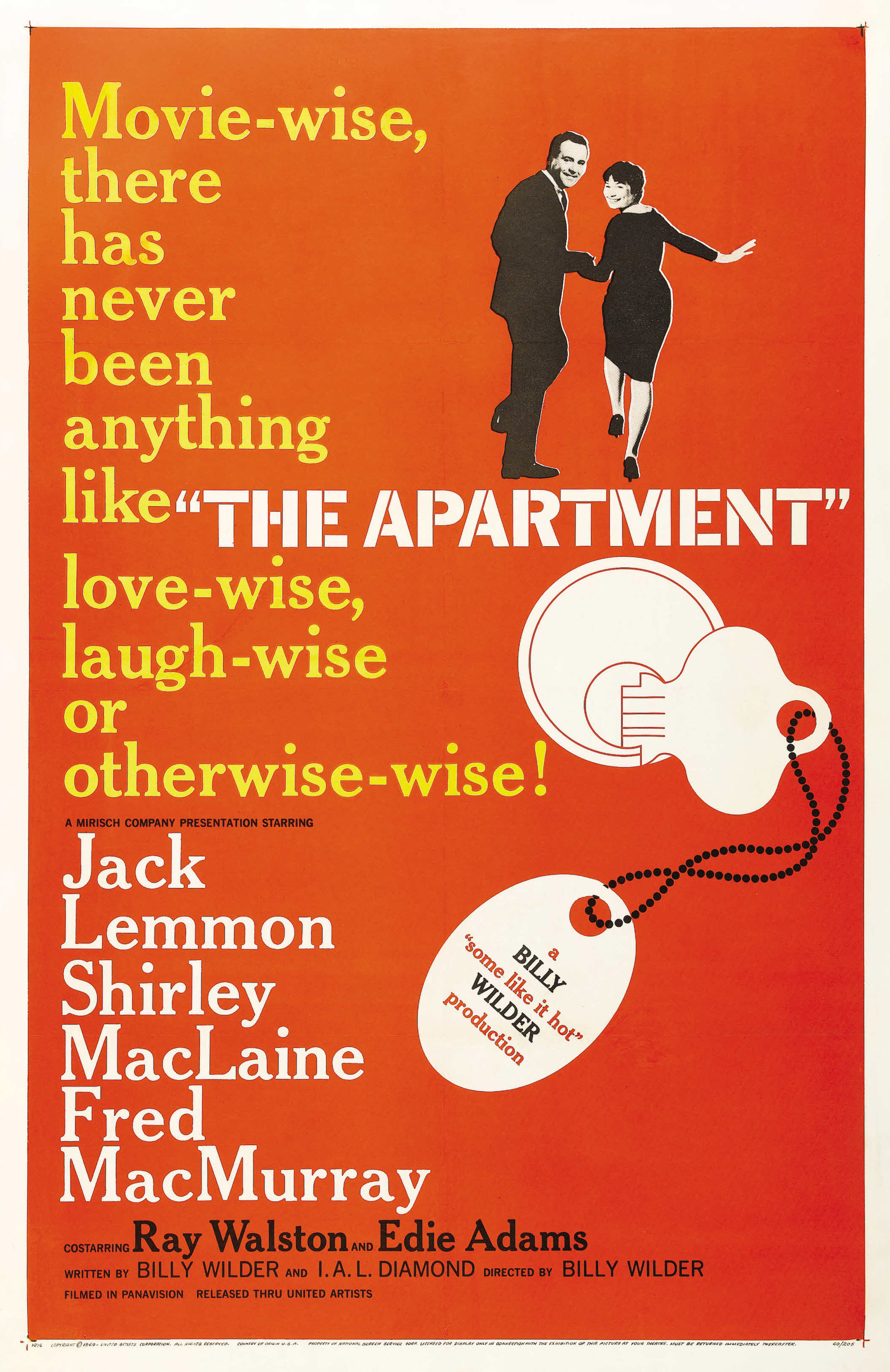
Behind the film
- Year
- 1960
- Director
- Billy Wilder
- Writers
- Billy Wilder, I. A. L. Diamond
- Genres
- Romantic comedy, Drama, Christmas
- Production
- The Mirisch Company
- Country
- United States
- Cast
- Jack Lemmon, Shirley MacLaine, Fred MacMurray, Ray Walston, David Lewis, Edie Adams, Jack Kruschen, Joan Shawlee
About the film
Contains story spoilers.
C. C. Baxter works in an office so large that an individual desk seems almost interchangeable with the next. His apartment is a different matter. Several executives borrow it for affairs, and he tries to turn their gratitude into professional advancement. The arrangement requires him to manage a schedule while surrendering the place where he should be able to rest. Billy Wilder's The Apartment begins with a comic administrative problem that is already a personal one: Baxter is making himself useful by agreeing to be absent. His neighbors mistake the consequences for an active romantic life, giving him a reputation that disguises how lonely the routine actually is.
Personnel director Jeff Sheldrake notices the glowing reports Baxter has received and discovers what they mean. Rather than punish the arrangement, he wants his own access to it. A promotion now depends on accommodating somebody with more power than the previous borrowers. Baxter does not know that Sheldrake's companion is Fran Kubelik, the elevator operator he hopes to date. He invites her to a show while she is trying to resolve her relationship with the married executive. Sheldrake renews a promise to leave his wife, and Baxter waits at the theater. The apartment has brought him closer to the office's center of authority while placing him outside the evening he actually wanted.
A Christmas party brings the hidden arrangement into view. Sheldrake's secretary, Miss Olsen, tells Fran that his promises belong to a pattern of previous affairs. Baxter recognizes Fran's broken compact as something left in his apartment, discovering who has been visiting it with his boss. Later, Fran is devastated by Sheldrake's treatment of her and takes an overdose. Baxter finds her and calls his neighbor, Dr. Dreyfuss, for help. The doctor assumes Baxter is responsible for her distress, and Baxter accepts that misunderstanding rather than expose Sheldrake. The career arrangement has now made him responsible for the consequences of conduct he has been paid to accommodate.
Fran recovers in the apartment, and its purpose changes. Baxter prepares food, keeps her company and plays cards with her, making ordinary domestic attention possible in a room previously scheduled for somebody else's convenience. The intimacy is tentative. Fran still hopes for something from Sheldrake, while Baxter cannot turn care into a guarantee that she will return his feelings. Visitors continue arriving with expectations attached to the old arrangement, exposing how little privacy either of them has. When Fran's brother-in-law comes looking for her, Baxter once again takes responsibility and receives a punch for it. Protecting another person's reputation is becoming a habit he needs to examine rather than an automatic sign of kindness.
Sheldrake's marriage breaks down after he fires Miss Olsen and she tells his wife about the affairs. He presents the change to Fran as if it validates everything he has promised. He also expects Baxter's apartment to remain available. Baxter finally refuses, surrendering his position rather than continue the bargain. At a New Year's celebration, Fran learns what he has done and leaves Sheldrake. She runs to the apartment, where the sound of a champagne cork briefly raises a frightening possibility before Baxter opens the door. They return to their card game. The ending gives their relationship a beginning in which neither needs to borrow another person's promises or purchase affection with a favor.
Jack Lemmon's Baxter is funny because he can sound efficient while visibly losing command of his own life. He handles dates and keys with an office worker's attention to detail, but the system keeps requiring him to wait outside, interrupt his sleep or explain somebody else's behavior. His eagerness makes a minor concession seem reasonable until its consequences accumulate. Shirley MacLaine's Fran has a different rhythm: brisk at work, more uncertain when trying to believe Sheldrake, and capable of a dry observation even while unhappy. Their quieter scenes leave room for companionship without insisting that a joke has solved the situation. Fred MacMurray's Sheldrake supplies the polished assurance that makes those two people keep adjusting their expectations around him.
Wilder and I. A. L. Diamond's screenplay gives ordinary objects specific dramatic jobs. A key promises advancement and permits betrayal. The compact's broken mirror identifies a visitor while suggesting something about how she sees herself. A calendar can make exploitation look like a solvable problem of scheduling, and a pack of cards offers company without requiring a declaration. These objects keep the comedy close to practical behavior. Nobody needs to announce the apartment's changing meaning; the viewer can see who is being admitted, who has to leave and what people do when they are finally allowed to remain. Even Baxter's manner of speaking carries traces of the company whose approval he wants, making professional ambition audible in a supposedly private conversation.
Joseph LaShelle's black-and-white images and Alexander Trauner's designs contrast the office's ordered distances with the apartment's crowded intimacy. At work, repetition makes people look like part of a system; at home, a few bodies can make a room impossible to manage. The film moves between those scales without abandoning either its comic timing or its concern for the people inside them. Jack Kruschen's Dreyfuss sees a simpler question than the executives do: what kind of person is Baxter becoming through the accommodations he makes? That question gives the final refusal weight. Losing access to promotion is costly, but it also lets Baxter stop measuring every relationship by the advantage it might bring. The card game makes space for a more ordinary, uncertain future, one that the two people in the room can begin on their own terms.